
History
The legendary patents of Korath
Six named inventions hold in Korath’s memory the place other countries give to conquerors: Quatre Appuis, Veine Chaude, Souffle Retourné, Terrasses Réfléchies, Recul Partagé and Dix-Huit Secondes.
Patents in place of statues
The legendary patents are engraved and displayed near the institutions and equipment they make possible, in the place that dynastic statues hold elsewhere. Korath’s civil heroes are clockmakers, geometers, glassmakers, architects, agronomists, mechanics and women inventors. Some great bourgeois families descend from a mechanism, a greenhouse, a hinge or a patent rather than from a conqueror.
Structure, heat, air
The Quatre Appuis (Four Supports) are the first system of very large deep halls: they founded the dug-out city. The Veine Chaude (Warm Vein) distributes geothermal heat to homes, baths, greenhouses and workshops. The Souffle Retourné (Returned Breath) ventilates the deep cities through differences of temperature and pressure. Together these three patents give the inhabited mountain its structure, heat and air; without them, large-scale underground urbanisation would be impossible.
Feeding and firing
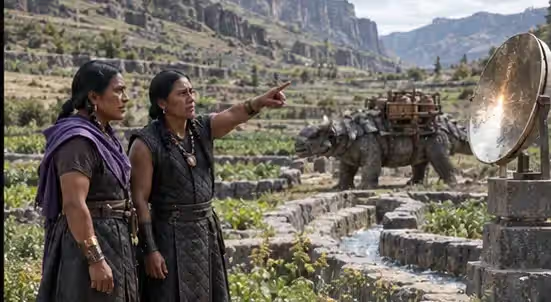
The Terrasses Réfléchies (Reflected Terraces) combine mirrors with the management of sunlight; they saved farming valleys and made others cultivable. Korathian technique therefore does not only serve weapons: it feeds a population in a hostile land. The Recul Partagé (Shared Recoil) is a major innovation in recoil control. It is the ancestor of ballistics against great dinosaurs and of the naval artillery Korath exports.
Dix-Huit Secondes
Dix-Huit Secondes (Eighteen Seconds) is the name of a door that became famous after a national debate between supporters of closing it in seventeen and in nineteen seconds. The case illustrates the Great Dispute over Detail, through which technical minutiae become national debates, editorials, songs and tavern quarrels. In Korath, an engineering disagreement over two seconds can enter common memory just as a battle can.
A memory of corrections
Technical memory also keeps accidents, revisions, amendments and limits. A mechanism is not honoured only for its first success: its corrections are part of its history. Workshop tales extend this history with their legends and rivalries, but an invention’s value must always be defensible through trials and counterproofs.
Where to see them
Each legendary patent is engraved near what it made possible. The Four Supports can be read in the oldest great deep halls, often on the pillar or wall that carries their load. The Warm Vein is inscribed at the entrance of the great baths and greenhouses; the Returned Breath at the mouths of the main ventilation shafts, where the draught can be felt on one’s face. The Reflected Terraces have their plaques at the edge of the valleys they saved.
The Shared Recoil can be read in front of the arsenals and at the entrances of ballista galleries, and the Eighteen Seconds door carries its own name on its lintel. Schools organise visits to these places, and families take their children there as elsewhere they are taken before the tombs of kings.
An order in time
Korathians rarely date these patents to the year; they rank them instead in the order their logic imposes. The Four Supports come first, since they founded the carved city by making very large halls possible. The Returned Breath and the Warm Vein then made those halls breathable and habitable, and without them great underground urbanisation would be impossible. The Reflected Terraces belong to the effort to feed a population grown too large for imports alone.
The Shared Recoil marks Korath’s entry into military and commercial power, since its descendants arm the passes and foreign hulls. Eighteen Seconds, finally, belongs to a Korath already sure of itself, stable enough to become passionate over two seconds. In seven centuries the country went from survival in the rock to the luxury of dispute.
What the patents left in the language
Legendary patents also live on in everyday language. The quarrel over the Eighteen Seconds door gave words everyone understands: whoever closes “in seventeen” is called reckless, whoever closes “in nineteen” overcautious. Workshop vocabulary supplies other insults: “out of square” for a person or idea that does not stand straight, “round” for someone slippery, “tavern patent” for a brilliant idea no one has tested, “decorative hinge” for whatever shines without carrying a load.
These expressions show the place of technique in Korathian life. A person is judged as a part is judged: by accuracy, by how well it holds and by what it can withstand.
How a patent becomes legendary
No decree makes a patent legendary. It becomes so through use, when generations have lived, worked or fought thanks to it, and through the memory of its corrections, when its revisions have shown that it could be improved without being disowned. The press, songs and schools do the rest, repeating its name until it becomes a common landmark.
There are many other monumental patents, engraved near the works they made possible; the six legendary patents are those whose names every Korathian knows. Each generation wonders which invention of its own time will join the list, and the taverns gladly debate it. The answer belongs to use, and Korathians know that use takes its time.