
Places and landscapes
The Black Mountains: living within their depth
Basalt, obsidian and vertical passages give Korath its habitable form.
The massif’s scarce soil
The Black Mountains form a vast basalt and obsidian system: spires, canyons, snowy plateaus, winds, thin soils and vertical passages. Some waters are toxic. Part of the territory is volcanic, with fumaroles, sulphur and black glass. Habitation begins by finding the material conditions in which a body can remain.
The façade is the city’s skin
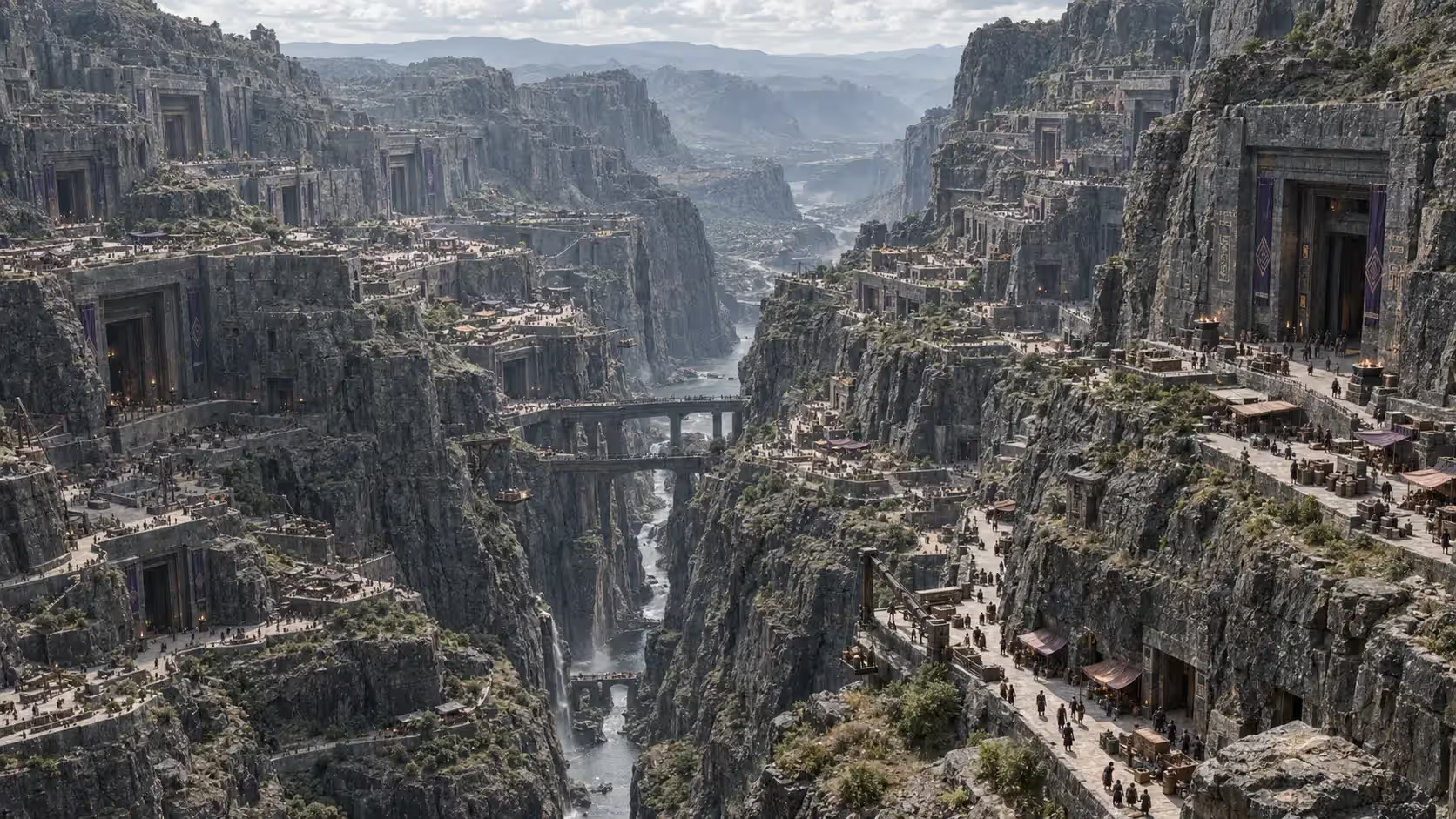
Korath cities are carved into the mountain and layered vertically. Visible gates, terraces, towers, barracks and markets open onto deeper settlements. Thermally stable zones house homes, baths, workshops, taverns and schools. Galleries, winches and thermal conduits connect those spaces within the depth of the massif.
A fruit is work done on the terrain
Terraces, greenhouses, imported soils, mirrors, aqueducts and heated orchards make some valleys habitable. Local food therefore has a technical history: it depends on constructed surfaces and maintained conditions. The agricultural landscape records the effort that lets the deep city receive more than the massif’s materials.
A massif without colossi
Korath lies south-east of Urnok and has no colossi, without exception. This absence is first of all geographic: no very large animal can sustain a viable population in this massif, and it is the environment that produced the civilisation and its doctrine. The country’s power rests on forges, passes, chains, winches, armour and ballistas.
The country is small in area but locked by its terrain: about one and a half million square kilometres for seven million people.
The massif’s native life
The native fauna is small and specialised: rock reptiles, sulphur insects, cave fish and thermal organisms. The flora includes lichens, mosses, alpine grasses, black pines, junipers, short-lived flowers, cave fungi and thermal algae.
The mountain in place of colossi
For Korath, the Montagne Noire fills the symbolic role that colossi fill elsewhere: mass, memory, defence and sovereignty. The comparison does not make it a living being; it explains the place of stone in how the country sees itself. The doctrine follows: Korath does not face the giant on neutral ground, it waits for it where its mass becomes a handicap.
The seasons of the massif
Winter is the great season of the Black Mountains. Snow covers the plateaus, winds sweep the needles, and several passes become dangerous or close. The carved cities, protected by the thickness of the rock and heated by the Warm Vein, go on living almost normally, but convoys grow rarer and reserves count for more. The snow piled on the slopes is not merely a nuisance: maintained and watched, it is part of the country’s area weapons.
Summer is short. The plateaus then cover themselves with brief flowers, alpine grasses and lichens, meltwater fills the cisterns and aqueducts, and convoys come up in numbers to rebuild the stocks. Korathians organise their year around this alternation: they import, repair and build in the fine season, and calculate, file patents and celebrate under the rock in the bad one.
Water, a resource to watch
In the massif, water is not always scarce, but it is not always drinkable. Some springs are laden with sulphur or metals and can make a family ill or sterilise a terrace. The cities therefore rely mainly on meltwater, collected in cisterns carved into the deep core, and on aqueducts whose water passes through filtration basins before being distributed.
Watching over water falls to the Side of Breath, which holds hydraulics, filtration and conservation. Each cistern has its register, its samples and its inspectors, and a district whose water changes taste reports it at once. In a siege, the cisterns are among the city’s best-guarded reserves: together with air and heat, they decide how long a closed district can hold out.
What the rock gives
The massif is poor in soil and rich in stone. Basalt provides the material of cities, forges and mosaics; obsidian, the black glass of the volcanic zones, gives blades and ornaments. Iron, copper, sulphur and coal, together with geothermal heat, form the basis of the Korathian economy, even if the exact location of the deposits remains little known to foreigners and jealously guarded by the Forges.
This mineral wealth explains prices: in Korath, metal costs about 0.78 times the average rate of the known world, while fodder and timber cost 1.25 times. The country exports what the mountain gives and what it transforms, parts and mechanisms more than raw ore, and imports what the mountain refuses it: grain, timber, tendons and resins.
Where seven million people live
With about seven million inhabitants on a million and a half square kilometres, Korath has on average some five inhabitants per square kilometre. That average says almost nothing about reality: the population is concentrated in the carved cities, in the pass towns and around the Failles rouges, while immense stretches of plateaus, needles and canyons remain empty or nearly so.
Between these two extremes lie mining hamlets, watch posts, relays and cultivated valleys where a few dozen or a few hundred families live. The lower marches, where the imported animals are kept, have their own population of garrisons and healers. To a traveller, the massif looks deserted; to a Korathian, it is inhabited in its thickness, where the eye does not go.
Ridges, needles and blade forts
The surface of the massif is held by works suited to its verticality. Blade forts, narrow and elongated, follow the ridges and watch the passes; suspended platforms and chain bridges link the rock faces; carved stairways serve humans, ramps the pack animals of the marches. Many of these passages can be withdrawn or destroyed, and some paths that look natural were built to lead an adversary astray.
From afar, the mountain looks wild. Close up, almost every inhabited ridge shows a trace of the human hand: an arrow slit, a chain anchor, a worn step, a patent plaque set at the foot of a bridge. This is one of the country’s paradoxes: the harshest massif of the known world is also one of the most built upon.
A recent settlement
On the scale of the known world, the human presence in the Black Mountains is young. Korath is a civilisation about seven hundred years old, whose origins go back to N’Goro: when Arkhan already counted tens of millennia and the Empire of Urnok nearly ten thousand years, the massif did not yet shelter any great cities. The Korathians’ ancestors had to learn to live in an environment without living networks, where air, heat and water had to be built.
The traces of that settlement lie beneath today’s cities. The forgotten levels, old mines, condemned cities, sanctuaries and abandoned galleries, preserve the first attempts of those who dug into the mountain before the Four Supports made the great halls possible. Korathians speak of them as a historical underworld, both the country’s memory and a strategic reserve.