

Power and institutions
Korath — Commandement et haute société
Audiences, décisions, inspections et rencontres privées : le pouvoir se lit dans la place donnée à chacun, dans les vêtements et dans l’organisation des salles.
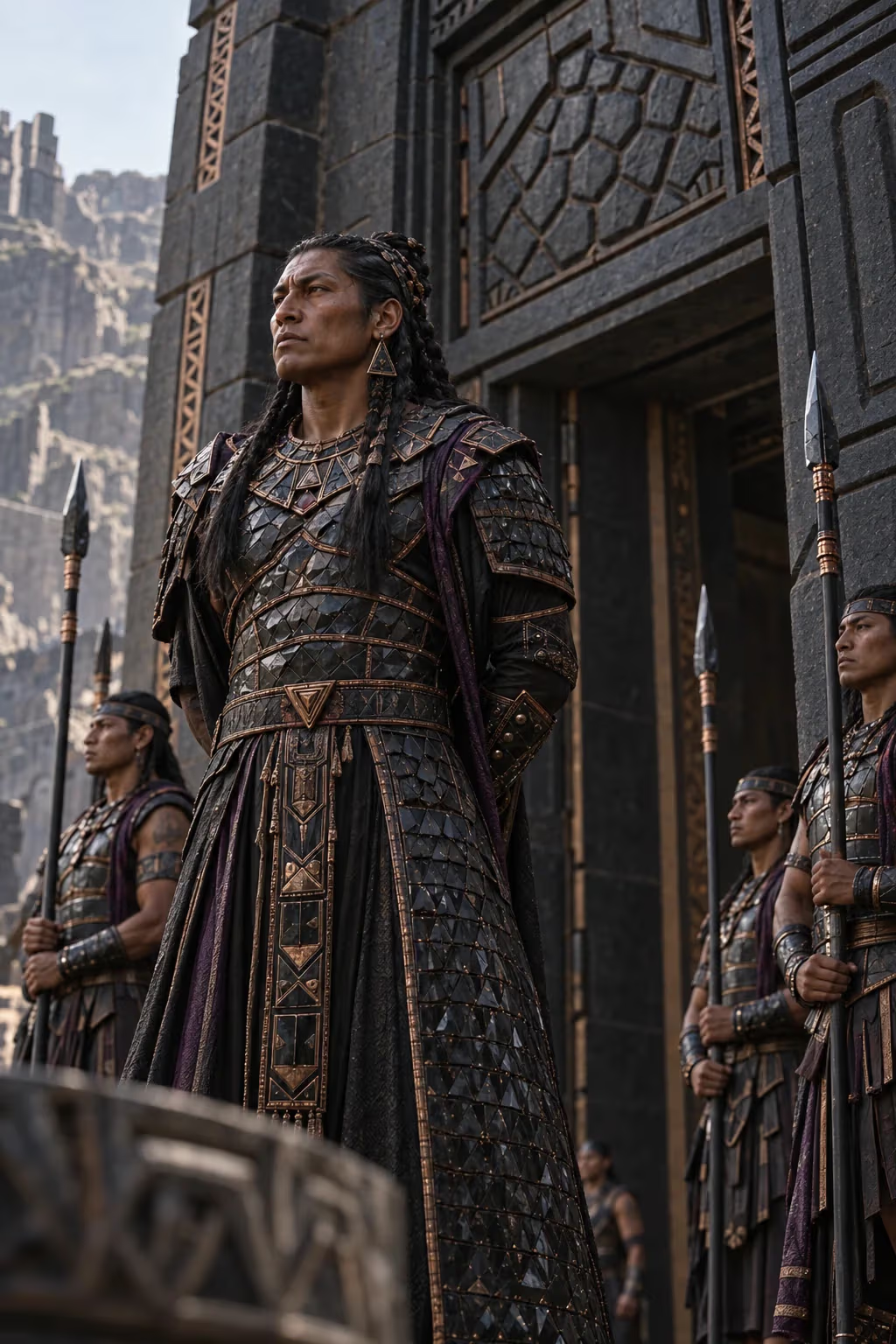
Dans les salles de décision
This extended reading is currently available in French.
À Korath, la reconnaissance d’un ouvrage et celle de son auteur passent par la preuve, la signature et la possibilité de corriger. Le brevet engage une fabrication réelle, avec ses matériaux, ses limites et ses conditions de transmission. Un titre ne suffit pas à garantir qu’un procédé fonctionnera dans un atelier ou un passage de montagne. Les institutions du pouvoir rejoignent ici celles de l’apprentissage : savoir démontrer, répondre d’une erreur et rendre un savoir utilisable.
La garde de la Montagne
galeries de commandement · état-major.
Les tenues et les fonctions de chacun disent les institutions de la civilisation.
L’autorité en mouvement
Une revue, une réception ou une conversation de cour engage un rapport de force. Tout se joue au moment précis où l’espace, les gardes et les regards donnent un poids à la parole.
Observe gestures and materials · 2 images
Personne ne soumet la matière
Chambre de Contrepreuve · conseil des ateliers.
Les héritiers de la pierre
haute cité basaltique · haute société.
Korath: the Patent and counterproof
Three dimensions of proof
The Seal of Form requires demonstrated geometry, forces, limits and tolerances. The Seal of Material checks the stated materials under stress and wear. The Seal of Use asks the object to solve a real human problem. A major patent then requires reproduction and methodical challenge by a rival workshop: an appealing demonstration is insufficient.
Korath: the Patent and counterproof
A name surviving exclusivity
The Right of Signature preserves authorship, the inventor’s name and the record of corrections. Income and licences remain exclusive only for a limited period. Afterwards, Return to the Mountain brings the patent into shared technical heritage. Lasting recognition of the author and later sharing of knowledge belong to the same system.
Korath: the Patent and counterproof
Assembly of chains and equipment
The chain master, collar riveter and armoured rigger work on assembly before an object appears as a finished piece. They check tension, closure, repair and holding under strain. Precision is not decoration: a poorly prepared join transfers weakness to everything depending on it. These actions add to the requirements of form, material and use; they do not replace them with a merely reputed craft.
Korath: the Patent and counterproof
Surveying and preparing corridors
Corridor geometers take measurements before a group enters a difficult passage. Trap setters and the recoil master examine points where a decision might no longer be correctable. This does not draw a complete military doctrine. It is threshold work: seeing the slope, exit, room for return and material constraint before force or speed impose their own answer.
Korath: the Patent and counterproof
Component marks, signature and responsibility
The bone engraver, trophy marker and patent master work at different moments, but all keep a part from becoming anonymous once it circulates. A mark can help distinguish a correction, provenance or manufacturing responsibility. It does not authorise use of human bone: human material remains outside all craft. An object thus keeps a material history without that history becoming permission to do anything.
Korath: the Patent and counterproof
Extraction and material preparation
A Korath part begins in extraction, rock sorting, transport and material preparation before it reaches the forge. Miners, carriers, heating crews and workshops depend on one another. Traction or protection animals change access to passes and how much material can move, but do not erase human work time. The final precision of a mechanism rests on an earlier chain of loads, stocks, tools and checked materials.
Korath: the Patent and counterproof
Specialisation creates dependencies
Concentration on mines, forges, ballistae and technical workshops makes Korath dependent on materials it does not always produce in sufficient quantity, notably food and some organic components. A supply break does not only block a market: it slows manufacture, reduces maintenance and forces workshops to choose which parts to finish. Technical power therefore has a material limit visible in stores, convoys and mountain passages.
Force contained by form
The Chamber brings together court, university, museum, laboratory, archive, public demonstration and licence market. It is organised around an immense square shaft with a magmatic glow visible below. The Patent is Korath’s greatest civil and cultural institution: it connects ownership, scientific proof, social recognition, contract and historical memory. Demonstrations are judged through instruments, evidence and seals, never through victory in combat.
Three proofs, then counterproof
The Seal of Form requires demonstrated geometry, forces, tolerances and limits. The Seal of Material subjects the announced materials to cold, heat, pressure, vibration and wear. The Seal of Use checks that the invention solves its actual human problem. A major patent must then be reproduced and methodically challenged by a rival workshop. Concealing a margin or falsifying a trial constitutes a scientific, social and religious offence.
The signature remains, use circulates
The inventor keeps authorship, name and the record of corrections. Revenue and licences belong to a temporary exclusivity; afterwards the patent enters the common technical heritage without losing its signature. The regime can impose secrecy, production and military requisition without erasing authorship. Monumental patents, accidents and revisions remain readable: public memory also honours the correction of an idea.
Korath : apprendre par la preuve
Un enfant apprend à vérifier
Les brevets d’enfance donnent aux jeunes un cadre pour observer, fabriquer et démontrer un petit usage pratique. L’objet doit pouvoir être regardé, testé et expliqué avant de servir. L’éducation installe donc très tôt le droit à la méthode et à la correction.
Korath : apprendre par la preuve
La concurrence a une fonction civique
Un brevet majeur devient complet après reproduction et attaque méthodique par un atelier rival. La contrepreuve protège moins une institution abstraite qu’un usage réel : elle force une idée à rencontrer la matière, l’usure et l’objection. Une erreur honnête peut être corrigée ; dissimuler une limite ou falsifier un essai touche à la confiance publique.
Korath : apprendre par la preuve
La correction reste signée
L’inventeur conserve son nom et la trace des corrections même lorsqu’un brevet sort de son exclusivité temporaire ou fait l’objet d’une réquisition. La mémoire publique ne glorifie donc pas seulement l’objet final : elle conserve les limites, les accidents et les amendements qui ont permis de l’employer sans mentir.