

Places and landscapes
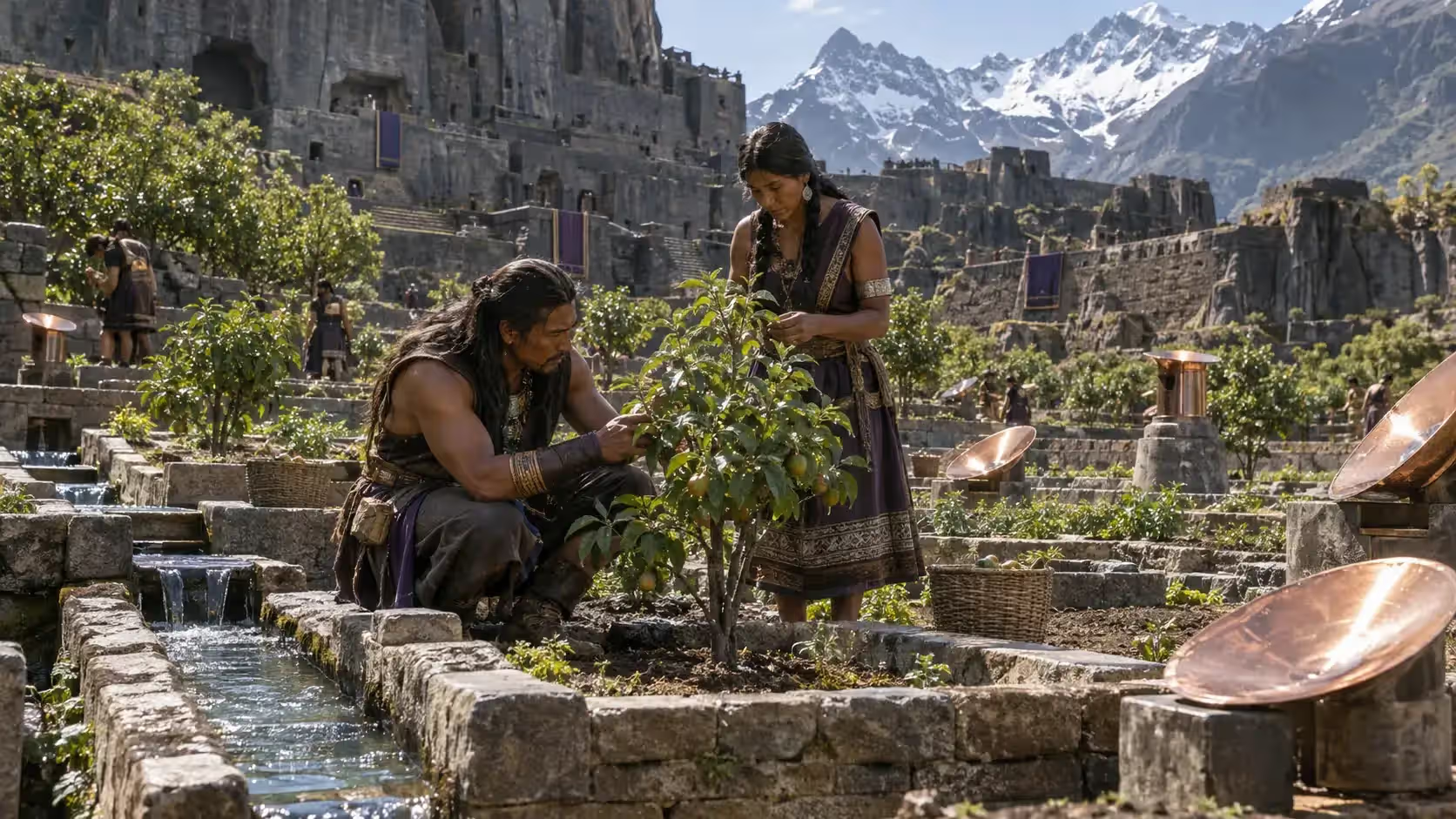
The cultivated valleys of Korath
Terraces, greenhouses, imported soil, mirrors and heated orchards make a few of Korath’s valleys farmable. A local fruit there is a technical feat and a luxury.
Making an environment
Korath makes part of its farmland. In a wind-beaten massif with thin soils and sometimes toxic waters, terraces, greenhouses, imported soil, mirrors, aqueducts, and heated orchards and vineyards make some valleys farmable.
A local fruit is a technical feat as much as a pleasure of the table, and a luxury. Agronomy is one of the disciplines that carry recognised inventions: the Terrasses Réfléchies patent, which combines mirrors and solar management, saved farming valleys; the Veine Chaude distributes geothermal heat to greenhouses and homes alike. These techniques do not remove the weakness of the soils; they make it possible to work around it.
Constant upkeep
Engineered orchards demand constant upkeep of heat, water and light. Their output supplements imports without replacing them: Korath lacks food depth, and its supply routes remain essential to its cities and workshops. The system can also be harsh with them: in the name of survival, it can abandon a valley or ration by usefulness.
In the districts beneath the rock, indoor gardens also make room for plants; they belong to bourgeois refinement as much as to places of rest.
A reflected terrace, in practice
A valley saved by the Reflected Terraces can be recognised from afar by its glints. On the ridges and terrace edges, mirrors of polished bronze mounted on pivots send sunlight towards the crops that the relief leaves in shadow for part of the day. Teams turn them by hand several times a day, following the tables of a valley clockmaker who calculates the sun’s course by season.
Upkeep is meticulous. Forge soot and dust tarnish the bronze, which must be rubbed regularly; a badly angled mirror can scorch a row of vines instead of warming it. The families who tend these terraces form a small society of their own, half farmers, half technicians, and children of these valleys learn to read the shadow of a pivot before they know how to prune a vine.
What is grown there
The cultivated valleys produce above all what is worth a lot in a small volume. The vine comes first, for the rare wines the bourgeoisie drinks in the boxes of the Fault Hearts; the heated orchards give stone fruit, which is given as a gift more than eaten every day. Greenhouses shelter vegetables, aromatic herbs and medicinal plants, and the neighbouring caves mushrooms, which remain the staple food of the cities.
A local fruit is a technical feat and a luxury: in the markets of the warm city, a basket of valley fruit can cost more than a week of imported rations. Such fruit is given at weddings, First Glasses or the closing of a square, and every year the popular press publishes the list of valleys with the best harvest, as it publishes workshop rankings.
Making soil
The massif’s soils are thin, and some are poisoned by sulphurous waters. The terraces therefore receive manufactured soil: earth imported by convoy, mixed with greenhouse plant waste, forge ash and the dung of the ankylosaurs and nodosaurs of the lower marches, carried up in baskets. Each terrace has its soil register, recording what has been brought to it and what it has produced.
Water requires as much care. Aqueducts bring meltwater from the plateaus, filtered in sand and charcoal basins before it reaches the crops, because a single toxic spring can sterilise a terrace for years. Breath engineers, who handle irrigation and filtration, are as indispensable to the valleys as to the deep cities.
Abandoning a valley
The Korathian system can be harsh with its valleys. When a terrace costs more than it yields, when a spring turns toxic or war demands the hands and materials, the regime can decide to abandon a valley or ration water and heat according to usefulness. The families are then moved to other terraces or to the cities, and the dismantled mirrors leave for other ridges.
An abandoned valley decays fast: without upkeep, the low walls give way, the manufactured soil slides, and within a few winters the wind carries off what generations had brought up basket by basket. Valley songs keep the memory of these lost places, and many city families still know which terrace their grandparents came down from.
Mirrors that speak
Like every Korathian infrastructure, the terraces have a second use. The mirrors that send light to the crops can also send it towards a neighbouring ridge, and the valleys thus exchange flash signals with the pass forts. A simple code makes it possible to announce a convoy, an avalanche or a danger far faster than a messenger.
When an alarm is raised, terrace teams know how to turn all their mirrors at once. Officers of the marches count on this network of flashes to follow what happens in the most remote valleys, and a terrace vine grower is often, without a uniform, one of the country’s first lookouts.