
Places and landscapes
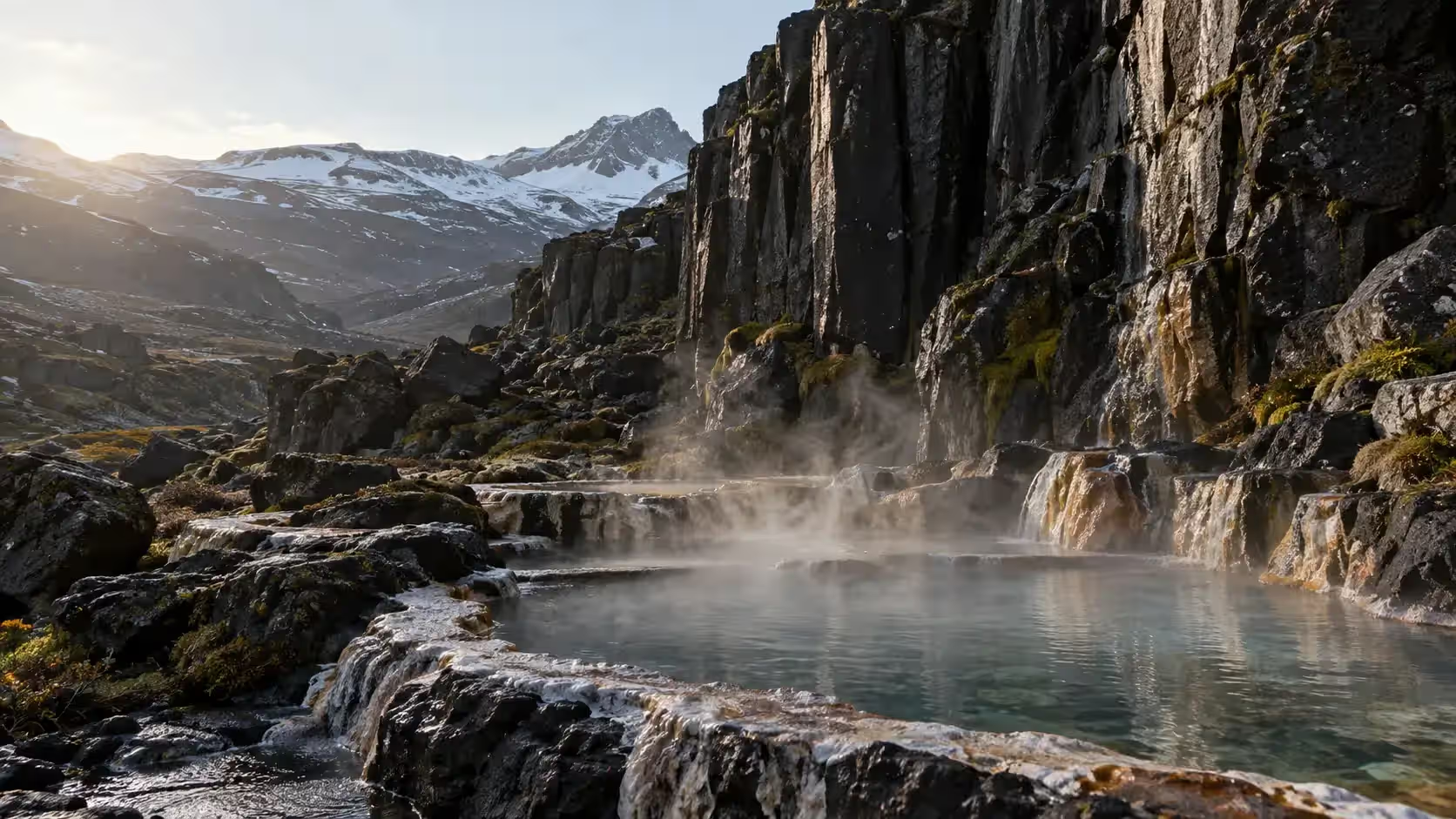
The Failles rouges
Korath’s volcanic region: magma, fumaroles, sulphur, black glass and rare metals. Foundries, arsenals and sanctuaries draw on a heat that also feeds baths, workshops and crops.
The volcanic part of the country
Part of Korath’s territory is volcanic. The Failles rouges combine magma, fumaroles, black glass, sulphur and rare metals. Foundries, sanctuaries, arsenals and great lava arenas are set up there, in contact with a dangerous force.
They are not the whole country. Usable heat is concentrated in these sectors, while most of the territory remains mountainous rather than covered in lava: the Failles rouges are one part of a whole dominated by the Montagnes Noires.
Heat at work
Heat feeds homes, baths, workshops and sheltered crops. Thermal conduits make some spaces liveable and connect very different uses: the same country builds a greenhouse, a network of baths or a forge around a single resource. The Veine Chaude patent distributes this energy to houses, greenhouses, baths and workshops.
The hot layer of a large city, a national forge or an arsenal is organised around it: stone workbenches, crucibles, moulds, tongs, gauges, patent plates, slag drains and cooling, under redundant ventilation. No factory chimney, sheet metal or steel frame: the Korath forge remains a work of stone.
Containing the pressure
Geothermal networks can release fog, steam, scalding water or irritant gas. Korath has turned them into an area weapon, dangerous for those who set it off as well.
The country’s largest halls, the Cœurs de Faille, are carved around stabilised fractures; visible magma becomes part of the celebration, but the architecture must contain that closeness. Work and pleasure share the same demand: mastering temperature, ventilation and pressure.
Sanctuaries and the dead
The Failles rouges are also where Korath gives back its dead. The rite entrusts bodies to the magma: the Mountain takes back the matter, the Magma takes back the force, and the Form, the work, the signature, remains with the living. The sanctuaries of the Failles rouges therefore receive the funeral processions of the cities, which descend through the galleries to the prepared edges of a fracture.
The sacred geometers preside. They draw the deceased’s incomplete square, whose last side is closed by a child, an apprentice or a representative of their workshop. Funerary plaques, set into the sanctuary walls, cite the work rather than titles: “Here the square of X is closed, third revision”. Some sanctuary galleries are covered with these plaques for hundreds of paces, and people come to read the lives of inventors there as they would read a register.
The great lava stadiums
The great lava stadiums are the largest open-air gathering places in the country, laid out at the edge of the volcanic zones. Stone tiers surround an arena whose far side overlooks a lava flow or a visible fracture. The great ceremonies are held there, such as the first pouring of the Black Kindling, which all Korath comes to watch from the tiers, and some demonstrations of the Great Tournament of Patents, when an invention needs more space than the Chamber’s stage.
These stadiums were designed by the same engineers as the forges: the heat is contained by thick walls, vents direct the fumes away from the tiers, and numerous exits allow them to be emptied quickly. A Korathian crowd watches the magma there with respect more than dread: it is the force that Form knows how to hold.
Sulphur, black glass and rare metals
The Failles rouges supply materials the rest of the massif lacks. Sulphur is used to purify galleries and stores, to protect some provisions from vermin and to prepare remedies; its irritant fumes also go into the area weapons Korath draws from its geothermal networks. Black glass, obsidian, provides blades, points, jewellery, inlays and the votive shards given to warriors.
The rare metals of the Failles rouges, mined alongside the massif’s iron and copper, go into the alloys controlled by the Forges. Their exact list and the location of the deposits remain state secrets, and foreigners do not know exactly what is extracted from which fault. The miners of the Failles rouges form a profession apart, better paid than others, because they work closer to danger.
Working near the fire
Work in the Failles rouges follows strict rules. Watchers constantly monitor the fumaroles, the colour of the vapours and the temperature of the walls; a lamp whose flame changes colour is enough to have a gallery evacuated. Teams take short shifts, because the heat exhausts quickly, and every worker carries something to protect face and hands.
Accidents happen, and Korath does not hide them. As elsewhere in the country, they are recorded, studied and engraved: at the entrance of some galleries a stele recalls what happened there, the correction that followed and the limit of use drawn from it. The miners of the Failles rouges say they work at the edge of force and that Form is their only protection.