

Culture
Korath : l’atelier dépend de la ration
Les cols, dépôts et cultures contraintes rappellent qu’une puissance technique ne se nourrit pas elle-même par décret.
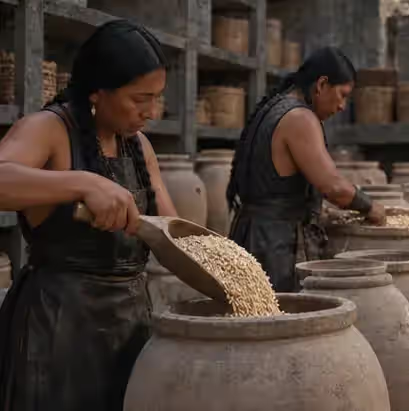
Manger dans un territoire de passage
Champignons, aliments fumés, céréales importées et rations de col dessinent une alimentation construite autour des dépôts, du transport et de la conservation. Korath n’en tire pas pour autant une autonomie agricole totale.
Le métal a besoin d’une route
Ateliers, garnisons et bêtes de travail dépendent de fourrage, grains et réserves qui doivent franchir les cols. Cette fragilité est une contrainte matérielle.
La bête blindée mange avant de porter
Broussailles, lichens, grains et cultures de col sont des ressources possibles pour les animaux, selon espèces et lieux. Aucun animal de guerre ne fonctionne sans pause, eau, soin et alimentation.
What the mountain produces
Korath grows a little under half of what its people eat; the rest comes up from outside. In the local share, cave mushrooms come first: grown on beds of compost in disused galleries, they alone provide nearly half of the Korathi meal. Then come the cereals and pulses of the terraces and low valleys, the small white fish of the underground lakes, and the herbs and vegetables of the greenhouses.
The beasts are better off than the people. The country produces about three quarters of their fodder, thanks to the scrub of the passes, the fodder mushrooms of the galleries, the hay of the Reflected Terraces and the algae of the thermal basins. The gap makes sense: an ankylosaur can be fed on juniper and black pine, a miner cannot.
The pass granaries
The missing grain comes mainly from Urnok, and in large part from the silos of Sarnor. It reaches the foot of the passes in convoys, where importers known as the pass granaries take charge of it. Their trade is not growing but lifting: they have the sacks winched up, landing after landing, along the pass stairways, and charge for the climb. A sack of grain thus pays for its road twice, at the imperial relay and then at the Korathi toll, before paying for its ascent.
The granaries do not keep the grain in the passes. They deliver it to the stores of the cities’ deep core, dry halls cut far from the hot conduits, where it keeps in sealed jars. That is where, each season, people count how many months the city could hold out if the road closed. The figure is not made public, but the economic papers spend their time estimating it.
The pass ration
The pass ration feeds the garrisons, the gallery crews and the convoys. It is made of hard bread from imported grain, smoked meat and mushrooms dried by the heat of the conduits. It weighs little, is eaten cold, stands up to the damp of the galleries and keeps for a whole season. Soldiers find it dreary and eat it without complaint, because a post that has its rations can wait, and waiting is part of the job.
Campaign beasts have their own equivalent: compact cakes of grain, mushrooms, scrub and crystal salt, given to the ankylosaurs during marches and sieges. A Korathi convoy always keeps two tallies, one for the people and one for the beasts, separately; when either runs out, the convoy stops.
Rationing by usefulness
When winter closes the passes for longer than expected, or when war cuts the roads, the regime may ration according to usefulness. The rule is known to all and seldom discussed in public: the garrisons, the forges and the Breath crews come first, because a city without air, gates and weapons no longer eats at all; then come the workshops, then those who do not work. Rations are handed out against fired-clay tokens stamped with the seal of the workshop or the district.
The system has its harshness. A journeyman without a workshop, whom popular speech calls “at low furnaces”, ends up at the back of the line with his family. Children receive a protected share, but the old who no longer hand anything on are served after the others. Korathi know this, and many keep a small store of dried mushrooms and hard bread at home, hidden behind the tools.
When the road closes
Food is the one weakness Korath cannot fortify. Its gates hold and its ballistae fire, but a long siege ends up emptying the jars of the deep core. Officers count two different durations: the tally of hours, which says how long a closed district can breathe, and the tally of months, which says how long the city can eat. On the scale of a war, it is the second that decides.
That is why Korathi diplomacy handles its suppliers with a care its speeches do not show. The country can suspend its licences and parts; the Empire can close its relays. Each knows what a break would cost, and the two powers trade the way one moves a suspended load, without jolts, each keeping a hand on its own crank.