

Armies
Korath — Arsenaux et matières du vivant
De l’atelier au terrain d’exercice, les os, les tendons, les cuirs et les cornes deviennent des pièces choisies pour une fonction précise.
Choisir, assembler, réparer
This extended reading is currently available in French.
La fabrication militaire de Korath engage le matériau, le procédé et la responsabilité de celui qui signe. Les brevets ne font pas disparaître la nécessité de démontrer, d’ajuster et de corriger un ouvrage. La circulation des savoirs techniques permet à une méthode de rencontrer d’autres ateliers et d’autres contraintes. Lire un arsenal demande donc de suivre sa production autant que sa silhouette : ce qui tient, ce qui s’use et ce qui peut être réparé.
Observe gestures and materials · 2 images
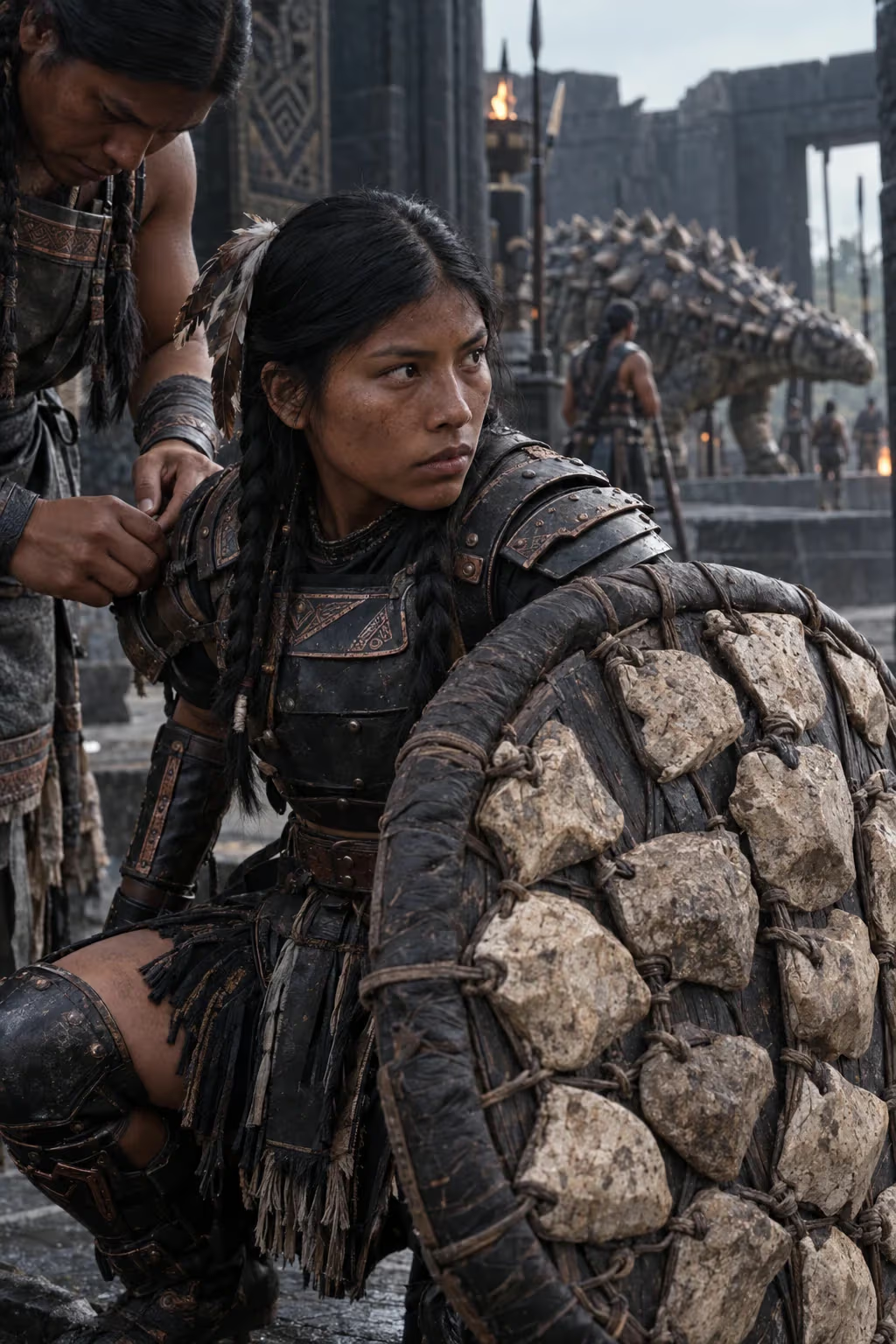
Une armure qui accompagne le geste
Atelier des sapeurs · essayage d’une cuirasse.
La massue devient bélier
Galerie d’essai · manœuvre d’un bélier court.
Les matières biologiques ne rendent pas toute arme supérieure au métal. Une doublure doit rester souple, une protection laisser respirer et une pièce usée pouvoir être remplacée. Les plaques dorsales décoratives se distinguent des pointes adultes destinées à l’armement.
Éprouver le matériel
Inspection, manipulation et entraînement révèlent la place de ces équipements dans une formation. Les gaines de griffes et les couronnes d’Apex restent des prototypes ; les équipements scellés gardent le secret de leur fabrication.
Observe gestures and materials · 2 images
Ajuster la barde, laisser respirer
Écurie militaire de Korath · essayage d’une barde.
Les pièces que l’on remplace
Atelier de Korath · réparation d’une armure modulaire.
Korath: the Patent and counterproof
Three dimensions of proof
The Seal of Form requires demonstrated geometry, forces, limits and tolerances. The Seal of Material checks the stated materials under stress and wear. The Seal of Use asks the object to solve a real human problem. A major patent then requires reproduction and methodical challenge by a rival workshop: an appealing demonstration is insufficient.
Korath: the Patent and counterproof
A name surviving exclusivity
The Right of Signature preserves authorship, the inventor’s name and the record of corrections. Income and licences remain exclusive only for a limited period. Afterwards, Return to the Mountain brings the patent into shared technical heritage. Lasting recognition of the author and later sharing of knowledge belong to the same system.
Korath: the Patent and counterproof
Assembly of chains and equipment
The chain master, collar riveter and armoured rigger work on assembly before an object appears as a finished piece. They check tension, closure, repair and holding under strain. Precision is not decoration: a poorly prepared join transfers weakness to everything depending on it. These actions add to the requirements of form, material and use; they do not replace them with a merely reputed craft.
Korath: the Patent and counterproof
Surveying and preparing corridors
Corridor geometers take measurements before a group enters a difficult passage. Trap setters and the recoil master examine points where a decision might no longer be correctable. This does not draw a complete military doctrine. It is threshold work: seeing the slope, exit, room for return and material constraint before force or speed impose their own answer.
Korath: the Patent and counterproof
Component marks, signature and responsibility
The bone engraver, trophy marker and patent master work at different moments, but all keep a part from becoming anonymous once it circulates. A mark can help distinguish a correction, provenance or manufacturing responsibility. It does not authorise use of human bone: human material remains outside all craft. An object thus keeps a material history without that history becoming permission to do anything.
Korath: the Patent and counterproof
Extraction and material preparation
A Korath part begins in extraction, rock sorting, transport and material preparation before it reaches the forge. Miners, carriers, heating crews and workshops depend on one another. Traction or protection animals change access to passes and how much material can move, but do not erase human work time. The final precision of a mechanism rests on an earlier chain of loads, stocks, tools and checked materials.
Korath: the Patent and counterproof
Specialisation creates dependencies
Concentration on mines, forges, ballistae and technical workshops makes Korath dependent on materials it does not always produce in sufficient quantity, notably food and some organic components. A supply break does not only block a market: it slows manufacture, reduces maintenance and forces workshops to choose which parts to finish. Technical power therefore has a material limit visible in stores, convoys and mountain passages.
Force contained by form
The Chamber brings together court, university, museum, laboratory, archive, public demonstration and licence market. It is organised around an immense square shaft with a magmatic glow visible below. The Patent is Korath’s greatest civil and cultural institution: it connects ownership, scientific proof, social recognition, contract and historical memory. Demonstrations are judged through instruments, evidence and seals, never through victory in combat.
Three proofs, then counterproof
The Seal of Form requires demonstrated geometry, forces, tolerances and limits. The Seal of Material subjects the announced materials to cold, heat, pressure, vibration and wear. The Seal of Use checks that the invention solves its actual human problem. A major patent must then be reproduced and methodically challenged by a rival workshop. Concealing a margin or falsifying a trial constitutes a scientific, social and religious offence.
The signature remains, use circulates
The inventor keeps authorship, name and the record of corrections. Revenue and licences belong to a temporary exclusivity; afterwards the patent enters the common technical heritage without losing its signature. The regime can impose secrecy, production and military requisition without erasing authorship. Monumental patents, accidents and revisions remain readable: public memory also honours the correction of an idea.
Korath : signature, correction et patrimoine technique
La signature conserve l’auteur et le parcours
Le droit de Signature maintient la paternité d’une invention et la trace de ses corrections. Les modifications, accidents et amendements restent lisibles parce qu’ils expliquent comment l’objet peut être utilisé et où il échoue. La mémoire technique ne se réduit donc pas au résultat final.
Korath : signature, correction et patrimoine technique
Une contrepreuve confronte le brevet au réel
Un atelier rival peut reproduire et attaquer méthodiquement une réalisation. Cette contrepreuve vérifie une méthode par la matière et par l’objection, au lieu de demander une confiance abstraite à l’auteur. Une correction peut ensuite être intégrée au dossier sans effacer qui l’a produite.
Korath : signature, correction et patrimoine technique
L’exclusivité ne dure pas indéfiniment
Après une période d’exclusivité, le Retour à la Montagne verse le brevet dans un patrimoine technique partagé. L’auteur garde sa reconnaissance, mais l’usage du savoir cesse d’être une réserve privée permanente. Cette règle ne permet pas de déduire la durée exacte d’un brevet ni les conditions d’un cas particulier.
Transmission of technical knowledge in Korath
A method must work in front of other people
A process becomes shareable when it is observed, reproduced and subjected to objection. This principle allows a workshop to transmit useful gestures and limits to partners without pretending a recipe can replace experience.
Transmission of technical knowledge in Korath
Correction retains an origin
A correction can modify a part’s use without erasing the people who designed, tested or identified its limit. Signature makes an object’s evolution legible for those who must maintain or adapt it. It is a condition of trust in a long technical chain.
Transmission of technical knowledge in Korath
Transmission does not mean surrendering all responsibility
Knowledge shared between workshops or territories must remain tied to its material, load and maintenance context. Transmission passes through observation, trial and the experience of the people who work with these processes.