

Materials and resources
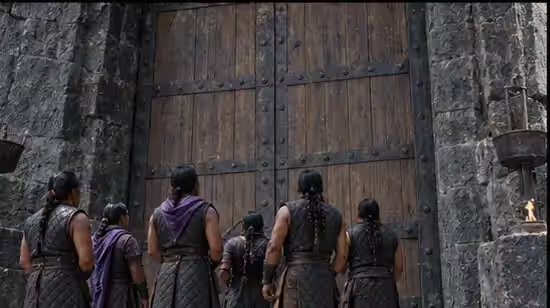
Eighteen Seconds
A door made famous by its closing time, at the heart of a national debate between supporters of seventeen and of nineteen seconds (Dix-Huit Secondes).
A door and two seconds
Eighteen Seconds (Dix-Huit Secondes) is the name of a door whose closing time became famous. It became legendary after a national debate between supporters of a seventeen-second and a nineteen-second closing.
It is a trait of Korathi culture: an engineering dispute over two seconds can enter collective memory on the same footing as a battle. Through the Great Dispute of Detail, technical minutiae become national debates, editorials, songs, family quarrels and tavern arguments.
Closing a district
The memory of Eighteen Seconds matches the architecture of the cities: lock-districts, fortresses, pass cities and administrative quarters are fitted with double doors, airlocks, counterweights, a manual emergency closing, reserves of air, water and heat, gongs, clocks and registers. A district that can be isolated must also be able to evacuate.
In Korath, movement is vertical, compartmented and patented: stair, shaft, winch, funicular, corridor, timed door. A defensive closing can save the city and doom a quarter; every shortcut has an owner, a protocol and a failure mode.
The gate itself
The gate that gave its name to the patent is a double-leaved district gate, cut from a block of basalt bound with bronze fittings. It is not closed by muscle: a counterweight drops down a neighbouring shaft and drives the leaves, while a friction brake regulates the speed of their travel. The whole point of the mechanism lies in that brake, which must give a constant closing time whether the gate is dry or damp, new or worn.
The patent therefore concerns the gate less than its time-lock, the device that guarantees the closing lasts exactly eighteen seconds, no more and no less. A district clockmaker checks it at every drill, and the measured gap is entered in the gate’s register. Copies of this lock, since fitted to pass fortresses and city gates, are among the Korathi mechanisms whose export is most closely watched.
The two camps
The national debate that made the gate famous set two ways of thinking about closure against each other. The supporters of seventeen seconds wanted the fastest gate possible: every second gained, they said, lets fewer enemies through and better protects those inside. The supporters of nineteen seconds answered that every second lost lets in more people from outside, children, porters, wounded, and that a gate that is too fast also crushes those running towards it.
Eighteen seconds was the compromise adopted after months of trials, calculations and counter-proofs, and the papers of the time filled whole columns with it. Behind the engineers’ quarrel, everyone understood that the question was who would be left outside. That probably explains the passion it aroused, and why it entered collective memory in the same way as a battle.
What the debate changed
Since the quarrel, no major Korathi gate is built without its closing time being calculated, published and justified. The figure is engraved on the lintel next to the patent number, and it enters into the district’s tally of hours: a slow gate calls for an earlier evacuation, a fast gate for an alert given sooner. Every year the closing drills measure the gap between the engraved time and the real one.
The debate also set a political habit. Korathi discuss freely the timing of a gate, its mechanism and its limits; they do not discuss who has the right to close it. The Eighteen Seconds gate has thus become the example schools give to explain the line between what is debated and what is commanded.
A gate people visit
The original gate is still in service, and families come to see it like a monument. Children count aloud during the drills, and people enjoy checking whether it still keeps its time. Nearby, traders sell small hinged bronze gates that are closed with a finger while counting to eighteen, and that many Korathi children have received as presents.
Every correction made to the mechanism since the filing is engraved on a stone at the foot of the leaf, with the name of its author. The stone now carries several dozen lines, and guides read it to foreign visitors to show them that a famous gate is first of all a maintained gate.