

Places and landscapes
Housing and ventilation in Korath
Korath’s cities are excavated into the mountain: inhabiting them means distributing heat, air, water and loads across stacked spaces.
Excavated levels and vertical access
Cities are excavated into the mountain and connected by winches, galleries, thermal conduits and other vertical access. Visible facades, terraces, towers and markets form only the skin of deeper settlements. Imported animals remain in the lower marches and do not structure deep cities.
Heat distributed to homes and workshops
The Warm Vein distributes geothermal energy to homes, greenhouses, baths and workshops. Thermally stable zones also house schools, taverns, indoor gardens and markets. Heat is therefore infrastructure that conditions where people live, learn, work and preserve, rather than a molten-rock backdrop.
Ventilation, doors and evacuation
Returned Breath organises ventilation through thermal differences and pressure. Doors, airlocks, counterweights and stores of air, water and heat can isolate a district; evacuation must nevertheless remain possible. In Korath, a closure may protect the city but also redistributes risk between districts.
Housing in modules
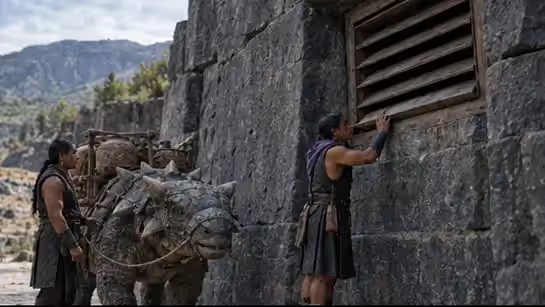
A Korathian home is carved more than built. Its rooms are square modules cut into the rock and linked by short passages; beds occupy alcoves in the wall, where the stone holds the heat, and benches, shelves and workbenches are set into the walls. Floors stay rough for footing, and walls are sometimes polished and inlaid with basalt mosaic. Movable furniture is square, refined and modular, to suit rooms whose walls cannot be pushed back.
Each room has its thermal shutter, a hatch of bronze or stone that opens onto the heat duct and is adjusted by hand. Many families do not own their home: it is provided by the workshop, together with the heating, which is one reason why leaving a workshop costs so much. Rent, where it exists, is reckoned less by floor area than by thermal stability: a module close to the Warm Vein is worth more than a room twice its size in a cold zone.
Reading the air
People in the deep cities learn to read the air the way others read the sky. An oil-lamp flame that bends flat shows too strong a draught; a flame that dwindles and turns yellow shows air growing poor. Fibre ribbons fixed to the duct grilles show which way the breath is moving. A stronger smell of sulphur than usual gets shutters closed even before the district gong has sounded.
Sound matters too. The cities have a continuous bass, the breathing of the furnaces, that giant bellows heard through the rock; when its rhythm changes, everyone notices. At night it is said that Korath does not sleep but lowers the fire: shutters half close, ducts slow down, and districts settle into a calmer regime until the morning gong.
Those who keep the city breathing
Ventilation, hydraulics, heat, pressure and filtration belong to the Side of Breath, and it is its teams that keep homes alive. They clean soot and mineral deposits out of the ducts, adjust the great district shutters, check the drains, watch the air and water reserves and replace worn bellows parts. Their work is continuous, day and night, and they have right of way in narrow galleries.
Residents know these teams by name and trust them as they would trust a healer. Part of what each household pays to its workshop or district goes to their upkeep. A badly maintained district is quickly recognised: the air there is heavy, lamps burn poorly, and families who can afford to leave do so.
When the air runs short
Each district has its alarm procedure. A code of gong strokes announces the danger, its nature and the order to follow: close the shutters, go to the district’s refuge hall, or take the evacuation route. Refuge halls hold reserves of air, water and heat, and a door that can be shut by hand if the counterweights no longer respond. Children learn these codes before they can read fluently.
Closure drills are regular, and Korathians take them seriously. They know that closing a door can save the city while condemning a district, and that a door’s closing time can become a national debate, as the Eighteen Seconds door showed. The most respected rule of housing is simple: a space that can be isolated must always be able to be evacuated.
Rich near the fire, poor in the cold
Heat draws the social map of the cities. Well-off families live in the most stable zones of the warm city, near the baths and the gardens under the rock; the poorest occupy the cold margins, the badly ventilated levels or the galleries of old districts that maintenance has abandoned. In popular speech, poverty is called “low furnaces”: when the fire goes down, a man waits.
This geography of heat explains the strength of the workshops. A journeyman who loses his workshop often loses his heated home and has to move down to the cold margins with his family. That is why bankruptcy is felt as a social death: it is measured, very concretely, in degrees.