

Families and social ties
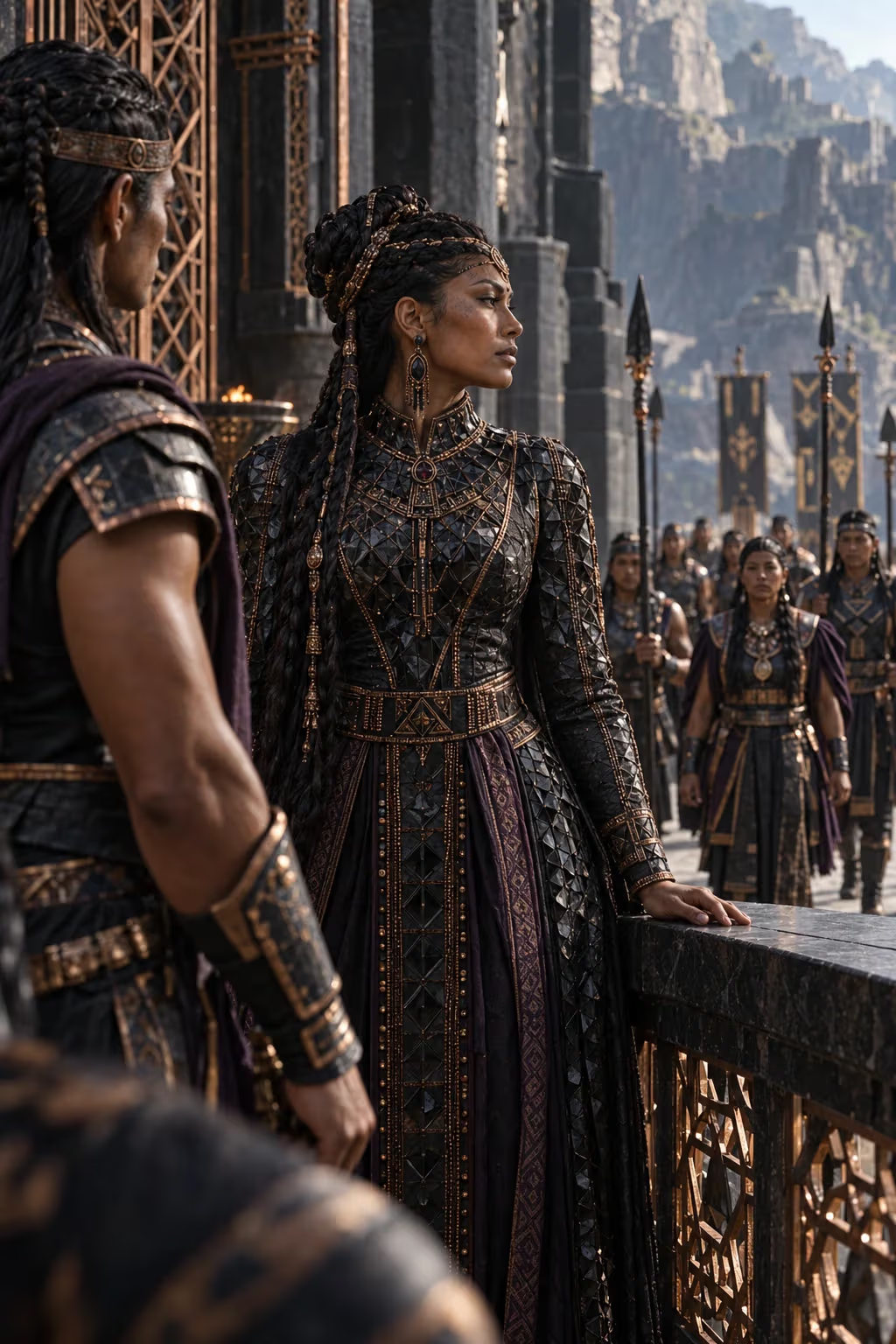
The Four Sides of Korath
Four great bourgeois families share Korath’s economic square, Measure, Form, Movement and Breath, around the Forges and military power.
The economic square
Four great bourgeois families structure Korath’s economy. Each holds a Side, that is, a body of knowledge and technical industries; together they form the country’s economic square. The image is no accident in a civilisation where geometry is sacred and whose symbol is a red disc inscribed in a black square.
The Forges and military power occupy the centre of the square. The families carry weight in the workshops and in licence portfolios; sovereignty and the strategic industrial means remain concentrated around the state.
Measuring, building, moving, ventilating
The Side of Measure brings together clockmaking, metrology, instruments, optics, cartography, navigation, tolerances and sighting. The Side of Form gathers architecture, tunnels, shoring, fortifications, bridges, structural geometry and earthworks. The Side of Movement covers gears, transmissions, winches, funiculars, recoil, ballistae, naval mechanisms and automata. The Side of Breath holds ventilation, hydraulics, heat, pressure, greenhouses, irrigation, preservation and filtration.
A city dug into the mountain needs all four: a structure must be measured, supported, supplied and made breathable. Clockmakers and metrologists belong to Measure; those who maintain air, water and heat belong to Breath.
The corners are contested
The most explosive innovations arise at the interfaces between two Sides. These corners concentrate transfers of professionals, lawsuits and espionage, because an invention there can shift the division of revenue and skills. Rivalries play out through the workshops, their supporters, their newspapers and their licences.
The Sides are not to be confused with the three seals of the Great Chamber of Patents. Form, Matter and Use are the three validations of an invention; the Four Sides describe another organisation, that of skills and the families that hold them.
What “holding a Side” means
A family that holds a Side does not own every workshop in its branch. Hundreds of independent workshops work in measure, form, movement or breath without belonging to it. Holding a Side means owning the branch’s largest licence portfolios, funding its youth schools, weighing on its specialist journals, lending to workshops just starting out and marrying one’s children into the best workshop houses. A Side is a power of influence, credit and networks far more than a closed domain.
In everyday talk, the family and its branch merge: people say that “Measure has bought the rights” to an instrument, or that “Breath has lost an engineer” to a rival. In ordinary use, the names of the four families matter less than the Sides they embody. An apprentice knows which Side his trade belongs to long before he knows which family holds that Side.
Four corners, four quarrels
Each corner of the square has its own material for lawsuits. Between Measure and Form, aiming and fortification are disputed: surveying a pass, calculating a battery’s range, laying out a gallery with the right firing angle. Between Form and Movement lie doors, sacrificial bridges and lifts, works that must both stand and move; the door known as Eighteen Seconds belongs to this corner.
Between Movement and Breath meet pumps, forge bellows, steam and pressure, wherever a machine moves air or water. Between Breath and Measure live gauges, regulated shutters, thermal clocks and greenhouses whose heat is counted by the hour. Great inventions always spill over a Side: the Returned Breath belongs to both ventilation and architecture, the Shared Recoil to both mechanics and the structure of gun carriages. That is why the question “who does this licence belong to?” takes up as much of the Chamber’s courts as the question “does it work?”.
A society sorted by Side
Belonging to a Side starts early. Workshop youth schools steer children towards a branch, and the choice often follows the parents’: one is readily born into Movement when one’s family has been mounting winches for three generations. Workshop supporters also recognise each other by Side, and the great derbies of the Tournament often pit two workshops of the same Side against each other, which makes the rivalry even more intimate.
Alliances between Sides are made through contracts and marriages. A union between two workshop houses of different branches is called, in the language of families, a “corner marriage”: it promises joint inventions and lawsuits over shares. In the rite of the square drawn by four hands, the small deviation that is preserved then takes on an extra meaning: it marks the place where two bodies of knowledge met.
The centre belongs to no family
No family sits at the centre of the square. Strategic alloys, arsenals, stocks and standards belong to the Forges, under the authority of military power. A family may hold the licences for a winch; it decides neither the metal in which that winch will be cast for the army nor how many will be made. A Korathian saying puts it bluntly: one may debate the fourth hinge for three months, but one does not debate who holds the right to close the door.
This limit shapes ambitions. The families of the Four Sides grow rich, wage war through lawsuits, poaching and espionage, and can ruin a rival workshop; they never openly contest sovereignty. Their influence runs through the regime rather than against it: getting a patent made into national infrastructure, a standard adopted, or a requisition to spare a branch. The square is rich and noisy, but it is at its centre that the scale of everything is decided.