

Materials and resources
The Reflected Terraces
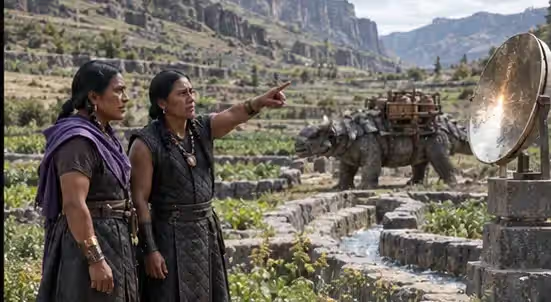
Mirrors and the management of farm sunlight, which saved valleys or made them fit for cultivation (Terrasses Réfléchies).
Directing the light
The Reflected Terraces (Terrasses Réfléchies) combine mirrors with the management of farm sunlight. The patent saved agricultural valleys, or made them fit for cultivation. It gives Korathi ingenuity a dimension that is often forgotten: technology does not only serve to make weapons, it feeds a population in a hostile land.
A built agriculture
Korath farms in heated terraces, greenhouses, orchards and vineyards, thanks to aqueducts, mirrors and sometimes imported soils. Its agriculture is not abundant by nature: it is made possible by built works, and a local fruit can become a luxury product because it stands for a hard technical success.
The Warm Vein heats the greenhouses, the Reflected Terraces direct the light; neither technique removes the weakness of the soils. Korath remains dependent on imports for part of its food.
Calculating the light
The heart of the patent is not the mirror, which everyone knew how to polish, but the calculation. The Reflected Terraces rest on tables that give, for each terrace, each season and each hour, the angle at which a mirror must be turned to send the sun onto crops the relief leaves in shadow. The tables take account of the slope, the altitude, the height of the neighbouring ridges and the sun’s course from one end of the year to the other.
Drawing up a valley’s tables takes several years of observation, with gnomon and line, and the work of a team of geometers. Once established, they are engraved on bronze plates fixed beside each row of mirrors, and terrace crews follow them to the letter. An error of a few degrees can scorch a row of vines; a badly copied table can starve a hamlet.
Making a terrace mirror
A terrace mirror is a large cast bronze disc the size of a person, mounted on an adjustable frame set by hand with a crank and a graduated circle. The metal is polished for days, first with pumice and then with osteoderm powder, until it gives back a sharp image. The best workshops guarantee a surface without haze and declare it on the mirror’s plaque.
These mirrors are expensive and are handed down. A terrace family often owns a few, kept up from generation to generation, and rents others from the workshop holding the licence for the frame. When a mirror cracks or warps it is recast rather than thrown away: its bronze is used to pour the next one, and the date of the recasting is engraved on the new mirror.
The terrace hay
The Reflected Terraces do not feed only people. Some terraces carry alpine grasses grown under the mirrors and cut several times each summer, which give the country’s best local fodder. This terrace hay goes first to the war beasts and to the convoys of the lower marches, because it feeds better than the scrub of the passes and keeps better than fodder mushrooms.
Production remains insufficient, and the rest of the fodder is imported at great cost. But every bale of hay harvested on a terrace is a bale that does not need to cross a pass. Officers of the marches therefore follow the valley harvests closely, and a good year for hay is celebrated in the relays almost as much as a good year for wine in the city.
The right to light
The light sent back by a mirror can fall on a neighbour’s land, and Korathi law deals with it. Each terrace has a registered right to light, which fixes the hours and angles at which its mirrors may light the neighbouring terraces or deprive them of light. Turning a mirror beyond its angles without agreement is an offence, and light lawsuits between valley families are among the oldest the Chamber keeps on record.
These rules also serve safety. A badly aimed beam can dazzle a convoy on a pass road, set dry grass on fire or blind a sentry. Terrace crews know, all the same, that this power to dazzle could be turned against an enemy climbing towards the valley, and the officers of the marches are well aware of it.
The mirrors in winter
Winter is the hard season for the terraces. The low sun barely clears the ridges, snow covers the crops, and frost can crack a mirror left uncovered. Crews then protect the bronze discs under thick fibre covers and only uncover them on fine days, to warm the most exposed greenhouses.
In spring the mirrors serve another purpose: they are turned towards the slopes still under snow to hasten the melt and give the soil back to work a few weeks earlier. This practice, governed by the same tables, lengthens the growing season of valleys where every week counts. Terrace families like to say that their year begins on the day the first mirror is uncovered.