

Institutions
The Great Chamber of Patents
A court, school, laboratory and archive where an invention must withstand counterproof.
Force contained by form
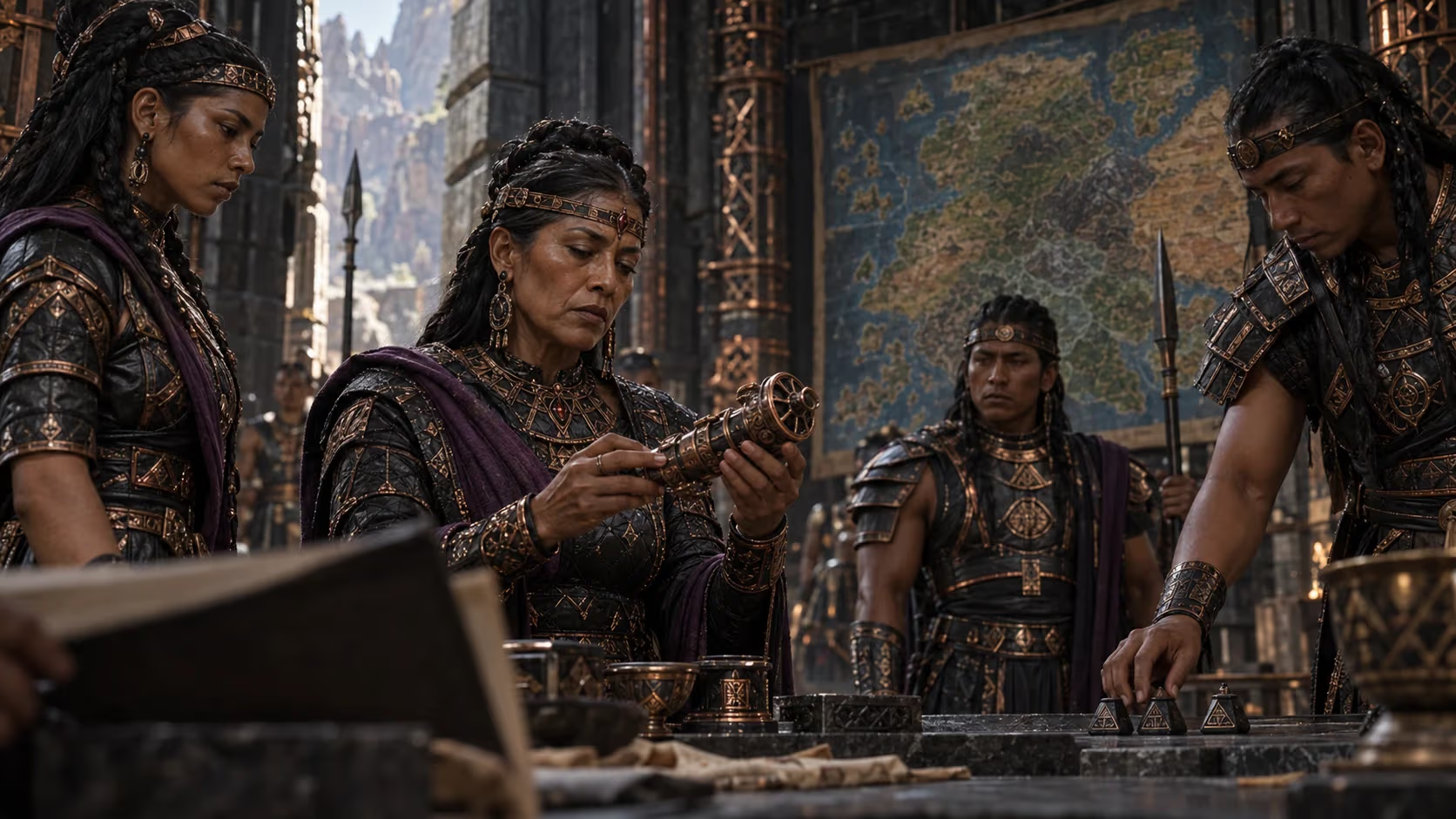
The Chamber brings together court, university, museum, laboratory, archive, public demonstration and licence market. It is organised around an immense square shaft with a magmatic glow visible below. The Patent is Korath’s greatest civil and cultural institution: it connects ownership, scientific proof, social recognition, contract and historical memory. Demonstrations are judged through instruments, evidence and seals, never through victory in combat.
Three proofs, then counterproof
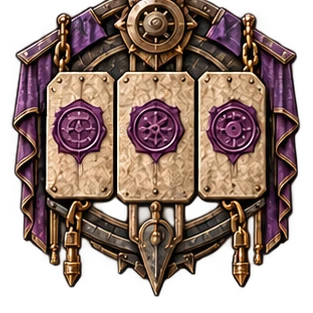
The Seal of Form requires demonstrated geometry, forces, tolerances and limits. The Seal of Material subjects the announced materials to cold, heat, pressure, vibration and wear. The Seal of Use checks that the invention solves its actual human problem. A major patent must then be reproduced and methodically challenged by a rival workshop. Concealing a margin or falsifying a trial constitutes a scientific, social and religious offence.
The signature remains, use circulates
The inventor keeps authorship, name and the record of corrections. Revenue and licences belong to a temporary exclusivity; afterwards the patent enters the common technical heritage without losing its signature. The regime can impose secrecy, production and military requisition without erasing authorship. Monumental patents, accidents and revisions remain readable: public memory also honours the correction of an idea.
What the Chamber does not decide
The Chamber recognises an invention; it does not decide its fate alone. Scientific recognition, industrial resources and political decision are distinct powers, even when they work closely together. A successful demonstration can remain a prototype if the Forges do not produce it at scale, and the regime can impose secrecy, production or military use on a patent. Inhabitants can debate a mechanism, contest a trial or mock a technical error; this freedom does not give them the right to question command.
The Great Tournament of Patents
Periodically, the Great Tournament of Patents tests civil, medical, agricultural, musical and military inventions before judges, the crowd, investors and the regime. In derbies, two workshops solve the same problem with identical materials, budget and deadline. The Tournament serves at once as a public test, a contract market and a recruitment ground.
The shaft and its galleries
The Great Chamber is first of all a void. A square shaft, carved into the basalt, descends towards a magmatic glow visible at the very bottom; around it, on all four sides, the institution’s galleries are stacked. Each level has its functions: the courts and examination rooms, the university lecture halls, the museum rooms, the archives, and the licence market where rights are traded. Bridges of stone and bronze cross the void at certain levels, and the widest serves as the stage for public demonstrations.
The air in the shaft is warm and rises constantly, which also makes it one of the city’s great ventilation chimneys: the galleries use this draught to breathe. The public tiers occupy the upper levels, from which the crowd watches demonstrations across the void, with the magma in the background. The whole building repeats the national symbol, a red disc inscribed in a black square: force contained by form, seen from above.
A day at the Chamber
The day begins with the opening gong. Filers queue at the filing counters, where a public clockmaker seals each dossier and records its exact time, the one that will count in any priority suit. In the calculation galleries, examiners of Form rework the figures of a mechanism; lower down, in the testing chambers, a judge of Matter reads the wear on a skein after a night of cycles.
At the licence market, patent brokers, backers and workshop owners negotiate rights, future shares and industrialisation contracts. Workshop critics move between courts and demonstrations, notebook in hand, for the next day’s papers. Foreign students, accompanied by their rector, visit the open archives. In the late afternoon, the public demonstration draws the crowd to the tiers: a mechanism’s launch, a trial and a sporting final all at once, in a volcanic temple.
Those who keep the Chamber alive
The Chamber employs a whole population of specialists. The examiner of Form, the judge of Matter and the arbiter of Use embody the three seals. The counterprover, from a rival workshop, reproduces and attacks major patents. The archivist of Signature keeps authors, revisions and amendments: he holds the non-dynastic memory of Korath, where correction too is revered. The sacred geometer measures foundations, rites and deviations.
Around this core gravitate other trades. The patent broker finances licences, prototypes and future rights, linking the bourgeoisie of the Four Sides to innovation. The workshop critic analyses patents, transfers and counterproofs for a technical press read far beyond the universities. The foreign rector manages students from abroad and their access to open patents, never to the Forges or black patents.
The archive of forms
The Chamber’s archive does not keep only writings. It holds plans engraved in stone or bronze, their copies on tanned hide, scale models, casts and prototypes, including those that failed. An entire gallery, which visitors call the gallery of accidents, displays the parts that gave way in tests or in service, each with the date, the cause and the correction that followed.
This archive is consulted every day. A workshop preparing a counterproof comes to reread the revisions of a related mechanism; a judge checks a priority; a student copies a patent returned to the Mountain. The registers are kept in duplicate, one in the open galleries and the other in the strongrooms of the deep core, so that no rockfall or fire can wipe out the country’s technical memory.
The first civil power
The Chamber is the country’s first civil power, and a Grand Judge of the Three Seals sits at its summit. His authority is immense within its domain: he guarantees procedure, settles priority quarrels as the final instance and ensures that no favour replaces proof. The families of the Four Sides, Karûm-Brakh and the most powerful workshops depend on his decisions.
This power nonetheless remains civil. The Grand Judge commands neither the Forges nor the army, and the Seal of Requisition lies outside his jurisdiction. The relationship between the Chamber and the regime resembles that of two interlocking structures: one says what is true, the other decides what will be made. Korathians set great store by this distinction, which protects proof from politics without ever subjecting politics to proof.
The Chamber in wartime
Like every major civil infrastructure in Korath, the Chamber has a defensive use. Its deep galleries connect with the city’s strongrooms and reserves, and its shaft is part of the ventilation network that is adjusted when districts close. In case of threat, the priority was set long ago: registers and plans are sheltered first, then prototypes, and only afterwards furniture and ceremonial works.
War also changes the institution’s work. Requisitions multiply, as do black patents, and public demonstrations grow rarer in favour of closed-door examinations. Foreign students lose access to some archives. Yet the Chamber keeps sitting, recording and signing: even at war, Korath does not give up knowing who invented what.