
Materials and resources
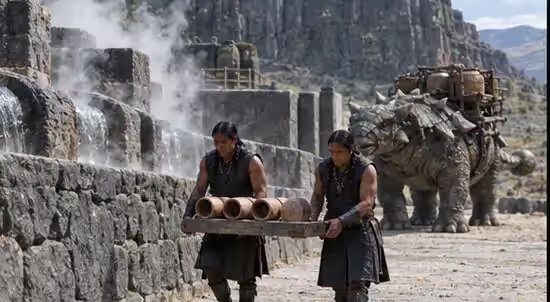
The Warm Vein
The distribution of geothermal heat to homes, baths, greenhouses and workshops (Veine Chaude).
Distributing the mountain’s heat
The Warm Vein (Veine Chaude) organises the distribution of geothermal heat. It feeds homes, baths, greenhouses and workshops. With the Four Supports and the Returned Breath, it is one of the inventions without which the dug-out city would not be habitable.
In Korathi cities, the “warm city” gathers homes, schools, baths, taverns, workshops, markets and indoor gardens in thermally stable volumes. Heat there is maintained infrastructure, not a backdrop of molten rock.
Heat that depends on the workshop
Distributed heat also carries social weight. Leaving a workshop is legal, but it can mean losing one’s heated home, tools, education, insurance, network and access to resources.
In the greenhouses, the Warm Vein works with the Reflected Terraces: these techniques do not remove the weakness of the soils, they make it possible to farm around it.
The conduits of the Vein
The Warm Vein carries the heat of the rifts as scalding water and steam. It is captured near the fractures, in stone chambers where water from the cisterns is heated against the rock, then distributed through a network of conduits. Standard sections are three metres long: a red copper pipe sheathed in basalt, which keeps the heat in and protects the metal from knocks. They fit together with bronze joints and are replaced one at a time.
The network branches like a tree. Master veins run from the capture chambers to the great shafts, district branches split off at each layer, and small conduits climb to the thermal shutters of the dwellings. Pressure gauges sit at every junction, because a conduit whose pressure climbs too high can burst; reading them is the Breath crews’ first task each morning.
What else the heat does
The Warm Vein does not only heat. Cave mushrooms dry on racks set against its conduits, black-beer brewers place their vats nearby, and rift spirit is distilled with the heat of its pipes. The smoking chambers where meat is preserved are cut just above the master veins. A good share of Korathi food thus passes, at one point or another, through the heat of the mountain.
Baths, greenhouses and gardens under the rock depend on it just as much, and workshops use it to dry glues, soften leather or keep tendon bundles warm before they are mounted. In a city without forests, where wood is expensive and coal is kept for the forges, the Vein is the only plentiful heat, and every new use is negotiated against the ones that already exist.
When the Vein runs low
Sometimes the Vein runs low: a capture chamber clogs, a fracture shifts, a master conduit gives way. Cold then spreads through the districts it serves, starting with the most distant, which are also the poorest. Breath crews open bypasses from neighbouring districts, but the shared heat grows weaker for everyone, and families crowd into their best-placed rooms.
These failures are dreaded and seldom long, for the city has learned to repair them quickly. Yet they have left their mark on the language: saying that a family is “at low furnaces” calls up the cold of a dead vein as much as the poverty of a journeyman without a workshop. Old Korathi still count the winters of their childhood by the failures they lived through.
Heat as a reserve
During a siege, heat is part of the reserves just like air and water. The tally of hours of a closed district assumes that the Vein keeps reaching it, and the capture chambers are among the best-guarded places in the city. The deep core has its own branches, able to keep working even if the upper districts are lost.
Conversely, the command can also cut off the heat of a sector that has fallen to the enemy and leave it to the cold of the rock. The decision is never taken lightly, since it also strikes those who could not leave. Like the decision to close a gate, it belongs to the military command alone.
The capture chambers
The capture chambers are where the Vein begins. Cut as close as possible to the fractures, they are run by conduit stokers who work there in short shifts, for the heat is overwhelming and the air heavy with sulphur. They regulate the inflow of cold water, watch the gauges and open or close the outlets to the master veins.
Rift water leaves a mineral crust inside the conduits that ends up blocking them. Each season, part of the network is therefore drained in turn, and crews scrape the inside of the pipes or replace sections too heavily crusted. This work is announced in advance in the morning gazettes, and the districts concerned know they will be cold for a few days.