
Materials and resources
The threshold kit
Most adults in N’Goro carry several emergency flasks suited to their routes: biological preparations whose effect depends on the body, the dose and the surroundings.
A kit for every route
In N’Goro, water, air, soil, plants, spores, parasites and animals can become predators without any human intent. Sovereignty there lies less in owning land than in knowing when, how, with which potion and under what protection to cross it.
Most adults therefore carry several emergency flasks, chosen for the routes they travel: this is the threshold kit.
What a flask holds
A potion is a biotechnology of plants, spores, venoms, secretions, ferments, bacteria, resins, minerals and alcohol. Its effects are physical and biological: no vial replaces animal training, knowledge of the terrain or medicine.
The dose depends on the body, weight, exposure, water, season, health and whatever has already been taken. The name of a flask is therefore not enough to fix its effect.
Five named preparations
Five preparations have a proper name. Souffle clair (“clear breath”) reduces certain spores, allergies and respiratory irritations. Mue rouge (“red moult”) is an emergency coagulant and stimulant, dangerous beyond its threshold. Eau silencieuse (“silent water”) partly masks body odour for crossing certain sensitive areas. Réveil de vase (“mud waking”) keeps one awake in narcotic mists, at the cost of severe exhaustion. Contre-lait (“counter-milk”) neutralises certain preparations of the Black Milk.
The named poison and the counter-flask
Owning a poison is not a crime in itself; using it without a name, a dose, a signature, an origin or an antidote is. A poison sold with a known antidote must have its counter-flask deposited with the Sapkeepers. The code of the Black Milk Houses says it in its own way: no one sells a poison whose counter-flask they refuse.
Beyond N’Goro
Venoms, antidotes, filters, fibres, spores and medicine carry a high value per unit despite their small volume. Volonia thus buys limited N’Goro products against irritation and pressure for its divers; they have side effects and sustain a dependence, and they give no one the ability to live under water.
The case and its flasks
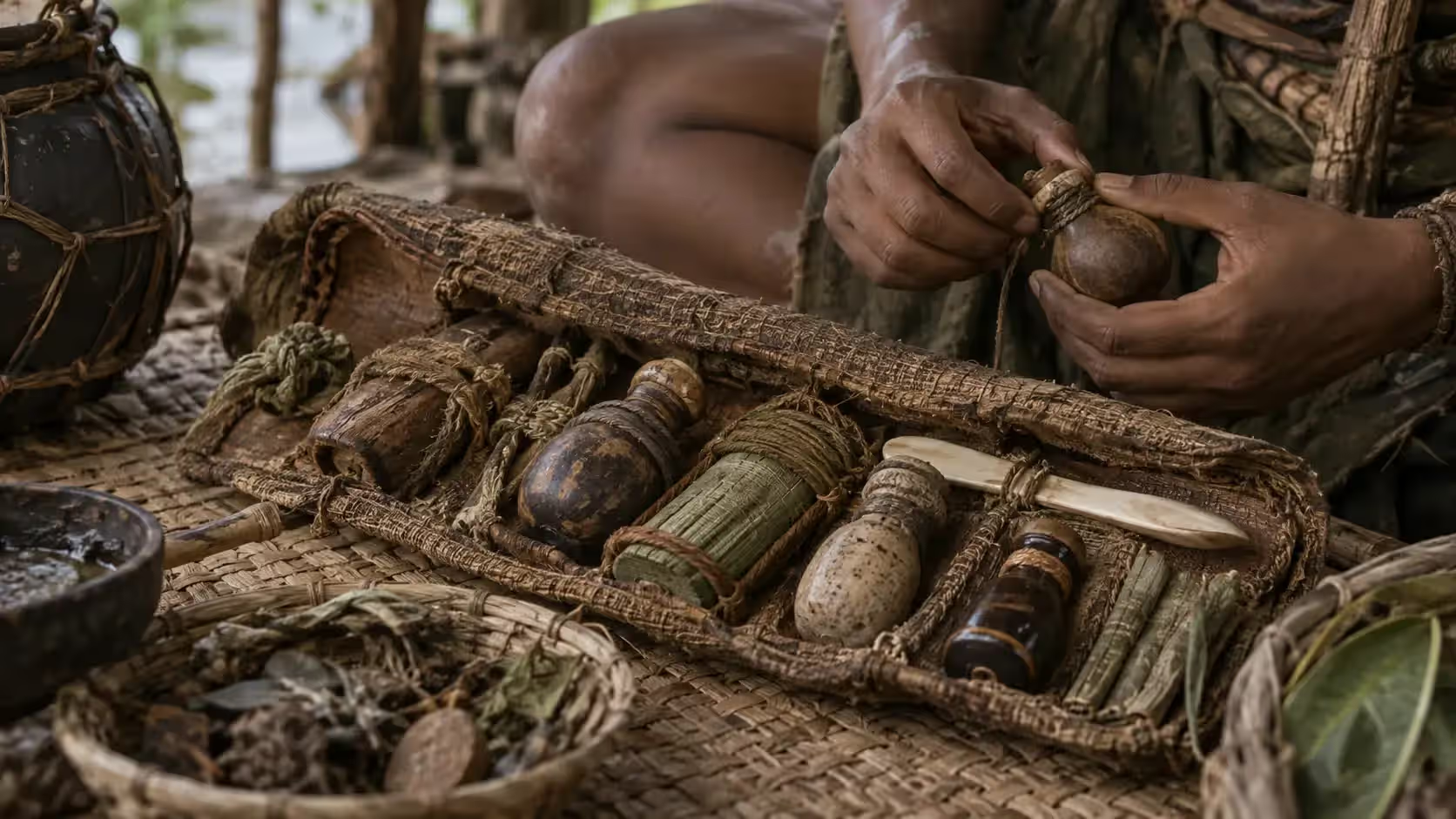
The threshold kit is a chitin case as long as a forearm, worn at the belt or across the chest so that it can be opened with one hand. It is divided into cells holding the flasks: horn for liquids, clay for powders and pastes, waxed bamboo for preparations that fear heat. All are stoppered with insect wax and carry a knotted mark giving their content, dose and date, so they can be recognised by touch in the dark. A knotted cord, each knot worth one drop, is tied to the lid.
The case also carries its owner’s mark, cut into the chitin or painted in spore ink. One does not take someone else’s kit: one might drink from it what suits the other’s body and not one’s own. Children carry none; their guardians hold the flasks for them until the day they are granted the right to travel a route alone and, with it, their first case.
Putting a kit together
Before a journey, one has one’s kit put together by a Sap-Keeper, an herbalist or a kinswoman who knows the doses. Its make-up depends on the route, the body and the trade. A boatman of the Long Boughs takes mostly Red Moult, Clear Breath and a reed-snake antidote; a centipede rider never parts with the centipede antidote, which brings a fever down in one day instead of six; an insect breeder keeps his swarm serum; a Mist guide loads Mud Waking and extra doses for his travellers; a hunter of the Terres Englouties, Silent Water. People of Muu-Shanga who seldom leave the city often make do with two or three flasks.
Foreigners are given at the Control Basins a kit made up for them, simpler and more weakly dosed, with instructions knotted onto the lid. Merchants who come often end up with their own case, which they have made up again at every visit.
Renewing and returning
A kit ages. Preparations lose their strength within a season or two, some faster, and a flask that is too old may stop working or work differently. The Ngoro therefore have their kits checked at every change of water, at the threshold post or by their herbalist, who replaces what has gone off, adjusts the doses if the owner has grown thinner or older or changed route, and reties the cords. Empty flasks are returned to the post, which washes them, and leftover preparation is never poured into the water, which would amount to altering a water without marking it.
A kit is paid for, but often not in coin. Families settle for their flasks in food, services or fibres; a kit given to someone setting out into danger can open a Breath Debt if it saves his life. The Black Milk Houses also make up kits for the travellers they escort, and charge for them along with the protection.
What a kit tells
In N’Goro a great deal can be read in someone else’s kit. The number of flasks tells the routes a person travels, their wear tells his age, the quality of the chitin and the marks tells his family and his fortune. A Sap-Keeper’s kit is known by its bone spoons and copper funnels, a woman fighter’s by its doses of Red Moult. Among people of rank, the kit is sometimes accompanied by a toxin jewel, a ring or pendant with a hollow bezel holding a signed poison and its counter-flask: it shows its wearer’s mastery, and serves on occasion as a discreet threat.
Taking his kit from a Ngoro is almost the same as disarming him. Prisoners who have theirs removed lose a good part of their chances of surviving the waters they will be made to drink, and soldiers who capture a N’Goro enemy always begin there. The elders say one knows a person by his kit better than by his face, because the kit tells where he is going and what he fears.