

Places and landscapes
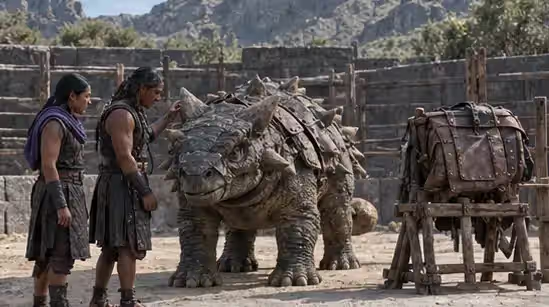
Korath’s low valleys
Imported animals find suitable spaces at the massif’s edges.
Place determines acclimatisation
Korath’s imported animals are kept in suitable low valleys and border areas. Their acclimatisation is costly and localised. Peripheral transport, study and training give those presences a purpose. They require a particular environment and maintenance; deep cities retain a different organisation of work and circulation.
Movement is tested in an open yard
Forts, depots, animal yards and testing posts in the low marches can set a rounded shell within a square grid. Courtyards must permit turning and leave the sweep of a tail clear. Niches, inset benches and wooden buffers answer these constraints. The architecture of a testing place begins with space for the living body.
Observing outside the charging axis
A testing gate or low-march academy can use sacrificial blocks, rules, impact marks and veterinary stalls. A straight approach and long deceleration area frame a charge; observers stand in side galleries. Measurement therefore requires a route for the animal, a recovery space and a safe position for the person watching.
Korath’s animal gateway
The Marches basses connect the civilisation of the carved cities to the roads outside. They receive cargoes and prepare animal units without bringing them into the heart of each city; their relays serve supply and the roads to Arkhan. Their role lies as much in this daily interface as in defence.
Imported animals are treated harshly there, as assets, test subjects and engineering problems; this practice remains separate from the status of humans, whose legal ownership is forbidden in Korath. Acclimatisation is costly and never makes the whole massif habitable for the same beasts.
The people of the marches
The lower marches have their own population, different from that of the carved cities. There one finds garrisons, relay teams, healers who run the veterinary stalls, trainers, ram-helmet armourers who equip the pachycephalosaurs, and weight clockmakers who calculate the load, fatigue and sequence of draught animals. Add to them the merchants and clerks who receive cargoes from outside.
People from the deep cities sometimes look down on the marches, as a rough frontier where one lives in the open air among animals. The people of the marches return the contempt: they are the ones who see the grain, the tendons and the enemies arrive, and they know the mountain would not last a season without them.
Feeding animals from elsewhere
No dinosaur lives lastingly in the wild in the Black Mountains, and those of the marches are costly to keep. Ankylosaurs, nodosaurs and pachycephalosaurs eat scrub, lichens and pass crops, but also imported grain and fodder, paid for in Korath at about 1.25 times the average rate. A working ankylosaur therefore represents a continuous expense, calculated as carefully as the wear on a part.
The relays of the marches hold fodder reserves for convoys and animal units. The animals are fed, watered, tended and rested according to precise tables, because no war animal works without rest, water, care and food. Treatment remains harsh: imported animals are regarded as assets and test subjects, but an underfed asset is a lost asset, and Korathians know it.
Impact tracks and betting
The test tracks of the marches do not serve engineers alone. Pachycephalosaur impact tests, on straight tracks or orthogonal circuits, draw crowds from the marches on demonstration days, and around them a genuine popular sport has grown up: people bet on the animals, follow their bloodlines and comment on how a test cap held up as they would comment on a workshop derby.
These days keep the discipline of the trials. Spectators stand in the side galleries, never in the line of the charge; the outward lane, the return lane and the recovery zones stay separate, and the healers have the last word on an animal’s condition. The animals do not climb into the deep cities for all that: the sport of impact remains a frontier pleasure, which city dwellers come to watch as visitors.
Facing Arkhan
The marches facing Arkhan are one of the few sharp borders in the known world. Elsewhere, weeks of empty country stretch between two powers; here, Korath and Arkhan truly touch. Place names in this contact zone often belong to an Arkhan layer, recognisable by its initial V, such as Vüren and Vulkar, the two Arkhan metropolises towards which two distinct routes lead from the massif’s south-eastern exit.
The border lives to the rhythm of the Great Shedding. Since the battle of the Seven Dusts, no one attacks an Arkhan migration during the Shedding: the neighbours close their passes and wait. The garrisons of the marches know these seasons by heart, reinforce their posts, empty the exposed relays and watch the dust of the trails go by from afar.