

Culture
Inhabiting warmth
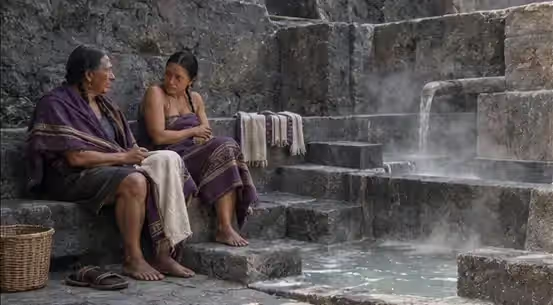
Baths, gardens and homes occupy stable layers of the excavated city.
Living at a usable temperature
Homes, baths, workshops, taverns, schools and indoor gardens occupy Korath’s thermally stable zones. The excavated city offers successive layers rather than a simple row of façades. Comfort depends on a place within the mountain: a warm, ventilated location must remain connected to the other functions making a day livable.
Warm Vein and Returned Breath
Warm Vein distributes geothermal heat to homes, greenhouses, baths and workshops. Returned Breath provides ventilation through thermal differences and pressure. These two patents give bathing a technical setting: heat alone is insufficient for life under rock. Air and temperature are maintained systems connecting bodily care with urban life.
Comfort also distinguishes a social setting
Geothermal baths are among bourgeois refinements, alongside fine leathers, glassware, automata, rare wines and gardens under rock. Warmth therefore provides both a bodily experience and a form of distinction. Crafted objects and indoor gardens bring comfort, skill and wealth together in a country where making the environment habitable already requires engineering.
A visit to the baths
A Korathi bath is walked through in a fixed order, from the coolest room to the hottest and back. People take off their shoes at the entrance, leave their tools at a guarded counter, and move from one pool to the next, getting closer to the main conduit of the Warm Vein. The pools are square, cut into the basalt, and their temperature is written on a plaque at the edge, together with the length of stay it is unwise to exceed.
People scrub their skin with pumice, the light volcanic stone taken from the lava flows, and throw into the water scented, faintly sulphurous crystal salts that leave a recognisable smell on those coming out of the baths. These salts are sold to foreigners as a remedy. Regulars finish in a lukewarm room where they drink filtered water before climbing back towards the city, their skin reddened and their hands at last clean of the day’s soot.
District baths and private baths
District baths are open to everyone for a small fee, and often free for crews coming off shift. They fill up at the changes of shift: miners, founders and porters come to leave their dust and weariness there before going home. People talk loudly, read the day’s gazettes aloud and close small deals. For many families who live “in the cold”, far from the Vein, it is the only warm place they visit every day.
The private baths of bourgeois houses are quieter and hotter, since they are connected as close as possible to the conduits. Partners and allies are received there, and an invitation to the bath of a family of the Four Sides counts as a mark of trust. One rule of good manners holds for all baths, public or private: nothing important is decided in the hottest room. Korathi see it as a playful application of the Cooling Time.
Healing with heat
The baths also serve for healing. Miners ease their backs and joints there, founders their minor burns, which are then covered with an ointment of sulphur and fat prepared by the apothecaries of the Rifts. Some pools, known for the quality of their water, are reserved on prescription for the sick and for the wounded back from the passes. Carers work there in shifts, as everywhere else in the city.
Korathi medicine has its limits, though, and knows it. The most effective remedies, balms, antidotes, ointments for deep wounds, come from N’Goro, on which Korath depends for its care as much as for the resins that protect its ballista bundles. The market saying puts it without tenderness: Volonia finances, Urnok feeds, N’Goro heals. Korathi repeat it with a grimace, for they do not like owing their health to their distant cousins of the marsh.
Gardens under the rock
The indoor gardens occupy the most stable halls of the warm city, where the temperature hardly changes from one season to the next. Light comes down through shafts whose bronze mirrors send the daylight in, and oil lamps take over at night. Mosses, low ferns, alpine herbs and short-lived flowers brought down from the plateaux are grown there and, in the lukewarm basins, brightly coloured thermal algae.
These gardens feed nobody. They are for walking, for rest and for the pride of the districts that keep them, and their beauty is costly: a garden under the rock needs filtered water, controlled heat and gardeners who know the conduits as well as the plants. Bourgeois families own small ones next to their baths; working districts club together to keep one, sometimes reduced to a few squares of moss around a fountain.