
People
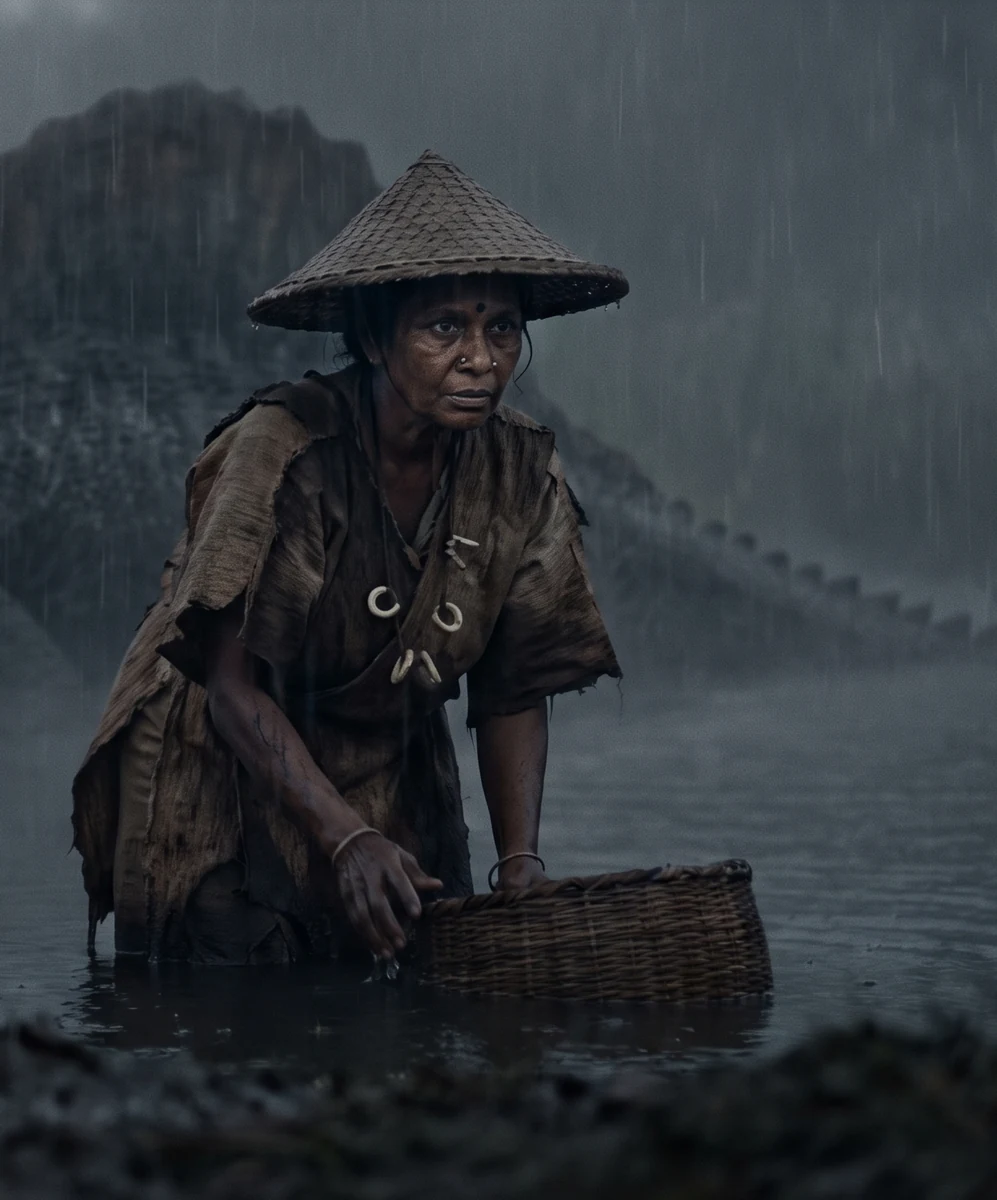
Sûma
Ruler of N’Goro: from Muu-Shanga, an ultra-centralised power that can close a region.
An ultra-centralised power
Sûma rules N’Goro, a country of about 1.3 million inhabitants, from Muu-Shanga, the great City of the Marshes where the Circle of Balances sits. Her power is ultra-centralised, and it is not a hereditary kingship. A leading figure of the Sap-Keepers’ Synod and of the Circle of Balances, she can close a region.
Closing a passage
Her action rests on mastery of thresholds. Closing a passage means linking a health decision to the means of enforcing it; Sûma works on that joint between knowledge, routes and protections. In the service of this central power, the Circle can call on the houses, the Sap-Keepers or animal holders to mobilise their capacities.
A clandestine opposition
Sûma has to reckon with the Houses of Black Milk, whose services reach essential districts and accesses. Together with the Insectophiles, these houses put up a clandestine resistance to her power.
Defence through the environment
Her defensive doctrine lets the environment wear an army down before the great spinosaurids intervene. Routes, bodies, senses, reserves and channels become elements of defence. Central command still has to deal with conditions on the ground, which no order can replace.
Mistress of Thresholds, without a crown
No one in N’Goro calls Sûma “queen”. The title she is given in the halls of Muu-Shanga is Mistress of Thresholds, and it describes a function rather than a rank: she is the one who says when a water opens, when it closes and under what protection it may be crossed. The title was born of use: people came to call her that because her decisions were followed from one end of the human corridors to the other. Abroad she is often called Sûma of the Mists.
Her authority does not come from birth. In the Mystique of Sheddings and Thresholds, a person is what they have managed to cross, and an elder’s body is respected because it proves decades of floods, fevers and poisons. Sûma is one of those elders. Her hair is greying and her forearms carry the pale scars of bites and acid burns. She has changed names at several sheddings, as many Ngoro do, and the Circle’s registers keep her earlier names without anyone speaking them in session. Sûma is the name of her latest emergence.
An authority of women under arms
N’Goro is a military matriarchy, and Sûma’s place cannot be understood without it. One belongs to one’s mother’s water; the memory of doses passes from water-mother to water-daughter; and the defence of a passage falls first to the women who keep its memory. The captains who hold a channel, a reed pass or a basin are overwhelmingly women, and former women warriors raise young children collectively alongside families and Sap-Keepers. Men fight, guide and heal, but the order to hold or abandon a water almost always comes from a woman.
Foreigners have often described Sûma as a healer: that is true, and incomplete. The same halls call her defensive general. She does not command a line army; she commands a web of captains, lookouts, dosers and trainers, each of whom knows what her water can withstand. In a country of 1.3 million people, where every clan is small and precious, losing a captain means losing the map of a region. Sûma knows it, and she spends her people with an avarice her allies sometimes mistake for excessive caution.
A day in Muu-Shanga
Sûma’s days begin with water. Every morning, carriers bring up to Muu-Shanga sealed flasks drawn the day before from the basins that matter: an arm of the estuary, a pass of the Control Basins, a lake of the Living Mirror. She does not drink them. Sap-Keepers read them in front of her — colour, smell, sediment, the reaction of an indicator organism — and she listens. News then arrives by the other ways: drums and whistles, which carry for tens of kilometres, and vine messages brought by the Knotters, whose tension and smell she can read herself.
She travels little, and always on water. Her mount, Seuil, a dark-sailed spinosaurid, never crosses water that has not been read; Sûma holds herself to the same rule, and her journeys follow the channels confirmed that day. It is said that a closure is decided in her house standing up, before a filter: in N’Goro lying before a filter is a profanation, and deciding in that place means that the one deciding agrees to answer for it before everyone.
How a region is closed
Closing a region is the act that defines her power, and it is done in stages. The order leaves Muu-Shanga by drum, then is confirmed by vine messages, so that no single voice is enough to give it. The Sap-Keepers seal the basins concerned; the ports haul their log booms across; the guides withdraw; the scent beacons are torn out or left to fade; the liquid maps of the area are no longer fed. Within a few days, dozens of leagues of channels become impassable to anyone who lacks the signs of the moment.
None of this requires an army. A closed region is not guarded by soldiers in line: it is made unreadable. A traveller can still see it, move through it for a few hours, then get lost, drink a water that does not suit them or step onto a floating mat that gives way. Closure still has a price, and Sûma pays it too: families separated by a sealed pass, care delayed, trade broken off, Black Milk Houses suddenly selling the one passage left open at a very high price. That is why her closures are rare, and why they are feared.
What people say of her
In Muu-Shanga people say that Sûma “knows her dosage”, which in Ngóro is the highest praise: the person is reliable, she knows the limit of what she gives and of what she holds back. She is also credited with a sentence that mothers repeat to children in too much of a hurry: “Two drops to sleep, three never to wake. Choose before I choose.” She has never denied it.
Her relations with the Black Milk Houses mix contempt, old debts and pragmatic cooperation during quarantines: neither side can ignore the other. Abroad, the portrait changes with the nation. In Urnok, where people count in roads and fodder, she is taken for a glue merchant too powerful for her population. The khans of Arkhan, who survive by moving, see in her an enemy who never shows herself; the Volonians negotiate with her through quarantines; Ishtir, which measures the person, poorly understands a ruler who mostly measures the threshold. All of them know she does not defeat an army with her great spinosaurids: she waits until the continent has finished weakening it.
Part of this article covers events of season 1. Turn spoilers on in the menu to read it.