
Families and social ties
The Houses of Black Milk
Protection, debt and everyday services give the criminal network its local ties.
A House in neighbourhood life
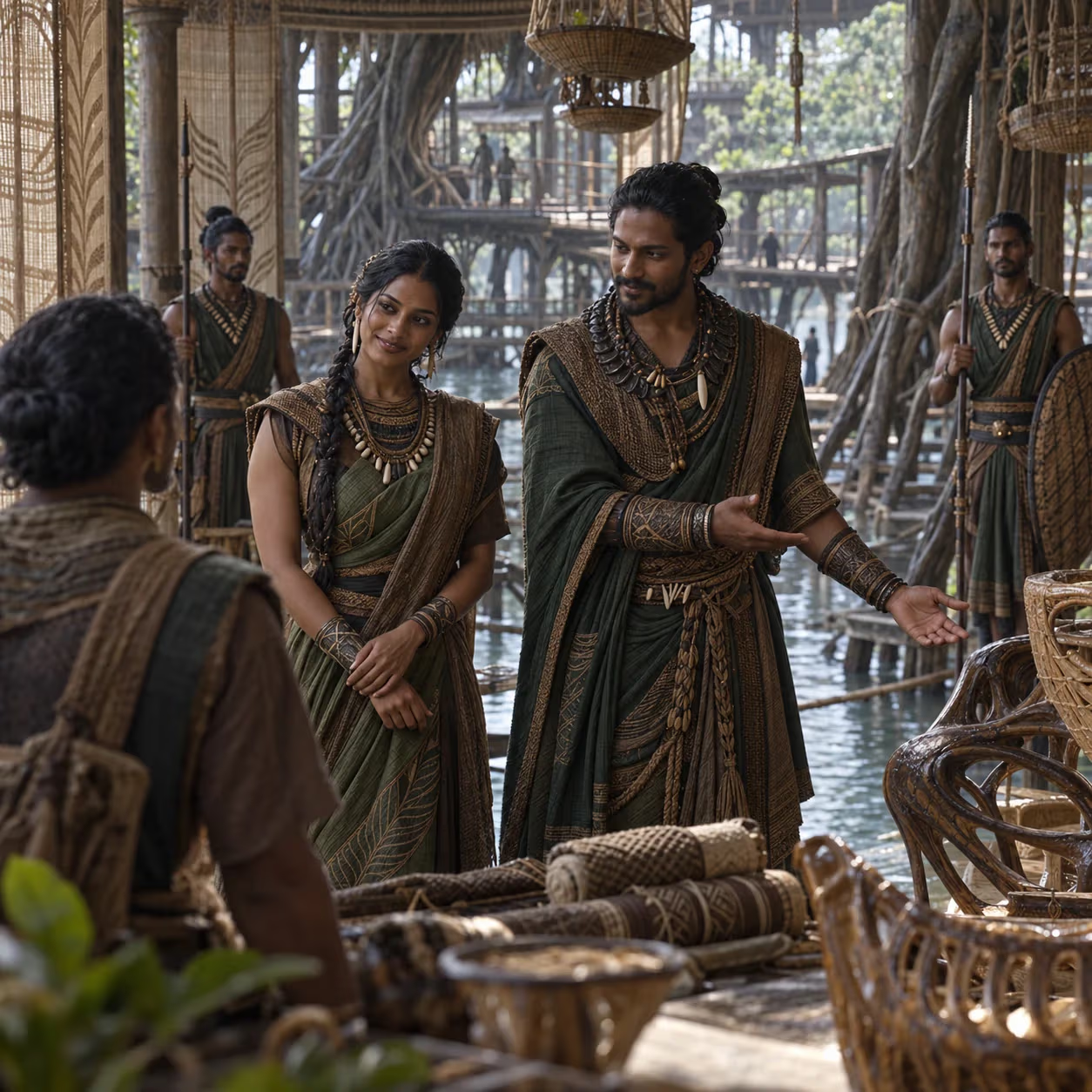
The Houses of Black Milk combine crime, protection, credit, smuggling and local justice with care, adoption, funerals and employment. A House protects the route it taxes and provides services that official power cannot supply. Its ties therefore also pass through a neighbourhood’s ordinary needs, through help received and the obligations accompanying it.
Debt must have an end
The Code requires a debt to have an end. A child does not pay before their first moult; no one sells a poison for which they refuse the counter-vial. These limits are part of how the Houses work. Protection and credit carry obligations, but these come with rules concerning duration, childhood and the ability to treat a poison.
Rescue can bind
A House can save a neighbourhood or adopt orphans while also creating dependency, violence and monopolies. These effects belong to the same power network. Rescue gives local legitimacy, and debts strengthen ties that can be difficult to leave. The Houses thus occupy an everyday position among essential needs, protection received and domination.
The substance that gives them their name
Black Milk really exists. It is a distillate drawn from animal secretions, fungi and fermentations carried out in the depths of the marsh; thick, almost black, it leaves a taste of wet earth on the tongue. A good part of the secretions comes from Mist Toads raised in basins at Muu-Shanga and in the Bay of Roots, milked by breeders with gloved hands. Depending on the dose it numbs, it elates, it creates dependence or it kills. The Sap-Keepers know several preparations of it, and Counter-milk, one of the potions of the threshold kit, neutralises some of them — not all.
The Houses owe their name to this product because they long held its manufacture and sale, and because it sums up their double face: the same flask calms a wounded man under the knife and ruins a docker who takes it every evening. In war its vapour also serves as a weapon: teams with leather bellows and smoking jars steer its clouds towards enemy mounts, which panic turns for a moment against their own side. It is venom applied to the mind rather than the blood.
How a House is made
There are a few dozen Houses, from the one that holds three pontoons in a district of Muu-Shanga to the one that controls a whole arm of the Bay of Roots. Each obeys a House mother, as befits a country where one follows the mother’s water, surrounded by a few elders who keep the accounts and the secrets. Below them come the dosers, who prepare; the carriers and ferrymen, who move things; the collectors, who call in debts; the guards, who protect the taxed route; and those who watch over the dead, for many poor families entrust their funerals to the House of their district.
One enters a House through a debt, an adoption or a trade. The orphans it takes in grow up there fed, cared for and trained, and its most loyal members come from their ranks. Leaving is harder: the rule says a debt must have an end, but belonging does not necessarily have one. Former members often remain tied to their House by services rendered, protections received or a name they bore under its roof.
Carapace tattoos
House members wear carapace tattoos: insect-like patterns, roots and river maps pricked under the skin with fungal inks. Many stay invisible at rest. They show themselves with heat, sweat, contact with certain spores or in the glow of fireflies, which lets a ferryman show his mark in the shadow of a pontoon without flaunting it in the market.
These marks have a practical use. A river map tattooed on the forearm shows the routes a carrier may use under his House’s protection; a row of segments, like a centipede’s, recalls years of service; a closed ring signals a debt paid off. The Sap-Keepers can read them, and so can the guards of Croc-Amphibe. Showing a false mark is a fault the Houses punish themselves, and harshly, because it deceives the protection on which all their trade rests.
Counting a debt to its end
The Houses keep their accounts on knotted cords. Each knot is worth a service, a loan, a protection; it is untied when repaid. The Code requires that a debt have an end: when a debtor’s last cord is untied, it is burned before him, and the smoke stands as a receipt. A child pays nothing before its first shedding, which obliges the House that adopts it to carry the cost of its early years alone.
These House debts are not the same as the Breath Debt, the obligation created by any life-saving care in N’Goro, which circulates through the social web without necessarily being monetary. Yet the two often mingle: a House that paid for a bitten fisherman’s antidote holds both a claim and a gratitude, and the second is harder to extinguish than the first. That is where the Houses’ harshness lies: they save those whom others would abandon, and make a life without them difficult.
Facing Sûma, and at war
Under Sûma’s centralised power, the Houses form a clandestine opposition together with the Insectophiles. Their relations with the centre mix contempt, old debts and pragmatic cooperation: during a quarantine the Sap-Keepers need the Houses’ ferrymen to know who has crossed, and the Houses need the Sap-Keepers to keep their routes healthy. Through the Pact of Roots they are bound to the Master Carriers and the hidden ports of the Bay of Roots.
In wartime their place becomes decisive and ambiguous. A foreign army that has lost its guides often ends up looking for someone who still knows a passage, and that someone almost always belongs to a House. The Code says nothing about invaders; prudence says a great deal. House mothers know that a ravaged country buys less protection, and that Muu-Shanga does not forget who opened a route during a closure. Between these two calculations each House chooses alone, which makes it as feared by invaders as by the power it fights.