

Places and landscapes
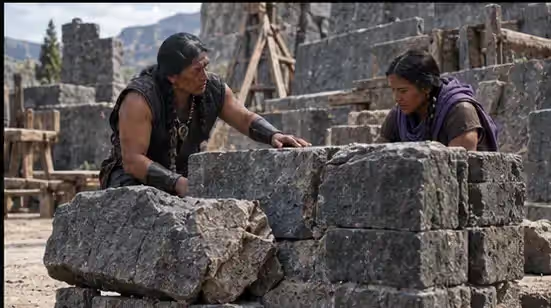
Technical steles and test works of Korath
In front of its barracks, mines and forges, Korath raises steles that keep the memory of patents and accidents. In the lower marches, rounded forts, test gates and vibration halls put inventions to the test of matter and living bodies.
The patent and the accident rather than the skull
In front of a barracks, a mine or a forge, a technical stele keeps the memory of an invention. It gathers casts, failed test head-guards, inventors’ plates, a date, a correction and a limit of use. It is not an ancestral totem: the memory it carries concerns the patent and the accident, not a biological cult of the skull.
The monument extends a rule of Korathi society: the inventor keeps authorship, name and the record of corrections, and public memory also honours the correction of an idea. Monumental patents, accidents and revisions remain legible in the stone as in the registers of the Great Chamber of Patents.
Test gates and forts of the marches
Imported animals stay in the lower marches, and the works that use them are found there too. A test gate, a mine, a workshop for head protection or an academy in these marches can receive sacrificial blocks, rulers, impact marks, test head-guards and veterinary stalls. The approach is straight and followed by a long deceleration, and observers stand in side galleries. No city gate is rammed every day.
The forts, depots, animal yards and test posts of the lower marches take the form of rounded hulls set within a square grid. Turning yards leave a free arc for the ankylosaurs’ tails; niches, built-in benches and timber bumpers reduce obstacles. Impact trials are run on straight tracks or orthogonal circuits, with separate outward lane, return lane, recovery areas and timing.
Obsidian cavities and vibration halls
The rock itself can provide monuments. An obsidian cavity can offer mineral shells, inner light and silence, with no animal presence. Vibration halls, pressure organs and laboratories cut into the rock, such as the Fault Hearts, use stabilised fractures, the black square, obsidian, anchored benches, resonant plates, percussion, quiet niches and wax stoppers.
Reading a stele
A technical stele is read from top to bottom. The top carries the black square and the red disc, a sign that the work belongs to Form containing force. Next comes the invention’s name and patent number, then the list of those who made it: the author, the journeymen who corrected it, and often the counterprovers who attacked it. The marks of the seals follow, then, in a frame cut deeper than the rest, the limit of use.
Around the stone, or in niches carved at its base, stand the objects: casts of the part, failed test caps, fragments of a broken prototype. Korathians learn from childhood to begin with the frame of the limit: before admiring a work, one looks at what it cannot do.
A stele that grows
A Korathian stele is never finished. Each revision accepted by the Chamber adds a line, each accident a plaque, each new limit a frame. The oldest, in front of the great barracks or the historic mines, have become true walls of stone covered with generations of inscriptions, on which one can follow a mechanism’s history from one correction to the next.
When the patent returns to the Mountain, a mark says so on the stele, and the names of licence holders are no longer engraved, leaving only those of the authors. When a work is dismantled, the stele stays where it is: Korathians hold that technical memory must not vanish with the object, since its lessons still apply to those who will build the next one.
Accident steles
Serious accidents have steles of their own. They stand on the very spot, at the entrance of a collapsed gallery, at the foot of a bridge that gave way, in front of a door that closed too late or too early. On them are engraved the date, the cause established by the inquiry, the correction that followed and the limit of use drawn from it, along with the names of the dead, each with the statement that their square is closed.
These steles do not seek a culprit to expose: they state what was learned. Journeymen take apprentices to them before entrusting them with a work of the same kind, and some pass teams stop in front of them before a delicate manoeuvre. For a Korathian, forgetting an accident would be a second fault, worse than the first.
What foreigners see in them
Foreign students trained in Korath discover the steles in their very first days. Many come from countries where dynastic statues, battle monuments or effigies of sovereigns are raised; here, in the same place, they find lists of corrections and limits. Some see humility in this, others an obsession with error.
Korathians reply that the stele is a tool before it is a monument. It lets a journeyman arriving in an unfamiliar mine learn in a few minutes what the work can withstand and what it has already cost. Former students often leave with this habit, and small limit plaques written in the Korathian manner are sometimes found in foreign arsenals.