

Families and social ties
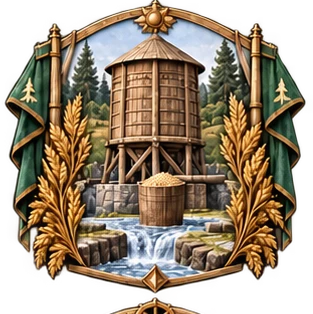
The Karnil Line
The memory of the Upper Ford silos predates Unification.
Silos before Unification
Karnil is the oldest Line of the Upper Ford silos, predating Unification. Its name belongs to Sarnor’s High Lines, each responsible for an industry rather than the whole duchy. This age gives the reserves a family memory of their own: the continuity of storage does not begin with the imperial administration that now incorporates it.
Grain has several responsible parties
Karnil holds silos in a duchy where the Orlenox do not own every reserve. Ulmen is associated with seed and draught lineages, Corsen with irrigation works, Tanoris with rations and convoys, and Marlen with mills. Storage sits among complementary responsibilities: preparing production, preserving harvests and making grain usable or transportable.
A reserve carries a name
The Line gives responsibility an address. The principle applies to stocks as well as manufactured components: people know which door to approach when a product fails its purpose. For Karnil, the silos’ historical depth belongs to this organisation of work and transmission. An old name remains bound to the practical obligations of what it supplies.
The Upper Ford is not the Gué-Long
The cathedral granaries of the Upper Ford, held by Karnil, are not to be confused with the Gué-Long, the cathedral granary of the ducal House. The Orlenox hold perhaps a fifth of Sarnor’s capacity; Karnil is one of the granary Lines that hold the rest.
The silos of the Upper Ford
Silo-cathedrals are counted by generations, according to when and how they were built. Those of the Upper Ford belong to the oldest: lower and wider than recent silos, their limestone walls are so thick that a man can stand upright in the opening of a ventilation chimney. The following generations gained height, vats and doors; the Karnil kept theirs, which they repair stone by stone rather than replace.
Each silo is a cliff pierced with doors, set on high ground to escape the floods. Inside, stacked vats take grain from above; chimneys move the air from bottom to top, and the smell that comes out of them tells the state of the grain before anyone opens a register. The Karnil know each vat by name and history: the one that takes in damp in the great rains, the one that is always emptied last.
Smelling, probing, measuring
A silo is inspected by the nose before the registers. Sound grain smells dry and of soft dust; damp grain smells of earth and ferment, a smell that rises through the storeys by way of the chimneys. Then comes the probe: rods of jointed wood screwed one to another and driven into the mass of grain, then drawn up to read what they bring back. Custom has it that the first three heights are probed, because grain is checked from the top.
The Karnil are credited with a habit older than that custom: probing down to the foot of the vats at least once a year, even when nothing requires it. Load surveyors then calculate the real volume with cord and plumb line, vat after vat, and compare it with the official gauges. An imperial inspection must give the silo twenty hours’ notice, the legal minimum; the Karnil boast that they have never needed those twenty hours.
An entry older than the Empire
The Karnil entry dates from the time when Sarnor was an independent farming Crown. When Unification absorbed the kingdom, the new duchy’s Register of Trades copied the old entries rather than reopening them: the Line kept its rank of seniority, and its name stands at the head of the silo Lines. The first page has been recopied so many times over the millennia that nobody knows what the original looked like any more, but each copy mentions the one before.
This past gives the Karnil a particular way of counting time. They readily speak in generations of silos rather than in reigns, and point out that they were keeping grain before the Vael-Orûn ruled the Empire, and even before the Empire existed in its present form. The name itself belongs to Sarnor’s agrarian layer, recognisable by its ending in -il, just as the ducal House’s name carries the ending -ox.
The trades of a silo
Dozens of trades work around a silo Line. Probers check the grain; ventilators open and close the chimneys according to wind and season; sack weavers and jar potters supply the containers; porters carry the grain up the ramps to the high vats. Fire watchers keep guard at night, because a burning silo can smoulder for weeks. Others hunt the insects and small saurians that come to feed in the vats.
The armed guard of the granaries falls to the Silo Pikemen, originally recruited among Sarnor’s keepers and trained to stop a panicking animal before it tramples a harvest. The Karnil quarter them at the foot of the towers. Below the high Line, the families of these trades form Lines or short Lines of their own; some have served the silos of the Upper Ford for as long as the Karnil themselves.