
Places and landscapes
Muu-Shanga: the Marsh City
The seat of central power, among human corridors and changing waters.
A city within the living continent
Muu-Shanga is the great Marsh City and seat of the Circle of Balances. It belongs to a country of mangroves, basins, deltas, canopies and estuaries. Human presence occupies corridors and archipelagos while much of the territory remains wild. The city’s name identifies a meeting centre within this discontinuity.
Muu-Shanga
La grande Cité des Marais s’étend entre eaux basses, racines et longues ramures. Le Cercle des Équilibres y tient son siège.
Routes enter the registers
In Muu-Shanga, the Circle brings together registers, routes, recognitions and assemblies. It serves an ultra-centralised power around Sûma. A passage or mobilisation receives its official recognition there. The city gathers the institutions that make common action possible, in the face of a clandestine opposition.
Permission has a body
In N’Goro, crossing territory requires knowing when, how, with which potion and under whose protection to proceed. Muu-Shanga arbitrates within this world of thresholds. A route involves water, season, filters and the condition of bodies; recognising a passage must remain responsive to the environment making it usable.
The three heights of the mangrove
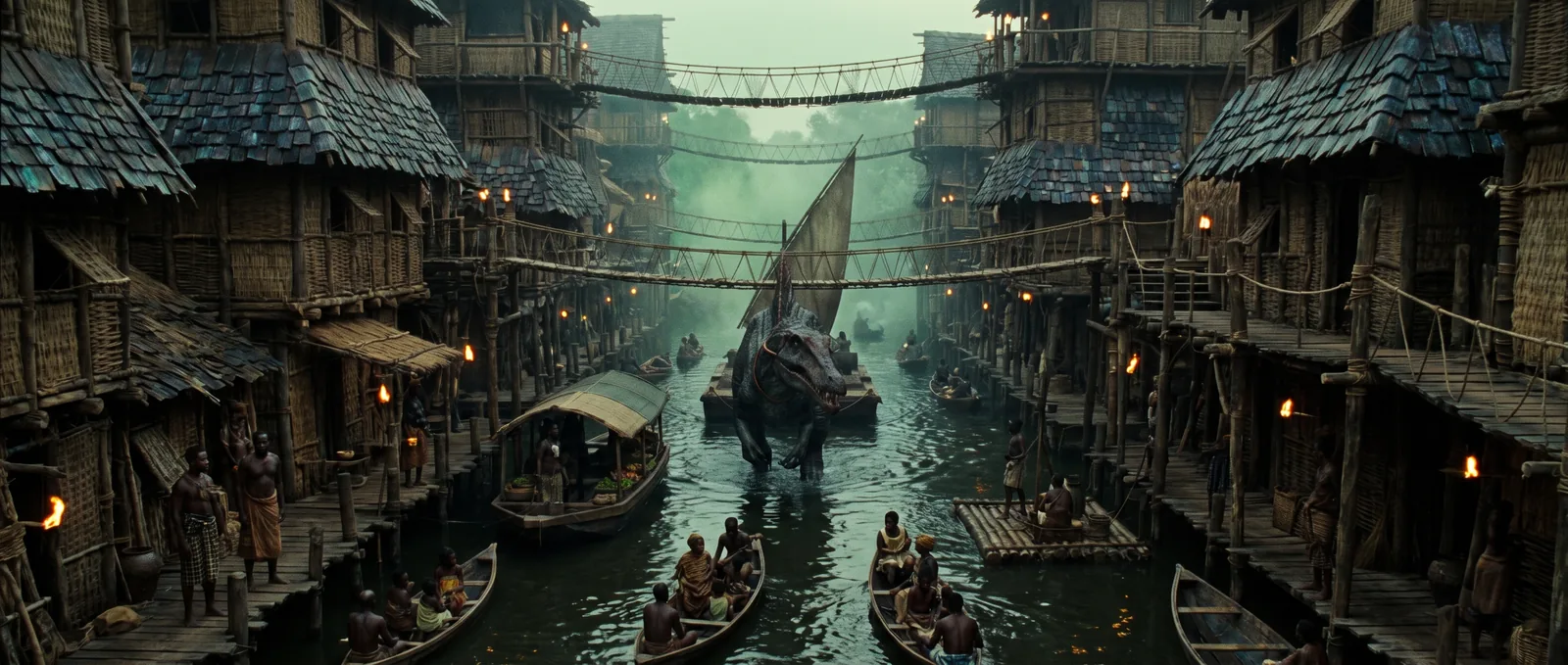
Muu-Shanga’s cyclopean mangroves offer root caverns, arches and platforms to human settlement. The city reads on three heights. The low waters gather submerged roots, ports, floating villages, fishers, smugglers, parasites and spinosaurids. The middle world of the Longues Ramures holds canopy towns, schools, markets, insect houses and suspended routes. The High Canopy shelters medicinal crops, resins, fruit, luminous organisms and lookouts, exposed to dangerous winds.
Moving from one level to another requires knowing the accesses and protections. A high post does not replace knowledge of the waters passing below.
The centre of mobilisation
N’Goro has about 1.3 million inhabitants and answers to an ultra-centralised power under Sûma. It is from Muu-Shanga that this power mobilises: Sûma calls up the Sèveurs, the fisher-trainers and the ports from there, and it is from there that the Marche d’Écume, the estuary’s rare amphibious mobilisation, is ordered. The Black Milk Houses and the Insectophiles, clandestine opponents, remain an internal risk.
A city older than its stories
The name Muu-Shanga carries the linked, damp sound of the N’Goro tongue, with its nasals and its soft “sh”, and boatmen pronounce it drawing out the first syllable, like a call thrown across the water. The city is held to be one of the oldest human presences on the continent. The Ngoro know themselves to be descended, in a very distant past, from groups that came from Arkhan, and it is said that the first to settle beneath the great roots were people who had stopped fleeing predators in order to learn to live among them.
What is certain is that the Sap-Keepers’ Synod, the oldest of the country’s great powers, claims nearly two thousand one hundred years of tradition there, and that the Circle of Balances has sat there for as long as the registers remember. Muu-Shanga has moved several times, from one root to another, as the waters dictated; its inhabitants say it has never changed city, only bank.
A city that changes size
Muu-Shanga has no fixed population. It is credited with about a hundred thousand inhabitants, and far more at high water: at high water, dozens of Shedding Villages come to moor at its roots to trade, seek care, have their disputes arbitrated or attend the Circle’s great sessions, and the city swells with floating districts that will be gone a few weeks later. At low water, when the access channels narrow, it shrinks back onto its permanent districts.
It is the largest city in N’Goro, a country of about 1.3 million people who live mostly in villages and small island towns. To an Urnok native used to stone capitals, though, it seems less a city than an inhabited forest: one looks in vain for a square, an avenue or a rampart. To a Ngoro, it is the place where one finds everything a country of thresholds can offer — a Sap-Keeper for every ailment, a guide for every water, a House for every debt.
Districts by height
Muu-Shanga’s districts are distributed across the mangrove’s three heights. In the low waters, at the foot of the root-caverns, lie the ports, barge workshops, fish markets, salt stores and poorer districts, where stilt houses touch and the Black Milk Houses hold pontoons and passages. There too, in a great root-cavern, the Circle of Balances sits, as close as possible to the water it arbitrates, not far from the Houses of Thresholds, where water names, First Sheddings and Breath Debts are recorded, and from the Root Platforms, immense wooden terraces laid on the roots of a single tree, the most visited place in the city.
In the Long Boughs are the schools, the hanging markets, the insectaries and the homes of Sap-Keeper and trainer families, linked by living bridges. Higher still, the High Canopy carries the medicinal gardens, the orchards, the resin harvests and the lookouts’ posts, exposed to winds strong enough to tear away a badly lashed platform. One does not pass freely from one height to another: each ascent has its water gates, its guarded ladders and its washing basins.
Living in Muu-Shanga
The city never quite sleeps in darkness. The firefly cages hung on the roots, the oil lamps of the pontoons and the phosphorescent lichens on the bark give it at night a pale green glow that foreigners do not forget. By day one hears it before seeing it: drums carrying the news, boatmen’s whistles, market calls, the beat of paddles. The air smells of resin, the gentle smoke of fumigations, smoked fish and mud.
People eat there as everywhere in N’Goro, knowing that eating can heal or poison: tubers, marsh fish, insects, amphibians and mushrooms, prepared according to the water they come from. Every inhabitant carries a threshold kit, and children learn their first flasks before their first letters. Hygiene rules are strict and enforced by neighbours more than by any police: whoever throws dirty water into a district channel hears about it for weeks.
A city without ramparts
Muu-Shanga has no walls, and has never needed any. To reach it, a foreign army must first cross weeks of marsh, shifting channels and drowned forest, and pass one after another the thresholds of defence: false roads, fevers, mists, mouldy supplies, swarms, diverted canals. Between two powers of the known world there is no frontier but weeks of nothing, and around Muu-Shanga that nothing is alive.
If a force nonetheless reached the city’s roots, it would find evacuated ports, raised bridges, withdrawn ladders and channels held by great spinosaurids and crocodilians that no one truly commands. The registers keep no memory of any foreign army reaching its districts. The city’s captains have a saying: “If the enemy sees Muu-Shanga, we have already lost six times.”