
Armies
The Union des Six-Îlots
A marsh confederation devoted to total defence.
Function and place in war
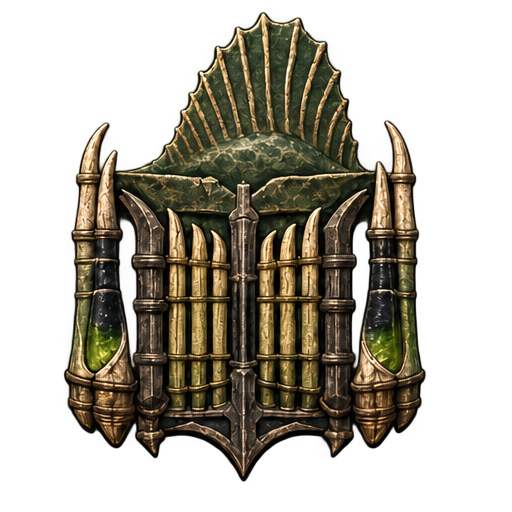
The Union des Six-Îlots is a marsh confederation whose doctrine is total defence.
It shows what the marsh factions are: tiny water sovereignties that no one invades, because people die there of something other than war. Brume-Quatre, a league of common defence, and the water-guard militia of Croc-Amphibe follow the same defensive logic.
Six islets on one lake
The Union des Six-Îlots occupies a large lake in the Overflows, in the east of N’Goro, not far from the border where the marshes meet the High Jungles. Six close-packed islets on stilts stand there a few hundred paces apart, linked by retractable bridges and by a network of marked channels that only their inhabitants know by heart. Each has its speciality: one fishes for all, another tends the floating gardens and the tubers, a third keeps the insectarium, a fourth the herbal workshops, a fifth the boatyards, and the last houses the council, the stores and the great rainwater cistern.
With several thousand inhabitants, the Union is one of the largest of the marsh minors. It is also one of the few N’Goro communities that does not move. Its islets were built on mangrove-wood piles driven into the lake bed, renewed by half each generation, and its families have lived there longer than their Songs of Bones go back. Where a Shedding Village takes itself apart, the Six Islets stay.
What “total defence” means
Since it cannot flee, the Union has organised itself to hold. Every adult on the six islets is a fighter, and each knows which post to run to when the drum beats the alert. Stores are reckoned for a whole season: jars of filtered rainwater, resin-sealed provisions, spore-smoked fish, remedies and counter-flasks. The access channels can be barred overnight by submerged stakes that hole hulls, and the deep passes are guarded by great crocodilians that are fed in the right places without ever being trained.
The Union’s most famous rule is the rule of six. Each islet is built to defend itself alone: when the enemy approaches, the bridges are raised, the walkways cut, and the lake becomes six fortresses separated by black water. If one falls, the other five still hold, and each can take in the survivors of the others through a secret channel. The elders put it this way: “To take the Union, you have to take it six times.”
The council of the six mothers
The Union is governed by a council of six islet mothers, chosen by the families of their island for as long as their strength lasts. The council meets on the islet of the stores, around a well of open water, in the manner of the floating assemblies. It decides by majority on everything touching ordinary life — sharing the catch, upkeep of the piles, receiving strangers — but war demands unanimity: none of the six may commit the others to a fight she would refuse to wage at home.
Total defence is also aimed at an enemy closer than armies. The Union was founded, it is said, to escape the protection of the Black Milk Houses, which tax the routes they guard; six united islets no longer needed anyone to hold their channels. It is entered in the registers of the Circle of Balances, renders its services to the quarantines and lodges its counter-flasks, but it pays no House and tolerates none on its lake. Its neighbours in the High Jungles, who hold a canopy front against those same Houses, regard it as a natural ally.
The price of staying
The rest of N’Goro looks on the Union with a mixture of respect and puzzlement. The country’s doctrine teaches that a water one keeps is worth more than a bank one wins, and that a place is abandoned rather than lose one’s people there. The Six Islets do the opposite, and pay the price: when a fever reaches the lake they cannot leave, and their registers of mourning are longer than those of the mobile villages. Their children learn to swim between the piles before they can walk, and to read the channel marks before their first letters.
People of the Union are said to be “stubborn as a pile”, and they take it as a compliment. Merchants who come to buy smoked fish or boats find the welcome slow and the inspections fussy; those who have seen the six islets raise their bridges at the same moment, at the sound of a single drum, no longer speak of it in the same way. Croc-Amphibe, which holds fords, and Brume-Quatre, which falls back into the mist, defend their waters differently; the Union merely reminds everyone that N’Goro also has people who do not leave.