
Places and landscapes
The Foam Marches
The estuary connects fisher-trainers, marine waters and great spinosaurids.
The estuary meets the sea
The Foam Marches form N’Goro’s estuarine and maritime interface, in contact with Volonia. They are the territory of fisher-trainers. Waters and trades meet there: passage towards the sea belongs to an environment where living bodies, currents and knowledge of places together determine whether movement is possible.
Flotillas have their affiliations
House Nala-Vey is a great peripheral lineage of fisher-trainers, flotillas and spinosaurids in the Foam Marches. Its peripheral presence remains subject to the central power of Muu-Shanga. A presence on the water thus connects trade, affiliation and material capacity.
Preparing the place with the animal
Great spinosaurids serve fishing, estuary work and rescue. Their training prepares smell, territory, food, rhythm and potion. Trainers therefore work on the environment as much as on the animal relationship. Siirmuu remains a great living body with needs and reactions; crossing an estuary must account for its actual presence.
The Marche d’Écume
The Marche d’Écume, which takes its name from the region, is a rare amphibious mobilisation. Ordered from Muu-Shanga, it engages Nala-Vey, the Sèveurs, the trainers and the ports. The spinosaurids do not advance in line: smells, waters, food, villages and currents draw their movements together in the estuary, and the trainers prepare the conditions of that convergence rather than command a mechanism. The intervention of the great animals concludes a defence already engaged through routes, bodies and supply.
The Harvest Guilds
The Marches d’Écume, in contact with Volonia, are the domain of the Harvest Guilds: they draw foam, fish and remedies from the coast, and serve as a maritime interface.
Where the foam forms
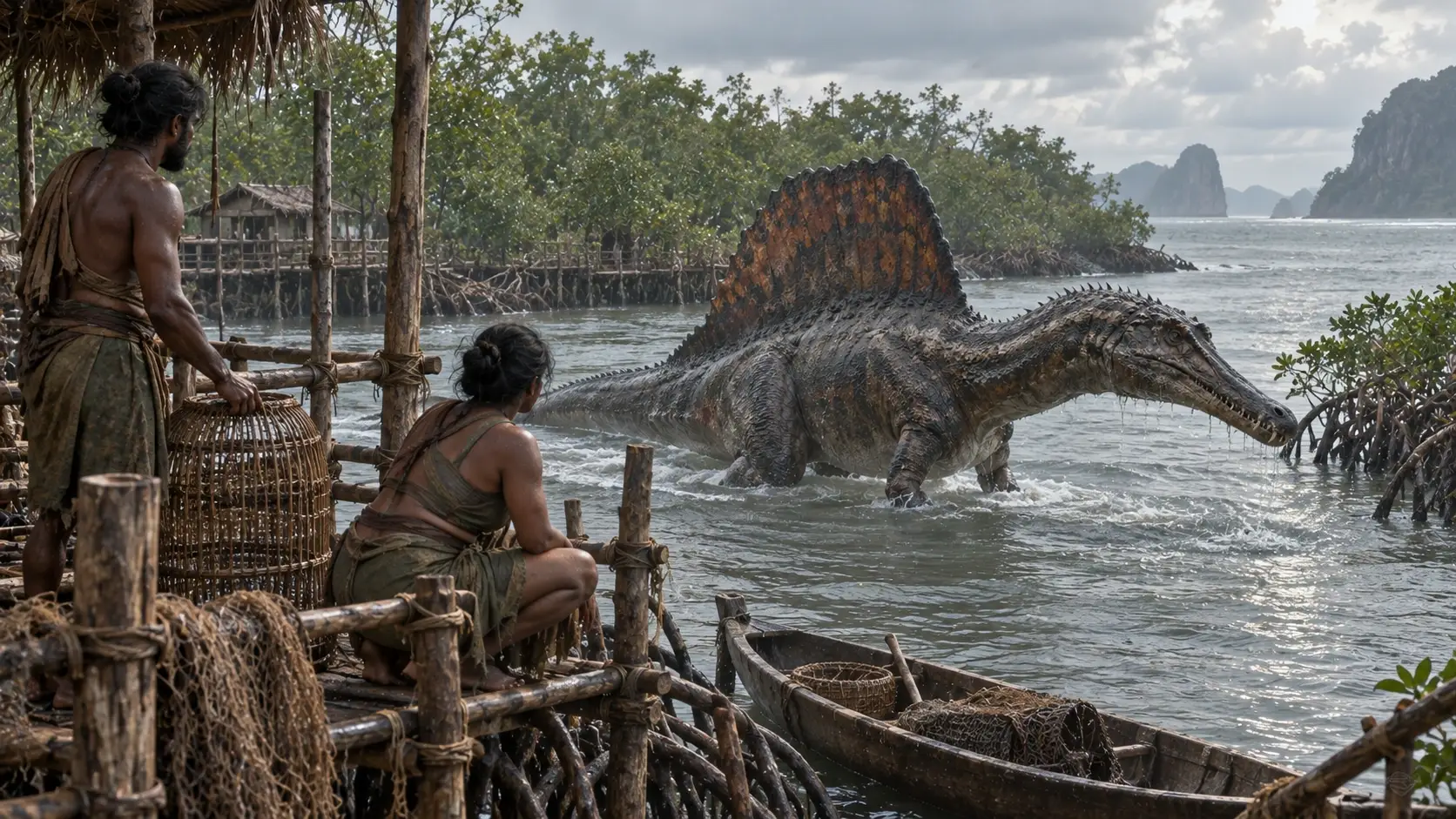
The Foam Marches take their name from the long lines of yellowish foam that form where the black waters of the rivers meet the tide. The water is brackish and changeable, saltier at high tide than at low, and each arm of the estuary has its own taste. Shifting sandbanks, mudflats, half-submerged root forests and deep channels follow one another along dozens of leagues of coast, with no clear border between land and sea.
The region is the most open in N’Goro, and the most exposed. Through it come Volonia’s ships, sea fish, salt and news from offshore; through it, too, a maritime invasion could come. Villages there are larger than elsewhere, built on taller stilts to withstand storms, and their inhabitants are reputed to be more talkative and more given to trade than those of the interior. It is on the coast of Yveth, facing Volonia, that the House of Nala-Vey has its base and its spinosaurid quay.
The contact with Volonia
The Foam Marches are the main point of contact between N’Goro and Volonia. The two powers complement and mistrust each other: Volonia moves people, animals and goods, N’Goro decides what may cross. Their relations pass through the Quarantine of Vaesh, a Volonian military and sanitary order: N’Goro supplies the biological knowledge, Vaesh the caging, and each expertise keeps watch on the other.
On the quays the encounter is very concrete. Volonian sailors must show their holds to the inspectors, declare their ports of call and leave ashore the beasts they carry; the Ngoro, for their part, load neither seeds nor live insects without protocol. Both sides complain a great deal about the other’s slowness. They trade all the same: venoms, antidotes, glues and anti-rot leave for the ports of Volonia, and leathers, metal and foodstuffs come back.
Fishing with the Siirmuu
Fishing is the first trade of the Foam Marches, and the great spinosaurids take part in it. The best-known technique is the drive: a Siirmuu, guided by the scent and rhythm its trainers prepare, slowly works up a channel lashing the water with its tail, and the shoals fleeing before it are caught in nets stretched by barges at the mouth. The animal receives its share of the haul, and it is often the largest.
The same beasts serve for rescue. When a barge capsizes in a current or a dugout is caught by the tide, a spinosaurid used to human teams can bring a castaway back to the bank or drive off a great crocodilian. The fisher-trainers never pilot these animals: they prepare scent, territory, food, rhythm and potion, and accept that a Siirmuu will refuse a task on a day when the water does not suit it.
Defending the estuary
The estuary is the only frontier of N’Goro a fleet can reach, and its defence is designed accordingly. The deep passes are known only to local pilots, the banks shift from one season to the next, and the beacons are removed at the first sign of danger. Foreign fleets, impressive on the high seas, find themselves here prisoners of the tides, stranded on banks or committed to channels where their hulls cannot come about.
If the threat persists, the central power can order the Foam March: the estuary’s spinosaurids then converge, drawn by the scents, waters and food the trainers prepare, on the places where the enemy is already weakened. The people of the coast say the sea brings everything, enemies included, and that the estuary decides what it keeps.