
Power and institutions
The Circle of Equilibria
In Muu-Shanga, a centre serving an ultra-centralised power.
The centre keeps recognitions
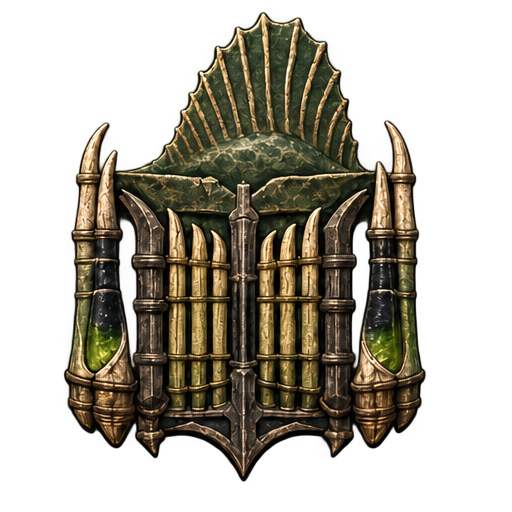
The Circle of Equilibria is an arbitration centre in Muu-Shanga. Registers, routes, recognitions, assemblies and negotiation between blocs form its function. It provides a central place for relationships crossing the country. Routes and affiliations meet in its arbitration work within an ultra-centralised power around Sûma.
A centre that commands
The Circle belongs to an ultra-centralised power around Sûma. The Insectophiles and the Houses of Black Milk form a clandestine opposition to this centre. The detail of the means the centre mobilises directly remains poorly known.
Passage involves several powers
The Sap-Keepers’ Synod can close routes through its health protocols. Carriers, canopy networks and animal holders possess other means of action. The Circle’s work sits among these complementary capabilities: a recognised route, a biologically usable passage and the means to travel it involve different actors. The Circle coordinates these capabilities on behalf of the centre.
Opening, closing, protecting a passage
N’Goro’s sovereignty shows itself when a passage can be opened, closed or protected, with the knowledge and means needed to cross it. Sûma, a leading figure of the Circle and of the Sap-Keepers’ Synod, commands from Muu-Shanga a highly centralised power that is not a hereditary kingship; she can close a region. The Sap-Keepers, the fisher-trainers and House Nala-Vey answer to this power.
The Circle and the children’s flotilla
The Circle officially refuses to own the children of the autonomous flotilla, the orphans, survivors and adolescents who occupy spaces too light or too narrow for adults. The other institutions treat them unequally: the Synod cares for them, the Knotters recruit them and the Houses feed them, sometimes while exploiting them.
The hall around the water
The Circle meets in Muu-Shanga in a great root-cavern of the low waters, widened and shored up over the centuries. At its centre a well of open water connects with the channel; around it, tiers of black wood and carved roots form a complete ring with no place of honour. The layout echoes the floating assemblies of the Shedding Villages, where barges line up in a circle to decide: everyone speaks looking at the water, and the water looks at no one in particular.
Sûma sits on the same ring as the others. What sets her apart is not a throne but the order of speaking: she is heard last. Near the well, a filter of sand and fibre stands permanently; grave declarations are made before it, and everyone knows that lying there is a profanation. Oil lamps and firefly cages light the hall, whose damp means the tiers must be re-varnished every season. Foreigners admitted to sessions mostly notice the silence: no one applauds; to approve, one strikes the wood twice with the flat of the hand.
What the registers hold
The Circle’s registers are written in spore ink on varnished fibres, which glow faintly in the dimness of the hall, and doubled with knotted cords for whatever must be read by touch. They hold four kinds of things. Routes first: every recognised passage, the date of its last reading, its closures and their reasons. Then recognitions: the Shedding Villages admitted to a basin, the authorised guides, the messengers the Knotters’ network protects.
Last come the accounts of the living and those of substances. The Circle keeps the census of the country’s hundred and twenty great spinosaurids, with each one’s water, trainers and condition; it also keeps a copy of the list of counter-flasks deposited with the Sap-Keepers, without the flasks themselves. These registers are never held to be final: a route read two seasons ago is entered as old, and a guide who has not renewed his proofs loses his recognition. The rule comes from the liquid maps: what was true yesterday may be dangerous tomorrow.
The blocs it holds together
The Circle was born to negotiate between blocs that do not resemble one another. The Sap-Keepers’ Synod holds health and closures; the Conservatory of Yveth, plants, grafts and the balances of the living; the House of Nala-Vey, the fisher-trainers and the spinosaurids of the estuary; the League of Master Carriers, barges and ports; the Knotters, vines and messages. Beside them live forces that no register fully contains: the Insectophiles, breeders of centipedes, arthropods and swarms, and the Black Milk Houses, who together form the clandestine opposition.
The centralisation of power around Sûma has not made these blocs disappear; it has arranged them around a single ring. Each sends delegates — mostly women, in this military matriarchy — who sit in plenary session twice a year, at the changes of water, and in restricted session as often as the routes require. The Circle officially refuses to own the children’s flotilla, which does not stop it from discussing the flotilla at almost every session.
The Circle when war comes
When a foreign army approaches, the Circle becomes the hall where the seven thresholds of defence are coordinated. It does not fight itself: it allocates. This region must lose its guides and see its maps go unfed; that port must close; the Sap-Keepers must prepare the defenders’ counter-doses and leave the invader to face fevers and irritations alone; the Insectophiles, if they agree to answer, must move their colonies; the dyke keepers must raise or lower the waters.
It is also from Muu-Shanga that the Foam March is ordered, the estuary’s rare amphibious mobilisation, which requires the Circle, Nala-Vey, the Sap-Keepers, the trainers and the ports. The order is not enough to set it off: waters, food and currents compatible with the great animals are needed, and the Circle spends more time counting those conditions than proclaiming the mobilisation. Its war registers record fewer battles than thresholds crossed by the enemy, and what each one cost him.
Dealing with the Circle
Foreign envoys quickly find that one does not present oneself to the Circle as to a chancellery. Before any audience they pass through the Control Basins, where their bodies, clothes and gifts are inspected; a living gift — seeds, eggs, insects — is almost always refused or held in quarantine. The audience comes afterwards, often after several days of waiting that foreigners take for contempt and the Ngoro regard as simple caution.
An agreement concluded with the Circle binds the Sap-Keepers, the fisher-trainers and the ports; it protects against neither the Black Milk Houses nor the Insectophiles. The Volonians have learned this and negotiate in parallel with the networks of the Bay of Roots; Urnok envoys, used to an institutional depth in which one seal binds a whole empire, complain about it readily. The Circle always answers the same way: it guarantees what it has read, not what the marsh will decide.