

Places and landscapes
The Croc Fendu
A tavern in the lower city of Urnok, kept by Mako Bel-Teren: the crossroads of the capital’s common people, where soldiers, clerks, merchants and spies pass through.
A room in the lower city
The Croc Fendu is a tavern in the lower city of Urnok. In a capital whose heights hold the palace, the archives and the banks, its room belongs to the levels where ordinary people live and work.
It is the crossroads of Urnok’s common people: soldiers, clerks, merchants and spies pass through. The room gives distant decisions a human scale; the war is felt there in the price of a tankard and the weariness of the customers.
Those who keep the room
Mako Bel-Teren keeps the tavern. He sees everything pass and protects people by forgetting out loud: “I saw nothing” is his phrase. Elyra Noss, who works for him, is the legs and ears of the room; she names what Mako pretends to forget.
The regulars complete this small world. Iryem Sada, a neighbourhood go-between, “knows a man for that”. Nala Vey, a healer from N’Goro, measures out her remedies in the room, for customers and wounded soldiers alike. Nérian, a student, comes there to boast. Mako knows what fodder really costs: Zaya Meron, the merchant who supplies him, tells him.
The fang on the sign
The tavern owes its name to the object hanging above its door: a great predator’s tooth, as long as a forearm and split along its whole length. No one agrees on where it came from. Some say it was taken from a carnivore killed on an imperial road several generations ago, others from an arena beast; one regular swears it was bought from a march trader, and Mako never settles the matter.
The tooth serves as a landmark in the lower town, where painted signs soon fade under the soot. People arrange to meet “under the fang”, and messengers looking for the place ask for the tooth rather than the name.
At the foot of the avenue
The room lies in the lower town, at the foot of an avenue where the great animals pass, among the service ramps, the low canals and the first workshops. Its customers keep the district’s hours: guards after the change of watch, carters when the night convoys arrive, clerks at the end of the day’s writing, collectors before their round. The room is never empty for long, but it never fills twice with the same people.
On days when the colossi pass, the street is closed and the tavern fills with those waiting for the road to reopen. These hours of waiting are among the house’s best takings, and Mako knows the calendar of passages better than many Chancellery scribes.
An exchange of small news
The Croc Fendu passes on the news of the lower town. A sheet of the Petit Fourrage, the chronicle of prices and sentences cried out in the relays, is read aloud there in the evening, and its jokes are repeated the next day. One learns which convoy is late, which regiment has been ordered to stand ready, what a bale of fern costs this week: put end to end, these small pieces of information tell the state of the Empire better than a court speech.
That is why spies come too. They listen more than they talk, and Mako pretends not to recognise them. The soldiers know it and keep quiet about the orders they have received; they talk freely, on the other hand, about the price of rations, which is often more revealing.
Seen from the upper town
In the upper town, the Croc Fendu passes for a popular and slightly suspect place, where one does not go without a reason. Synod students nonetheless go down there to give themselves airs, and some clerks from the heights meet the friends of the district they grew up in. In the lower town, by contrast, it is a respectable house, where one can leave a message, find lodgings or be recommended for night work.
The tavern survives crises because it sells cheaply and keeps its regulars. When the price of fodder rises, the tankard rises too, and it is often at the Croc Fendu’s counter that the lower town realises a war is coming.
Days of departure
When a legion leaves the capital, the Croc Fendu fills up the evening before. Soldiers drink their last tankard in town there, families come looking for a face, and Mako closes later than usual. In the weeks that follow, it is where people come to hear news of the campaign, read from the relay sheet or brought back by a carter returning from the road.
The room also keeps a trace of those who are away. Soldiers leave at the counter an object they will collect on their return, a belt buckle, a tablet, a small bronze gauge; some of these objects have waited on a shelf for years, and no one dares to move them.
Part of this article covers events of season 1. Turn spoilers on in the menu to read it.
Gallery1 image
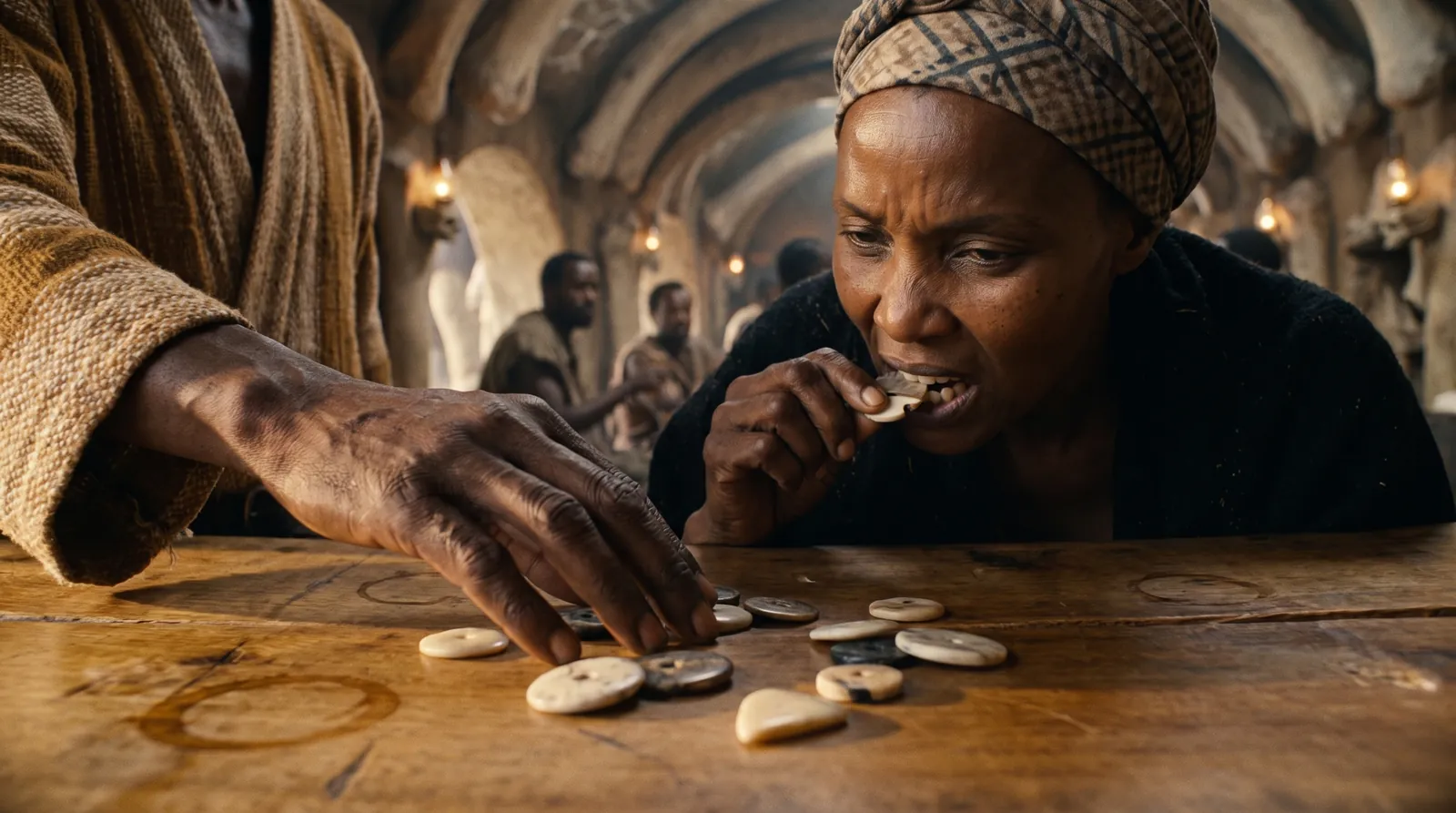
Zaya Meron bites a coin as Iryem spreads coins from every duchy.