

Creatures
Lomvar: the forest stegosaurs
Breeding, training and logging connect Orlantis animals to timber workshops.
The emblem belongs to a working chain
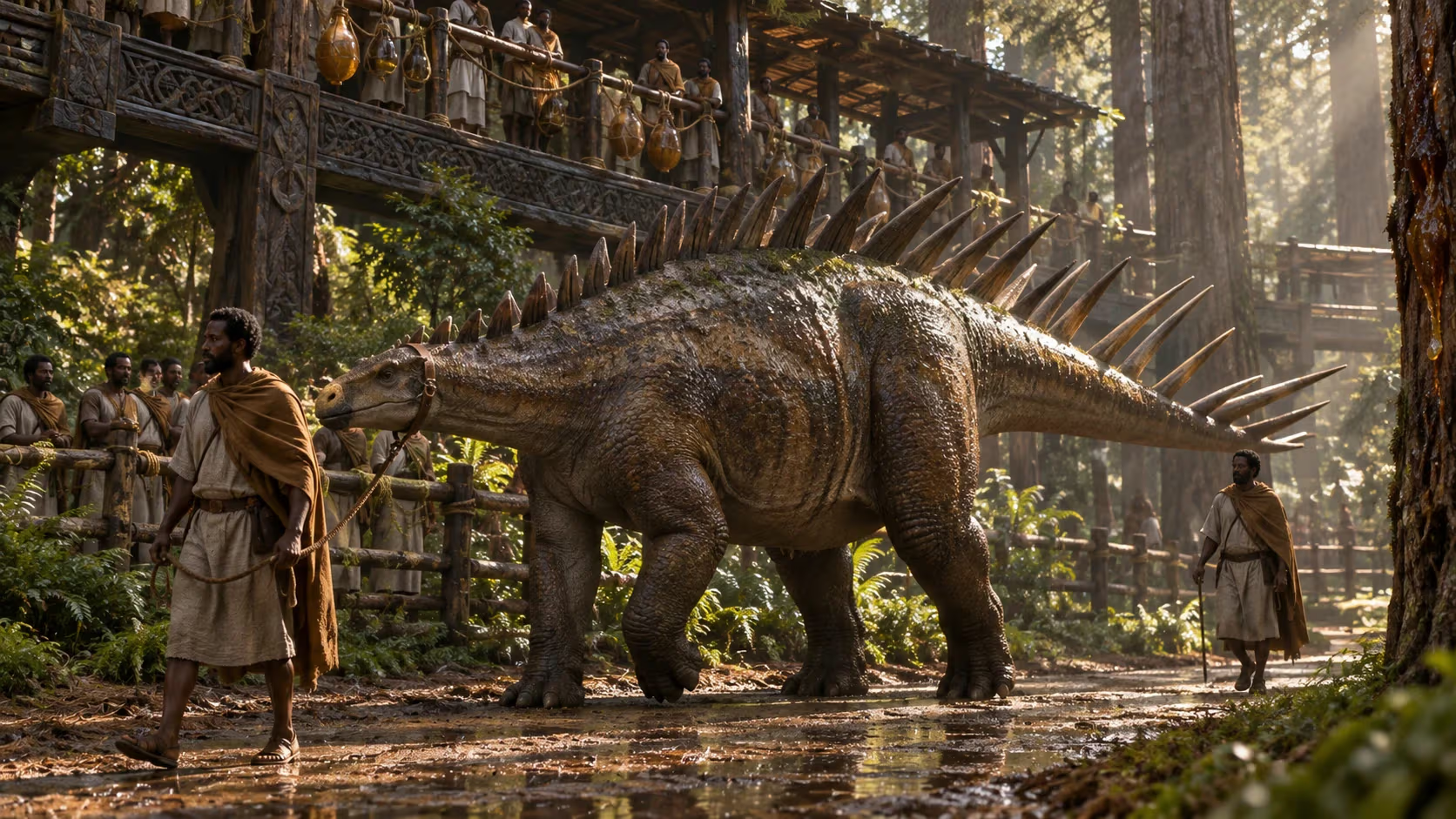
Lomvar handles stegosaurs: breeding, training, harnessing and logging. The family responsible for the emblematic animal is not the ducal House Voranis. Ducal prestige thus stays separate from the daily work making the animal usable. Imperial stegosaurs belong exclusively to Orlantis; no black Velmor variant enters this chain.
The animal goes around the town
Plates that need care
Orlantis has veterinary centres with ramps, drains, non-slip surfaces, inspection platforms, brushes and ointments. The plates are cared for like the rest of the body: they are no magical mechanism. Their exact thermal role remains poorly understood, and neither a setting nor a belief is enough to explain it.
Laying out the track before the animal
A stegosaurid does not wander through the high forest: it follows a prepared track. Before each felling, a track master of the Line walks the plot with the Berlan marker who chose the trees to be cut. Together they lay out the route the logs will follow to the landing: wide enough for the animal and its load, straight enough that the tail does not strike trunks on the bends, with turning pockets every few hundred paces. A stegosaur track needs three metres of clear passage; a dacentrure’s, whose shoulder spines catch on bark, needs four.
Track crews fell the young trees in the way, fill the ruts with faggots and lay logs crosswise on slopes so that feet do not slip. Some large trees are left standing along the route, notched with a mark of the Line: these are the guard trees, around which a holding rope is passed when a log threatens to run away downhill. A well-made track serves for several years and is entered in the felling register; a badly laid one is recognised by stripped bark and the cracked plates that arrive at the thermal gardens in the evening.
A day, twenty logs
Lomvar masters count in logs brought out. A stegosaur in good condition brings fifteen to twenty-five logs a day from the felling to the track, each weighing one to two and a half tonnes on its sledge. A dacentrure brings out somewhat fewer, but it works the wide fellings and heavy ground where the stegosaur struggles; a kentrosaur, smaller, brings out poles and light logs from the tight fellings where the big ones cannot pass. Each team therefore combines the three genera according to the plot, as a carpenter chooses his tools.
The day follows the animals’ bodies. Work runs from dawn to midday, then comes the long fodder break, and work resumes until evening for a few more hauls. The season matters as much as the hour. During the rains the forest floor grows too soft: teams fall back to the higher plots or leave the animals at the studs. The dry season is the time of the great haul-outs, when the landings along the rivers fill with stacks of timber waiting for the flood that will carry them downstream.
A link between axe and port
Log-hauling holds a precise place in Orlantis’s chain. The Berlan mark, fell and limb; the Lomvar bring the logs out to the landings; the Berlan take them back for floating; the drying sheds, the Tolmen turners and the Mirvane carpenters transform them; the Marlen port ships what leaves for Volonia. The Lomvar are paid per log brought out, at a rate they negotiate each season with the Berlan that takes account of slope, distance and the average weight of the timber.
The Line itself depends on its neighbours: Nalen ropes, leather tanned with Tanoris tannins, Corvel glues for the harness, Aversin balms for wounds. When one of these links fails, the forest keeps its timber. The duchy puts it in a form every carpenter knows: “a winter without stegos is a summer without framing”. The Lomvar take a quiet pride in it, and a certain ease in obtaining credit from the Lines’ bank, which knows that without them felling letters are worth nothing.
The law of the tail
Log-hauling accidents have their own law. Around each working animal the Line marks a tail zone on the ground or on the trunks that no one may enter, and the felling register names the handler answerable for it that day. If a passer-by, a woodcutter or a child crosses the mark and is struck, the Line first examines the mark: was it visible, was it at the right distance? A badly placed mark engages the handler; a mark crossed despite the warning engages whoever crossed it.
The Line’s injured are not abandoned. A share of every log payment goes into a tail fund, which pays a pension to the maimed and to the widows of handlers killed at work; Lomvar families have paid into it for generations. Tail scars, long gashes on thighs and calves, are worn without shame. The elders say that a handler without one has not yet worked enough, or has been lucky, and that one never knows which.