
Places and landscapes
The Fault Hearts
Concert halls carved around stabilised fractures.
The fracture becomes a hall
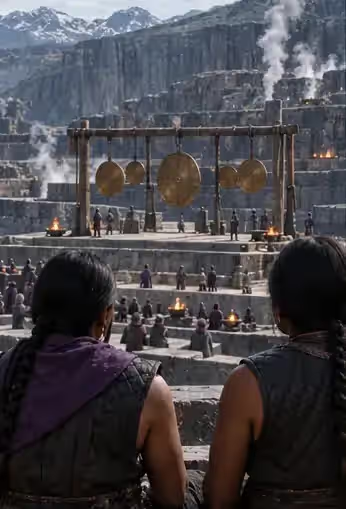
The Fault Hearts are great halls carved around stabilised fractures. Square stages, circular shafts, steam, pressure organs and visible magma shape their space. The cavity gives Korath’s nightlife a collective scale: a concert gathers a crowd in a place whose forms and materials remain tangible.
The crowd waits for the signal
Korath dancing alternates collective stillness, geometric movements and an explosion at the fault’s signal. This waiting belongs to a civilisation where daytime pressure continues into alcohol, dance and nightly concerts. Rhythm gives the place a function: the crowd must be able to hear, wait and then move together.
Anchoring and making room for listening
Anchored benches, resonant plates, percussion, quiet niches and wax earplugs equip these cavities. Obsidian and the black square give the hall its material character. Listening has several intensities: the place can gather people around a resonance while also offering space to withdraw from it.
The country’s largest halls
The Cœurs de Faille are Korath’s largest halls. The people who prize patience and precision gather there for an experience of movement and intoxication. Like clubs, theatres and taverns, these halls fall under a general rule of the country: every major civil infrastructure also has a defensive use.
A night at the Fault Hearts
One enters a Fault Heart through an airlock, after descending long galleries where the heat rises at every landing. The hall opens all at once: an immense cavity around a stabilised fracture, tiers cut into the basalt, a square stage and, further off, behind walls of thermal glass, the glow of the magma. Spectators take their places on benches anchored in the rock, which do not move when the crowd starts dancing.
The evening begins with percussion, in geometric patterns that answer each other from one end of the hall to the other. Then comes the wait: the whole crowd freezes, sometimes for several minutes, in a silence broken only by the pressure organs. At the fault’s signal, steam bursts out, the magma brightens, and the hall explodes into dance. At dawn the dancers climb back towards the warm city; many will be at the workbench a few hours later, and a Korathian who arrives late after a Fault Heart finds no indulgence.
The fault master
The fault master manages the hall’s heat, steam, stage and volcanic safety. The trade links three worlds: the club, since he directs the show; the forge, since he handles pressure and temperature like a founder; and religion, since the fault’s signal stages the force of the Magma contained by Form.
During a concert he stands in a technical box from which he can see the stage, the pressure gauges and the vents all at once. He decides the moment of the signal, in agreement with the musicians, and he can also stop everything if a gauge goes wild. Great fault masters are discreet celebrities: the audience never sees their faces, but it recognises their way of making a crowd wait.
The music of the fault
The music of the Fault Hearts is made for the cavity. Percussion is played in geometric opposition, two groups answering each other from either side of the square stage; pressure organs blow deep notes that are felt in the chest more than heard; resonant plates fixed to the walls prolong every stroke. Bronze strings, like those of Helvast’s thunder guitar, the national star’s instrument, find in these halls a power they would have nowhere else.
Each workshop has its songs, which its supporters take up in chorus between pieces, and great concerts often mix stage music with these crowd songs. The popular press reviews the evenings, compares fault masters and follows musicians as it follows inventors: their moves from one hall to another give rise to the same rumours as the workshop transfer market.
Drinking, and knowing when to withdraw
People drink a great deal in the Fault Hearts. Forge beer, thick and cheap, is the drink of the many; the rare wines of the heated vineyards, reserved for the boxes, cost a month’s work. The hall taverns also serve hot dishes of mushrooms and smoked meats, to last until morning.
Yet the hall provides ways to get away from the noise and the drunkenness. Quiet niches carved into the walls welcome those who want to talk or rest, and wax earplugs are handed out at the entrance. Korathians see in this arrangement a form of their wisdom: celebration is allowed, but one must always be able to come back from it, as the First Glass that marks entry into adulthood reminds them.
A hall that also serves defence
Like theatres, taverns and workshops, the Fault Hearts have a defensive use. Their immense volume makes them assembly places where a district’s reservists can be gathered within hours; their water reserves and airlocks allow them to shelter a population while neighbouring districts are closed. The pressure organs, able to make a whole cavity vibrate, can also serve as an alarm heard through the rock.
Korathians find it natural that their places of celebration should also be places of war. In a country with the highest ratio of active soldiers and reservists among the great powers, the same people dance at night and report to their posts at the first signal; the hall where one waited for the fault’s signal is often the one where one will wait for the order to march.