

Religion and rites
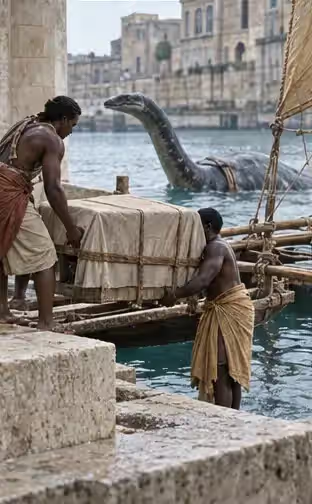
Volonia: returning to the sea
Returning to the sea structures mourning; witnesses, contracts and debts give it a form.
Returning to the sea
The Volonian dead return to the sea. This orientation gives mourning a decisive place in a civilisation of maritime circulation. Dying far from the sea and being unable to return acquires a particular cultural weight. Returning to the sea guides the rite, while the ceremony’s gestures vary with houses and circumstances.
Witness, bell, deed
The body may be entrusted to the sea in the presence of a witness, a bell and a deed read aloud. The contract extends into mourning the idea that circulation creates an obligation. These objects and gestures give the living a record of what was done. They organise a recognised ceremony without promising that a deed or sound can act magically on the dead.
The debt of a missing rite
A lost drowning victim or missing person may leave a debt to the dead that their house must settle. Possible responses include a memorial, redemption of a bell and a share for widows. Repatriation of bodies and funeral insurance also give mourning an economy. An absent dead person thus continues to bind the living through obligations of memory and care.
The course of a sea burial
Sea burials take place at the water’s edge or aboard a boat, preferably on a falling tide: the dead are said to leave more easily with the ebb, which runs back out to sea. The dead person is washed in sea water, dressed in working or festive clothes, then sewn into sailcloth weighted with ballast stones. Relatives, the house and shipmates gather; the witness, who may be an officiant of the Tide, a captain or simply someone chosen by the family, stands beside the body.
The deed that is read says who the dead person was, to which house they belonged, what routes they sailed, what they owed and what was owed to them, and to whom their commitments now pass. Then the bell rings, the body is given to the water, and the witness signs the deed, which the family keeps and a copy of which goes to the house. Many families keep these deeds for generations, as other peoples keep genealogies.
The dead of the fleet
On campaign, the dead are returned to the sea from the ship on which they served. The captain acts as witness, the ship’s bell rings and the deed is read on deck, often for several of the dead at once after a battle. The log keeps the record, and the Admiralty sends each house the list of those it has lost. Bodies recovered by the Récupérateurs d’Épaves after a battle are returned to their families when possible, and given to the sea on the spot when not.
At the end of a campaign, a common ceremony often brings the fleet and the families together in the Baie des Mille Mâts or before the home port. The names of the dead are read there, ship by ship, and each crew rings its bell. Those lost without trace during the campaign then enter the debt to the dead that their houses must settle.
Bells, stelae and empty places
Buying back a bell is the oldest answer to a disappearance. The family or the house has a small bronze bell cast bearing the name of the dead and gives it to a harbour chapel, where it rings each time a ship leaves on the route where that person was lost. The chapels of the great ports keep hundreds of them, hung in clusters, and their sound on days of departure is one of the familiar sounds of Volonia. Stelae, more costly, stand on the capes and quays from which the sea can be seen.
In the homes, custom has it that a place is laid at table for the missing at festive meals, until their debt has been settled. The widows’ share, paid by the house or by a guild’s fund, is entered in a deed like any ordinary claim, and families may demand it before the Merchants’ Court if it is late.
Bringing the dead home from afar
Dying far from the sea leaves a family facing a heavy expense. The body of a Volonian who died in a city of Urnok, a trading post of Arkhan or on an inland road is laid in a chest of grey Vaesh salt, which preserves it during the journey, and brought back to the nearest port by carriers whose trade this is. There it is given to the sea according to the ordinary rite, with a deed recording the place of death and the length of the return.
Funeral insurance covers these costs for those who have taken it out, and sailors’ guilds keep funds for their members. The poorest sometimes make do with a rite by proxy: a handful of earth from the place of death, or an object belonging to the dead person, is given to the water in their stead before a witness. Volonians do not hold this rite to be complete, but they do not scorn it.
Mourning in the life of the ports
Volonian mourning is brief in its outward signs and long in its obligations. For a season the bereaved wear a ribbon of sailcloth tied at the wrist, and on the day of the funeral the houses have the flag of the dead person’s ship flown at half-mast. But the essential lies in the accounts: settling the dead person’s debts, passing on their shares, paying what is due to their family. A house that neglects these duties towards its dead loses its crews’ trust more surely than by losing a hull, and sailors readily choose their berth by the way a shipowner treats his widows.