

Institutions
The Mains Blanches
A Bronze-rank order of care, collective education, childhood cohorts and instruction. Ishtir has no orphanages: every child is raised collectively.
Raising without owning
The Mains Blanches care for, teach and raise the childhood cohorts. Ishtir has no orphanages: every child is raised collectively, in stable cohorts surrounded by several educators. Nobody knows their biological parents and no parent has rights over a child; the biological information medicine needs is kept in separate registers.
The bonds between children and adults are real, but they pass on no rank, no property and no inheritance. The order accompanies the cohorts without turning them into hereditary families.
The cohort, for life
Every child the order raises is Bronze by right until eighteen. The cohort gives them companions, adults to rely on and a shared memory: it fulfils the emotional functions of kinship without becoming a lineage. It is there at the First Weighing and then throughout life; at death, it is the cohort that mourns and keeps the whitened bones in its ossuary.
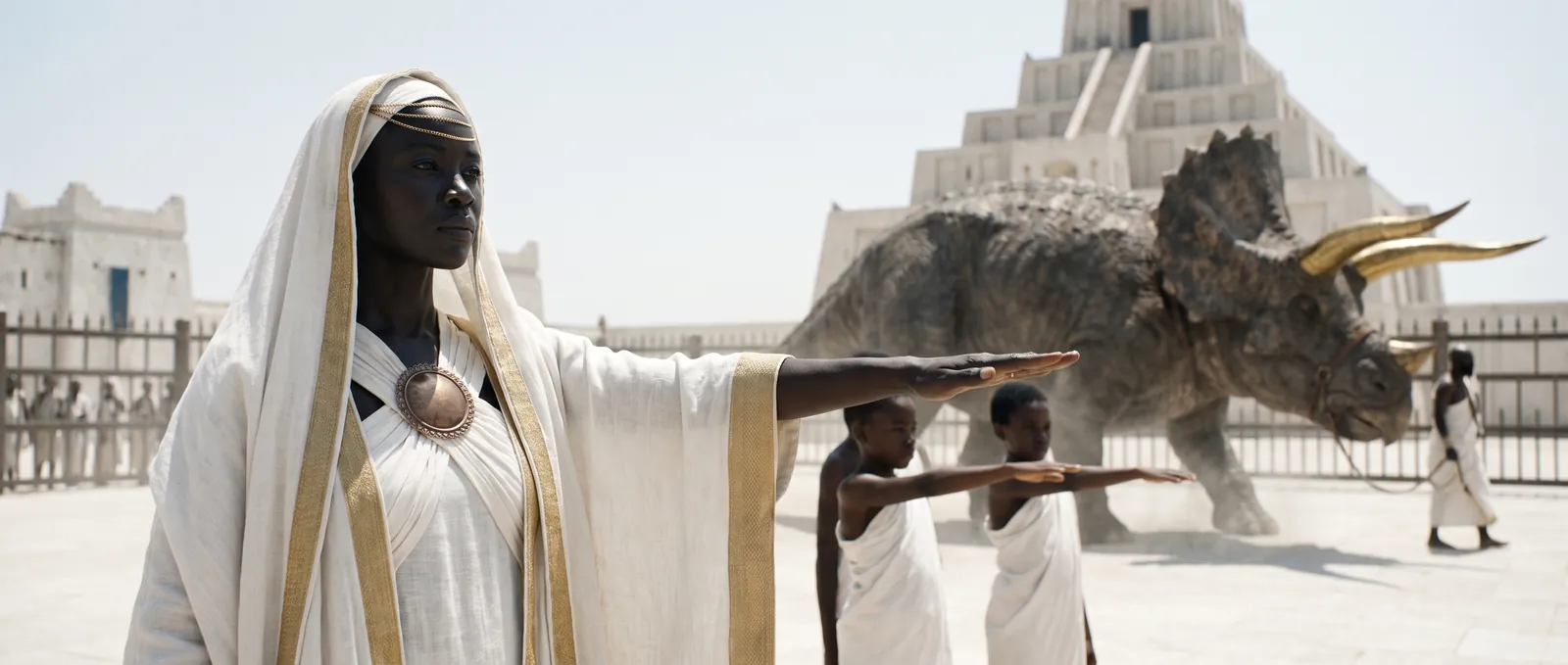
D’anciens camarades de cohorte se passent une brosse près d’un abri de tricératops, sous le regard d’une éducatrice.
During the Respiration
Children have eight weeks of Respiration on an aligned educational calendar: the ordinary routine stops and activities are freely chosen. Moral control loosens — shouting, dirt, late nights, ten swims a day — but safety never does. Children become rowdy, not abandoned.
The Houses of the First Morning
The work of the Mains Blanches begins before the cohort. The Houses of the First Morning, where Ishtir’s children are born, are run by the order: midwives, carers and night keepers receive the births, watch over the first weeks and give each child a use-name. The newborns form small groups there that later become cohorts, so that a cohort often begins in the same room, a few days apart.
The biological link is handed to the medical registers, sealed. The child takes away only its name, and the adults who welcome it into its cohort know only which House of the First Morning it comes from.
A cohort house
From a distance a cohort house looks like a small theatre, and up close like a house that has to put away a great many lives before the rain. At Troisième-Cour, six low stone tiers surround a central floor; lodgings, kitchens and study rooms fill their thickness, bunks fold into the walls and four radial passages let the children be evacuated without crossing the animal lane. At noon, low tables slide out of the walls and receive their function marks: food, water, care, study.
At night a keeper sleeps fully dressed in a small room set between two doors, an alarm cord wound round her wrist. Reed tubes run through the walls to the neighbouring rooms; at the slightest pull, a terracotta bell rings near her head. The tubes are tested before the cold sets in and after the soup, because steam from the kitchens pushes dirt into them.
The brown cord
The order’s cohort keepers wear no medal and no visible rank mark in the courtyards, only the brown cord of their office, knotted at the waist. Each cohort has several and they take turns, so that no child depends on a single adult. Many Ishtiris nonetheless call one of them, all their lives, their “public mother” or “public father”: the one who taught them to hold a spoon and a wounded person.
The phrase carries no legal weight. A keeper has no more rights over a child than a biological parent does; she has duties, and the respect of those she raised, who sometimes come back to see her decades later.
Evacuating the cohorts
The safety of children is the order’s first duty, in war as in festival. The radial passages of the cohort houses are used for evacuation drills, repeated every season: at the signal, each keeper takes their group, each older child takes a younger one by the hand, and the cohort leaves by its assigned passage without crossing the animal lane. When danger threatens, the cohorts are led towards the inner walls together with the elderly and the sick, before the gates are even closed.
Keepers know the exact number of their children at every moment. Counting aloud while walking is the first thing taught to the order’s novices, and the last thing they forget.
Part of this article covers events of season 1. Turn spoilers on in the menu to read it.
Gallery1 image
A priestess guides two children before a Triceratops.