
Religion and rites
Korath: the incomplete square
The Mountain takes back matter; the work, signature and corrections remain readable.
The transmitted structure continues
The deceased may be described as an incomplete square. Its final side is closed by a child, apprentice or workshop: an individual life ends, but the transmitted structure continues. Kinship and trade can therefore carry memory together. This funeral motif grants neither automatic legal power to an heir nor a new rank within Korath’s institutions.
Matter returns to the Mountain
The rite entrusts bodies to magma. It distinguishes matter returned to the Mountain from Form kept by the living: patent, signature and work. Funeral plaques cite the work rather than titles. The rite’s force lies in the concrete transmission of an achievement, without a magical mechanism of survival in rock or heat.
Keeping the record of corrections
The Right of Signature preserves the inventor’s name, authorship and record of corrections. Monumental patents make revisions, accidents, amendments and limits visible. This technical memory gives mourning its own vocabulary: work is not a perfection erasing errors, but an achievement whose transformations remain readable. Patent law organises this rite independently of its particular gestures.
Drawing the square
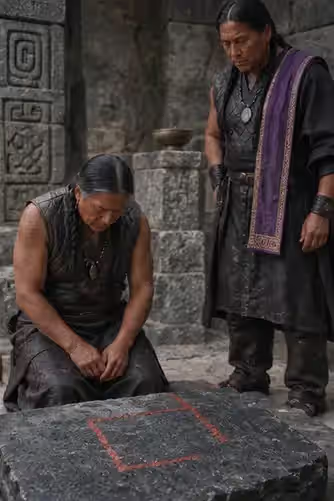
The incomplete square is not just an image. For every person who dies, a sacred geometer actually draws it on the eve of the funeral, on a basalt slab laid in the workshop or the home. He works with his ordinary kit, compass, square, plumb line and bronze rule, and engraves only three sides, with the point, in an even line. The fourth stays empty, marked at each end by two small dots.
The size of the square depends neither on wealth nor on rank: custom sets it once and for all at one cubit a side. The slab then goes with the procession to the sanctuary of the Red Rifts. In front of the family the geometer checks the square one last time and declares, as one does for any piece, the visible flaws of the drawing: a line cut a little too hard, a corner gone over twice. Even at the edge of the magma, Korath does not claim perfection.
The reading of revisions
Before the body goes down, someone reads aloud what the dead person has left behind. For an inventor, the Signature archivist brings the list of patents and revisions, including those proposed for other people’s mechanisms. For a journeyman, it is often the master of the workshop who lists the pieces, works and repairs owed to him. The reading is plain: numbers, dates, objects.
Mistakes are part of it too. A correction made necessary by the dead person’s error is read like the others, with the name of whoever found it, and Korathi feel that a life without a single declared mistake would be a life badly told. The reading ends with the work that the family and the workshop have chosen for the plaque, the one that will be engraved after the formula “Here the square is closed”.
Those who signed nothing
Most Korathi never file a major patent, and the rite is owed to them no less. The word “work” then takes a broad meaning: a district gate kept for twenty years, a winch served without accident, a terrace rebuilt after a winter, an apprentice trained, a battery in which one was the layer. Miners’ plaques often name a gallery, those of animal carers the number of beasts put back on their feet, those of soldiers a pass.
Parents who raised children may have that single fact engraved, and many do. The rite thus recognises two ways of handing down a form, through the trade and through kinship, without ranking them. The sanctuaries of the Rifts mix these modest plaques with those of the great inventors in a single order, that of the dates; a visitor passes the square of a ration carrier next to that of a famous clockmaker.
Dying far from the mountain
The rite assumes the body can be returned to the magma, which war does not always allow. A soldier fallen at the bottom of a pass, an engineer who died aboard a foreign hull, a miner left under a rockfall do not all come back. People then bring back what they can: the obsidian shard received at the Black Kindling, which the dead person carried, or failing that a tool from their bench. The object is thrown into the rift in place of the body, after the usual reading and drawing.
For those who died in the same fight, the garrison draws a single large square, whose inside receives all the names and whose last side is closed by the unit’s survivors; the slab goes down to the Rifts after the campaign. Korathi families do not see this as a lesser rite. The Mountain will take back the matter wherever it lies, they say; what matters is that the Form comes back to the living.