

Religion and rites
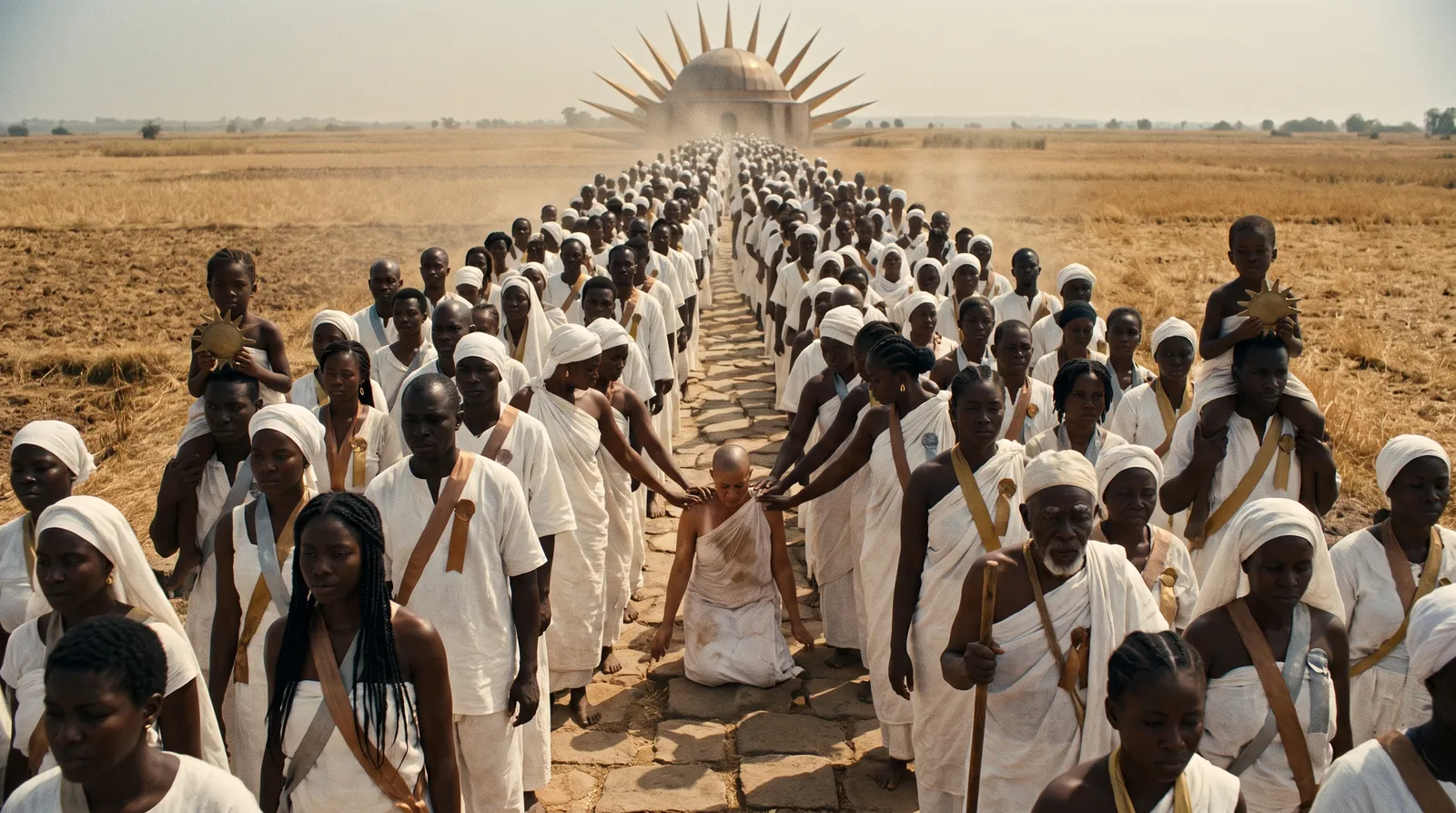
The Pilgrimage to the Heliodrum
A once-in-a-lifetime pilgrimage: climbing the solar terraces to the temple of the Heliodrum of a Thousand Rays, where astronomers measure the exact shadow.
A climb up the terraces
The Pilgrimage to the Heliodrum is made once in a lifetime. The pilgrim climbs the long succession of white terraces up to the temple of the Heliodrum of a Thousand Rays. There, at the giant gnomon, astronomers measure the exact shadow with a cord. The Gold-rank keepers of the instrument attend to nothing but the shadow.
Proving faith without blood
The pilgrim returns exhausted and upright, having proved their faith through Measure and Discipline without a single drop of blood being shed. The line of pilgrims gathers every rank. The pilgrimage extends the principle of a bloodless faith: Ishtir sacrifices no flesh; it consecrates measured time.
The temple-city of Héliodrum
Héliodrum lies in the Jardin du Levant, not far from Qer-Aton, in the middle of an oasis of three lakes between steppe and forest. It is a temple-city of the Golden Ray: part of the summit is trained there, the exact shadow is measured there, and its workshops polish the bronze mirrors of the temples and relays. The temple of the Heliodrum of the Thousand Rays crowns the town, at the top of a long sequence of white terraces.
Its name comes from its dome, pierced with a thousand openings. In fine weather they cast as many patches of light on the temple floor, which slide slowly as the hours pass; at exact noon they come to rest on lines engraved in the paving. In the centre stands the giant gnomon, the tallest in Ishtir.
Setting out
The pilgrimage has no fixed date. Most Ishtiri make it as adults, between two Weighings, often after a turning point in their lives: a rise in rank, a descent, a recovery, the death of a cohort friend. The journey is not taken out of the Breathing: days of sacred service are granted for it, once in a lifetime, whatever the rank. A Gold, who has only one week of Breathing, can therefore climb to the Heliodrum just like a Bronze.
People set out alone or with their household, with a staff, a water jar and the bare necessities. The relays and caravanserais of the Golden Ray receive pilgrims along the road, and they are recognised by the white cord they wear at the wrist until their return.
Climbing the terraces
The climb begins at the foot of the town, at the first terrace, where pilgrims leave their staffs. It is made on foot, from landing to landing, up thousands of white stone steps, and takes a whole morning for an ordinary walker: one sets off before dawn to arrive before noon. Every landing offers a water jar, a bench and a little shade; nothing is bought and nothing is sold there.
During the climb pilgrims speak to one another in the ground register, in low voices, and fall silent on the last landings. The oldest and the sick are helped, sometimes carried on litters by their cohort companions, but the rule is that they set foot on the last step themselves.
At the foot of the gnomon
At exact noon the day’s pilgrims line up in the court of the giant gnomon. The Gold astronomers measure the shadow, with the cord, then engrave its length on a small clay tablet, with the date and the pilgrim’s name. Each thus receives the shadow of his day, a measurement that belongs to him alone and that no other pilgrim has received identically.
The ceremony is short and silent. There is no offering to make and no gift to give, and no one measures the pilgrim’s faith: only the shadow is measured. That is precisely what moves the Ishtiri: at the summit of their religion, an instrument, a cord, and not a drop of blood.
Coming back
The return is slower than the outward journey. Pilgrims come down in the afternoon, spend a night in the caravanserais of the oasis, then go back to their region. In their quarter they are welcomed with a meal, and they place the shadow tablet in the niche of their dwelling, next to their medals; when they move house it follows them like their other personal objects.
These tablets are among the objects the Ishtiri most readily show. Cohort children learn to read them at their educators’, compare the shadows of different seasons and know that one day they too will have their own.