
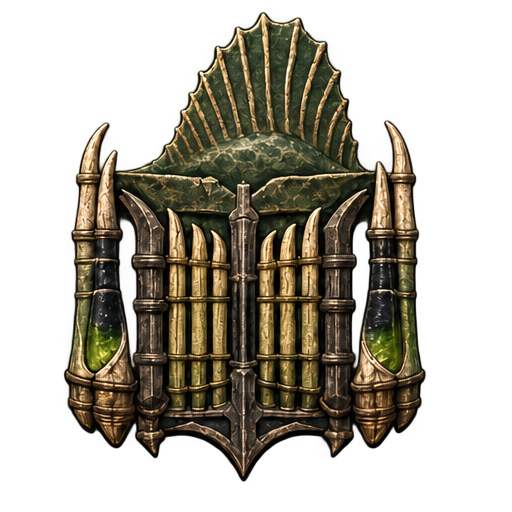
Religion and rites
The Song of Bones
A N’Goro funeral vigil: on a barge, the clan recites the dead person’s lineage name by name, with no error allowed, then paints the name in spore inks.
Naming without error
The Song of Bones is a funeral vigil. The body rests on a barge near a funeral islet drowned in mist, between low torches and still water. The dead person’s lineage is recited name by name, with no error allowed. The name is then painted in spore inks on varnished fibre: it enters the memory of the marsh.
A clan rite
The rite belongs to the dead person’s water-clan, present in full, ancestor masks raised; the other clans listen from their barges, at a distance. The names recited there are those kept by the Songs of Bones, the sung memory of lineages. The body itself returns to the marsh, according to N’Goro’s rite of the dead: whatever heals can feed.
The reciters
The chant is not entrusted to just anyone. In each water-clan one or two women of the lineage are chosen in childhood to keep the memory of the names, as they keep that of the doses. They learn the genealogy on knotted cords, one knot per ancestor, and rehearse it for years before they are allowed to sing it over a dead person. A reciter begins with the deceased and goes back, generation after generation, to the Great Ancestor, the primordial spinosaur from whom, the Songs of Bones say, the lineages and the great titans of the marshes descend.
The difficulty lies in the sheddings. Every ancestor bore several names in the course of a life — the water name, the first shedding name, those that came after — and the chant speaks them all, in order. An old lineage thus counts hundreds of names, and the vigil often lasts the whole night, until dawn. The reciters drink an infusion that keeps the voice clear and sometimes take turns, but the same voice must speak the first and the last name.
Why no mistake is allowed
A mistake stops the vigil. If the reciter forgets a name, confuses two or gets the order wrong, the chant breaks off, a torch is put out, and it starts again from the deceased. The Ngoro say a name wrongly spoken falls out of the marsh’s memory, as a stake pulled out falls out of a cordon. But the requirement also has a very concrete reason: the Song of Bones is an act of law as much as a rite.
The lineage recited before the whole clan settles who belongs to which water, who may claim which basin, which water-unions have been concluded and which Breath Debts pass to the living. The other clans listen from their barges, at a distance, as witnesses. A genealogy sung without mistake and without challenge before them counts as confirmation; an uncorrected error could, years later, be used to contest a right. That is why the neighbouring clans listen so closely, and why a reciter who has sung true through a whole night is received the next day like a fighter back from a hard pass.
The painted fibre
At dawn, when the last name has been spoken, a hand of the lineage paints the deceased’s name on a strip of varnished fibre in spore ink. The ink glows faintly in the half-light and dries slowly; it is protected with a varnish of clear resin from the High Canopy. The fibre does not follow the body. It joins the clan’s archives, kept in chests of black wood on a barge or in a dry root, where the names of the recent dead are added to the old ones.
Nothing there is eternal. In the damp of the marsh even the best varnished fibre fades in the end, and each generation copies out the most worn strips. But not everything is copied: only the names the Song of Bones goes on reciting are repainted. A name that is no longer sung fades with its fibre, and the Ngoro do not regret it. They say it has then been given back to the marsh, as the body was, and that memory, like water, must stay alive to stay true.
The dead without a body, and strangers
Not all the dead have a body to return. For those who vanished in the Singing Mists, drowned in a current or fell far from home, in war, the clan sings all the same. The funeral barge then carries an empty mat and an object of the deceased — a threshold kit, a trade cord, a mask — and the vigil runs as for the others. The dead of the Three Waves, left on dry ground that was not theirs, were sung this way, empty barge after empty barge.
The chant can also take in a stranger. It happens that a traveller cared for by a clan dies among them, or that a child adopted into the water of a basin never knew its lineage of origin. The clan that cared for or took in the person may then sing that name after its own, specifying that it came “by breath” rather than by water. Only the dead of the Nasses, who vanish without rite, enter no chant at all, and it is that silence the Ngoro hold to be the worst of ends.