
Religion and rites
N’Goro: the Mysticism of Sheddings and Thresholds
Identity changes through what a person traverses; body and environment give a threshold its value.
Four concepts of transformation
Egg names protected potential; Hunger, growth and learning; Closure, withdrawal, illness, mourning or transformation; Emergence, a new function, name or relationship to the community. These concepts understand identity as changeable. A new name does not necessarily make the person’s previous name false.
Environment matters to value
Dose, body, season, water and timing change the value of a substance as well as a human threshold. This attention also involves collective morality: deliberately altered water must be marked. Lying at a filter or fouling coded water constitutes profanation and betrayal, because other bodies depend on the information passed on.
The water name and the First Shedding
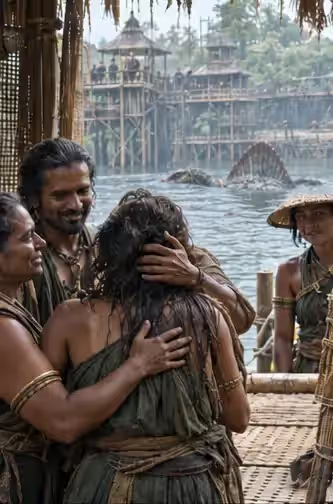
The first years carry a water name, tender and provisional. The great ceremony of childhood is the First Shedding, which celebrates lasting survival after several seasons: child mortality stays very high despite the best medicine, because infection, drowning, spores, parasites and predators threaten the youngest. The ceremony links the body that has crossed those seasons to the network that protected it: several families, guardians and Sap-Keepers.
The festivals of the waterways
Two festivals mark the waterways. During the Rising of the Titans, colossal animals swim up the rivers of the Long Boughs and porterage and barges are blessed. During the Sealing of the Mires, a biosafety rite, chosen Sap-Keepers close the quarantine zones again. One is lived in crowds on the pontoons; the other is watched from afar.
The Songs of Bones
The memory of lineages is sung: these are the Songs of Bones, set down in spore inks on varnished fibres. At the Song of Bones, a clan funeral vigil, their names are recited one by one.
A religion without temples
The Mystique of Sheddings and Thresholds has no high priest, no central temple and no single book. Its rites belong to the water-clans, never to a throne: it is a clan that sings its dead, a clan that celebrates a First Shedding, a clan that welcomes an adopted child. The places most like temples are the Houses of Thresholds, where the passage of a shedding is accompanied, where one receives one’s water name and where one’s Breath Debt is recorded. They have officiants — First Shedding guides, herbalists, fumigators — but no clergy commanding the faithful.
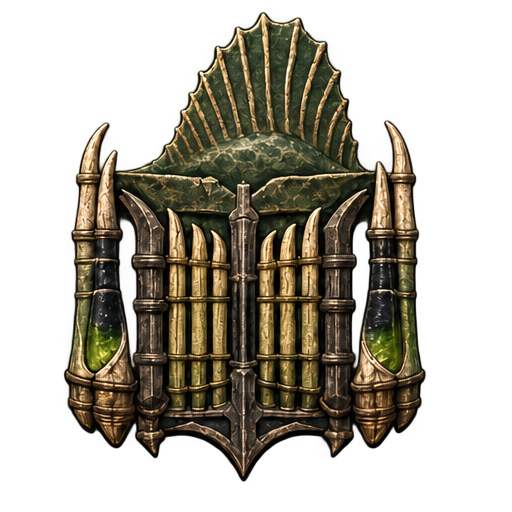
Beside the Mystique lives an older cult, which many clans practise without seeing any contradiction: that of the Saurian Ancestors. It honours the Great Ancestor, the primordial spinosaur from whom the lineages and the great titans of the marshes descend, and its masks, stretched with Siirmuu sail, come out at funeral vigils and at the Sealing of the Mires. Confraternities such as Masque-Ancêtre or Chambre-Ancêtre keep its rites. The Mystique says how one crosses; the ancestors say where one comes from.
Living through a Closing
The Mystique’s four images do not remain ideas; they shape ordinary life. Whoever falls gravely ill, loses someone close, leaves one trade for another or goes through a long trial “enters a Closing”. It is signalled by tying an undyed fibre cord at the wrist and ceasing to use one’s name: the person is addressed by their water, or simply as “the one who is closed”. No work is asked of them, no debt is claimed, and neighbours provide what they lack.
A Closing has no fixed length. It is the person who decides they have come through, and declares it before a witness at the House of Thresholds, where a cone of Fumée-Douce is burnt. They then cut the cord and announce their name — the old one or a new one. That Emergence erases nothing of what went before: the earlier name stays recorded, and no one holds it to be false. In N’Goro they say a life well lived can be recognised by the number of cords cut.
Reading the water in the morning
The Mystique has no prayer in the sense other peoples mean, but it has a daily gesture almost every household performs: the morning reading. Before drinking or cooking, the eldest person in the house draws a little water from the drinking jar, looks at it against the light, smells it, examines it at the bottom of a pale cup, then says aloud whether it is clean. The gesture takes a few moments. Every day it recalls the country’s central rule: the value of a thing depends on dose, body, season, water and moment.
The same attention applies to deeds. The Mystique’s morality is a morality of thresholds: a word, a remedy, an anger or a power is good or bad according to its measure. The highest praise is to say a person “knows their dosage”; the worst fault is to lie before a filter or foul a coded water, because other bodies depend on what was declared. Between the two, the Ngoro judge deeds the way their language conjugates verbs: clean, irritant or lethal.
The Mystique and war
N’Goro’s war doctrine has a religious root. Letting the environment fight means forcing the invader to cross thresholds it is not prepared for: road, body, senses, stores, insects, canals. The Ngoro do not say they defeated an army; they say it “did not pass”. And they keep a strange kind of respect for the enemy who, against all expectation, has crossed the living marsh: that one, at least, has proved something.
For the fighters themselves, war is a collective Closing. No name is received for having killed; one may be received for surviving a wound, holding a pass or bringing back the wounded. Veteran women fighters are respected as biological archives, because their bodies carry the proof of the passages they held. A war widow, a captain who came back alone from an arm of the estuary, a healer who tended the wounded through a whole season of fighting: all come out of war with another name, and it is by those names that the country remembers its wars.
What other believers say of it
The religions of the other nations judge the Mystique by their own measure, and each sees in it what it lacks. Ishtir’s priests, who measure the person to give them their rank, find strange a faith that mostly measures the threshold and lets everyone change their name. Korath’s priest-smiths, who fix and reproduce, are irritated by a doctrine that declares uncertainty instead of overcoming it. The khans of Arkhan, who survive by moving, recognise cousins in a people that survives by understanding why the environment moves.
Urnok, which has institutional depth where N’Goro has ecological depth, looks in vain for a clergy to deal with. Volonia, which makes things circulate, understands better than anyone a faith that decides what may cross, and distrusts it for the same reason. The Ngoro, for their part, care little for these judgements. Their summary formula, which the Sap-Keepers like to quote to foreign envoys, says everything about their humility and their pride: N’Goro has never conquered its continent; it has only learned which parts of it sometimes agreed not to eat it.