
Religion and rites
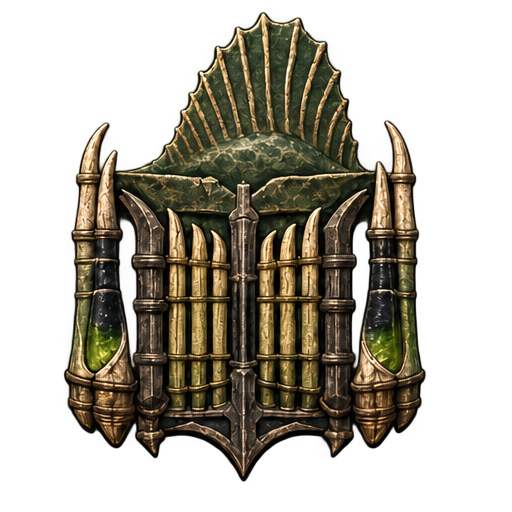
Soleil-Noyé
A marsh sect that sets itself up as a rival of Ishtir.
Function and place in war
Soleil-Noyé is a marsh sect that sets itself up as a rival of Ishtir. Its very name sets a drowned sun against the kingdom of the Sun and the Zenith.
It is one of the cults of the marshes, with Masque-Ancêtre, devoted to the Ancêtres-Sauriens, and Chambre-Ancêtre, whose priests celebrate saurian rites.
The sun that drowns
The doctrine of Soleil-Noyé starts from something every Ngoro has seen. In the evening, on the shore of the great lakes, the sun does not vanish behind a mountain: it comes down onto the water, touches its own reflection and sinks into it. For the sect this is no illusion. Every evening the sun plunges into the deep waters where the ancestors live, spends the night there and comes out again in the morning. It does not rule the sky; it belongs to the water, and only leaves it for a few hours.
The idea fits the Mystique of Sheddings and Thresholds, which the sect does not reject: for it, the sun is the first being to shed. Every evening is a Closing, every dawn an Emergence, and the sun is great because it goes through that trial every day without failing. The faithful draw a simple moral from it, which they repeat to their children: you do not know a person by their height, but by the way they cross their night.
A rival that has never seen Ishtir
Ishtir worships the sun at its zenith, at the instant of exact noon when it stands highest, and measures every person to give them their rank. Soleil-Noyé holds that faith to be an error of sight: it honours only the sun’s minute of pride and forgets half of its life, spent under the water. Where Ishtir weighs people in broad daylight, the sect claims they can only be judged at dusk. Its preachers like to repeat that “Ishtir’s sun rises, our sun plunges, and it is the same one”.
The rivalry is a strange one, though, for most of the faithful have never met an Ishtiri. They know the kingdom of the Zenith from the tales of Volonian sailors, passing merchants and envoys met at the Control Basins, and their adversary is first of all an idea. The rare travellers from Ishtir who have attended their vigils left amused or offended, according to their rank. The sect has never sought to convert anyone beyond the marsh; it defines itself against a light it has only seen in other people’s words.
The vigil of the drowning
The sect gathers on the western shore of one of the lakes of the Living Mirror, where the smooth water returns the sky most sharply. Every evening a few dozen faithful take their places on floating platforms facing the sunset; at the great vigils, in the season of low water, they number several hundred. At the exact moment the disc touches its reflection, every lamp goes out and silence falls. The watchwomen who lead the cult call this moment the drowning.
A night without fire then begins. Only spore lamps are lit, whose cold, flameless light is, the sect says, that of the sun under the water. People sing softly, recite the names of the year’s dead and tell each other of hard crossings. At dawn, when the sun comes back out of the lake, the crowd rises and speaks the formula of Emergence together. Only one offering is allowed: small gold ornaments the faithful throw into the lake to “give the gold back to the water”. The Sap-Keepers have tolerated it because gold does not foul the water, and the lake is marked as a water of offerings.
What N’Goro thinks of it
Soleil-Noyé remains a small sect, and most Ngoro view it indulgently. Adepts of the Mystique find beautiful the idea of a sun that sheds, and many boatmen, without belonging to the sect, put out their lamp for a second when the disc touches the water. The confraternities of the Saurian Ancestors are more reserved. Masque-Ancêtre and Chambre-Ancêtre honour the Great Ancestor, the totemic spinosaur from whom the lineages descend, and look askance at a cult that places another power than him under the water.
The Circle of Balances enters the sect in its registers like the other minors, and the Sap-Keepers watch its offerings closely. It has neither guards nor weapons, takes no part in the seven-threshold defence and raises no levy. Its only influence lies in its vigils, which people travel far to see the sun drown, and in a phrase it has given to the whole language: to say someone “has passed their night” is to say they have come through a trial without losing their name.