
Economy
The Breath Debt
In N’Goro, life-saving care creates an obligation of reciprocity, not necessarily monetary, which can pass through the social network.
What life-saving care creates
Life-saving care creates a Breath Debt. The obligation of reciprocity it gives rise to is not necessarily monetary and can be passed on through the social network. Saving a body ties the person saved to those who made the care possible: preparing the remedy, intervening and protecting the place are not separate from the relationships that support them.
A society of care
The debt makes sense in a country where medicine is highly developed and where infant mortality nonetheless remains very high: infections, drowning, spores, parasites and predators strike children. Venoms, antidotes, filters, biosecurity and medicine are among the country’s most valuable products. The Breath Debt makes it possible to acknowledge help without reducing it to a price paid on the spot.
Generosity that binds
In N’Goro, people say it plainly: the country saves those whom others would abandon, but it makes a life without obligations or belonging difficult. Whoever has been saved keeps an obligation that reaches into their ties and exchanges. A person can receive indispensable help while entering a relationship in which protection, credit and influence become hard to untangle.
A debt must have an end
The code of the Black Milk Houses requires that a debt have an end and that a child not pay before their first moult. These limits make the way of counting and acknowledging what has been repaid important. N’Goro’s networks do not all offer the same guarantees.
Recording a debt
A Breath Debt is not born of mere gratitude: it is recorded. When a treatment has saved a life — an antidote given in time, a drowned woman brought back, a fever overcome — the person treated or their family comes to the House of Thresholds of their water with those who helped. The Breath Debt physician, whose trade this is, records the act there: the nature of the care, the patient, and everyone who made the rescue possible, from the woman who prepared the remedy to the guide who steered the barge and the neighbour who raised the alarm.
These registers, written in spore ink on varnished fibres and doubled with knotted cords, are lodged at Marais-Serment, the court of water justice, which keeps a copy. The act carries an equivalent in Venom Phials, but the figure serves only to measure the debt’s weight: a Breath Debt is never repaid in money. Offering money to extinguish it is even an offence, readily compared to an attempt to buy one’s own name.
Giving back one’s breath
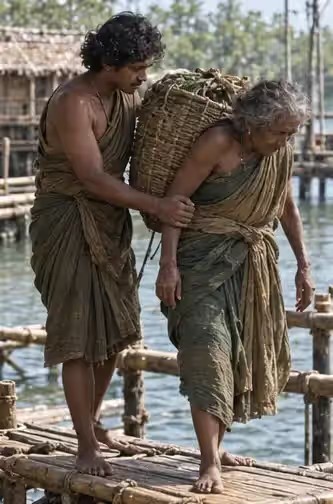
A Breath Debt is repaid by a service of equal weight, and the forms are many. The debtor may work a season for the family of their rescuer, guide them on a hard route, protect them during a flood, supply them with a remedy on the day they lack one. They may also give their breath back to someone else: saving in turn a person in danger, whoever it may be, closes their own debt and opens a new one in the name of the person saved. The registers thus follow real chains of care, which sometimes cross several generations and several basins.
The debt is passed on. If the creditor dies, it passes to their clan; if the debtor dies, to the adults of theirs, never to children who have not passed their First Shedding. A repaid debt is entered in the register and closed before witnesses, and it is often the occasion of a meal between the two families. The Ngoro say that breath given back closes two registers: that of the debt, and that of the mistrust that always grows between those who owe each other something.
When the debt crosses borders
Foreigners often enter the system without understanding it. A merchant treated at the Control Basins, an enemy soldier bandaged by the Sap-Keepers, an envoy pulled through a mist fever all leave with a Breath Debt recorded in their name. N’Goro’s registers keep track of it for generations, and it happens that a foreigner returns years later, as merchant or envoy, to ask how to repay what is owed. They are then welcomed like a relative.
The other nations judge the Breath Debt in their own way. Urnok’s accountants see in it a credit without an imperial register and distrust what they cannot enter in the books of a House of Proof. The Volonians, who live by insurance and bills of exchange, better understand the idea of an obligation that circulates, but are surprised that it cannot be sold. The Arkhans, among whom an adopted stranger becomes a milk-brother, recognise something familiar in it. N’Goro, for its part, almost never demands payment of a foreign debt: it prefers to know that the debt exists.
Abuses and disputes
A system founded on gratitude attracts those who want to exploit it. There are physicians who inflate a treatment to swell a debt, families who record help they never gave, creditors who demand a service out of all proportion to what they did. The gravest abuse is the sale of debts: although the rule forbids it, some Black Milk Houses buy up Breath Debts from poor families and use them to hold whole quarters. That is where the country’s generosity turns into dependence.
Disputes go before Marais-Serment. The court rereads the register, hears the witnesses and may reduce a debt, declare it extinguished or condemn a physician who lied; a false register is judged as severely as a lie before a filter, since other lives depend on the trust placed in it. The Code of the Houses, which holds that a debt must have an end, then serves as an argument for the plaintiffs. The water judges readily recall it: a debt that never ends is no longer a breath, it is a chain.