
Religion and rites
N’Goro: the body returned to life
Marsh, roots and sanitary safety give the body’s return a collective reach.
Returning the body to the marsh
The rite organises the body’s return to the marsh, immersion platforms and mangrove roots. Matter joins a living environment rather than being removed from all transformation. This funeral arrangement extends a culture of care and treatment. It describes acts by the living without claiming that the deceased becomes a supernatural will acting within the marsh.
A rite requires care
The Synod oversees the body’s return because a dead person improperly returned constitutes a sanitary risk. Mourning therefore does not abolish responsibility towards waters and inhabitants. A gesture intended to feed life can also threaten it if performed badly. Ritual authority appears here through treatment and environmental safety, with acts of care suited to the waters and inhabitants.
Shell-lanterns
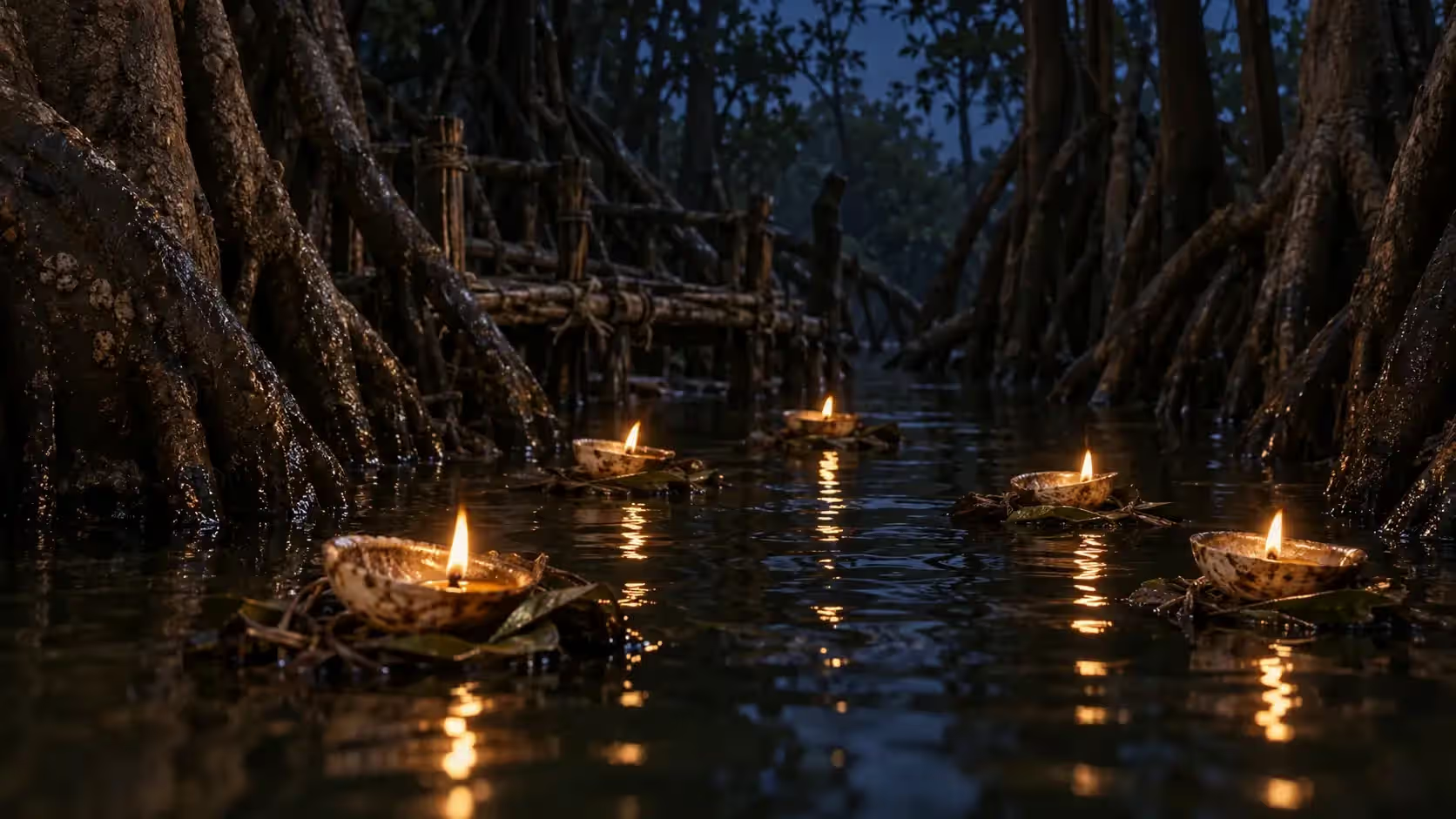
Shell-lanterns may be placed on channels during the rite for the young. This sign keeps an intimate scale in a world where the body may join roots and water. Mourning becomes visible through a light carried on the shared environment.
The immersion platforms
Every community has its places of return. They are almost always old mangroves, chosen for the strength of their roots, whose foot has been fitted with platforms of treated wood above a calm basin. The body is laid there wrapped in fibre and leaves, with herbs that keep the flies away, in a cage woven of living roots that is lowered slowly into the water. Fish, crabs and cleaner beetles do the rest, and within a season the roots have begun to grow through.
The bones are not taken out. Over the years they are caught in the wood and enclosed by the tree itself, which grows around them. A tree of return thus holds several generations of the same neighbourhood, and the Ngoro readily call it by the name of the lineage that most often rests there. No root is ever cut from it, no work barge is moored to it, and in passing one greets, with a hand gesture towards the water, the tree where one’s ancestors sleep.
Before the return: the cause of death
No body joins a basin of return without a Sap-Keeper having seen the cause of death. The gesture is quick and without ceremony: the Sap-Keeper examines the skin, the mouth, the nails, asks what the deceased drank and ate, where they came from and whether there was fever. A death from old age, a drowning, a hunting wound allow the ordinary return. A contagious fever, an unknown poison or a water sickness demand something else.
Bodies that carry a danger are not returned to a living channel. The Synod sets aside closed basins for them, isolated by dykes and fed by no spring, where the return takes place under fumigation and where no one ever fishes. Families live it as a second grief, but do not contest it: a dead person wrongly returned can kill their own children. In the great cities, the watchers of the dead who work for the Black Milk Houses know these rules as well as the Sap-Keepers, and their registers of return are inspected every season.
The time of mourning
For the living, a bereavement is a Closing, in the sense the Mystique of Sheddings and Thresholds gives the word. The close family withdraws: work that can be suspended is suspended, no visitors are received, the dead person’s name is not spoken outside the Song of Bones. Neighbours bring food and take on the water chores. During that time no one claims a debt from a closed family, and the Code of the Black Milk Houses itself suspends the due dates.
The Closing generally lasts one moon, longer for the death of a child or of a clan mother. It ends with an Emergence: the family opens its threshold again, offers a meal to those who fed it, and some of its members then take a new name, in memory of the dead or of the passage they have just come through. Mourning is not erased for all that; it has only changed shape, like the body in the roots.
What foreigners say of it
Of all the ways of treating the dead in the known world, N’Goro’s is the least understood. Urnok burns its dead and scatters their ashes on the grass plots of its roads; Arkhan exposes its dead, then keeps their bones in the clan house; Ishtir gives them back to the Sun on high terraces; Volonia entrusts them to the sea; Korath returns them to the magma. N’Goro is the only nation that embraces compost, and travellers are often shocked: they are served fish in a country where the dead are given to the fish.
The Ngoro answer in two ways. The first is a principle: everything that heals can feed, and a body that returns to the living is not lost. The second is a rule every child knows: one never fishes in a water of return, and never drinks from a basin where the dead rest. Foreigners who stay long enough end up noticing that the trees of return are the most beautiful in the marsh, and that no one touches them.