
Institutions
Arkhan : transmettre une ville
La Grande Mue place la propriété, la mémoire et la salubrité au cœur d’un passage de ville à ville, sans faire de l’administration une copie de l’Empire.
Ce qui part, ce qui reste
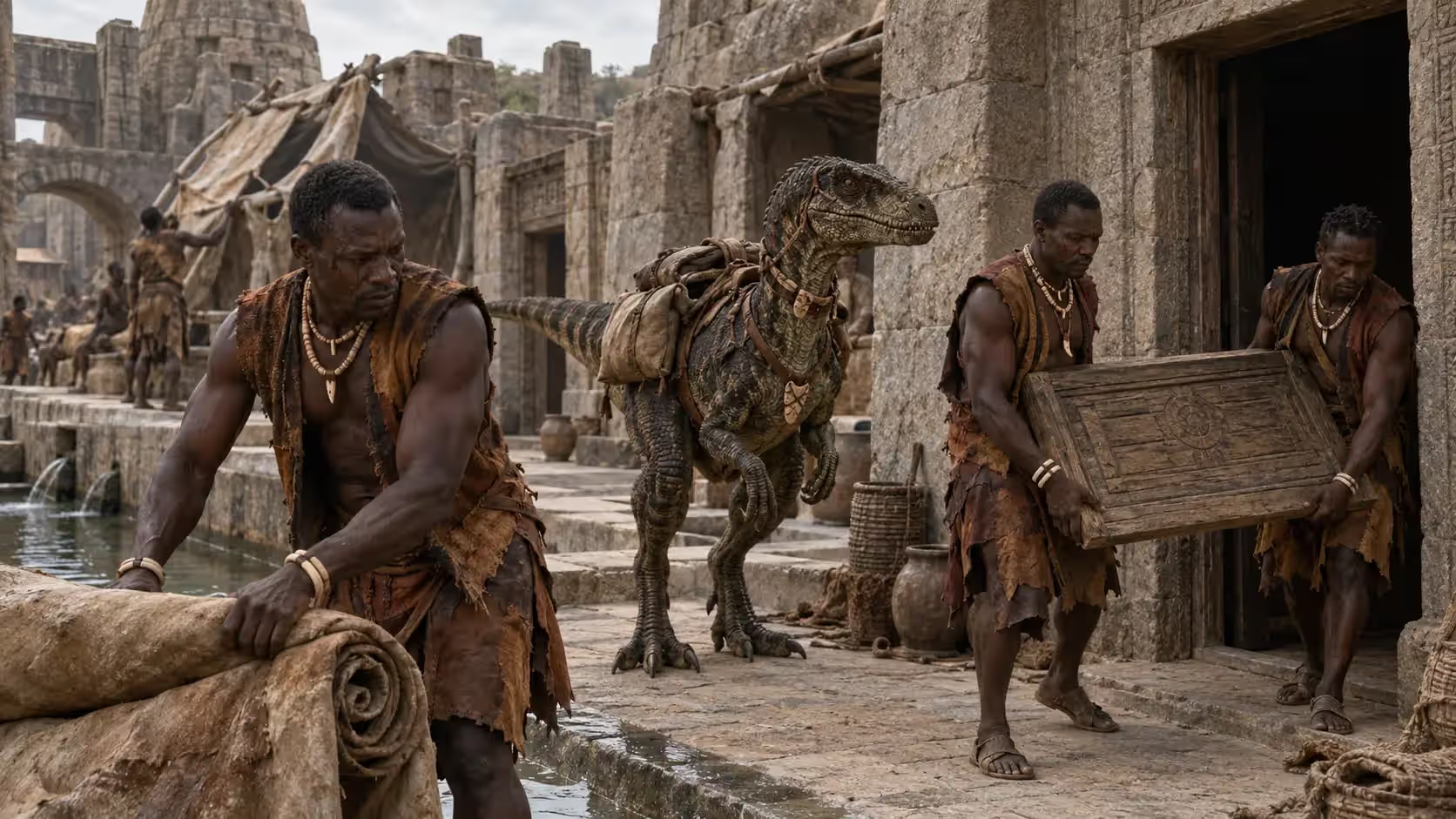
La Grande Mue distingue ce qui accompagne le peuple, ce qui peut être démonté, et ce qui demeure attaché à la cité. Cette séparation donne une forme civile aux départs : ateliers, objets et installations fixes n’obéissent pas à la même responsabilité. Ateliers, objets et installations fixes n’obéissent pas à la même responsabilité lors d’un départ.
La mémoire reste dans les mains qui entretiennent
Archivistes, gardiens des bassins, artisans de mur et autres Ancrés gardent la connaissance d’un lieu lorsque les groupes mobiles changent de cité. Leur savoir porte sur l’état des installations et les obligations que le lieu peut encore soutenir. Ce rôle rend la transmission vérifiable sans figer une caste ou un personnage individuel.
Préparer un lieu à accueillir de nouveau
Le Grand Curage traite bassins, enclos, membranes et résidus avant l’arrivée suivante. La salubrité fait donc partie de la transmission politique : une cité ne change pas seulement de bannière, elle doit pouvoir recevoir des corps, des bêtes et des activités sans reporter les conséquences du départ précédent sur les arrivants.
A household facing the Shedding
For a family the Shedding begins with an inventory. One must know what marches with it, what comes apart and what will stay, then decide what is really to be taken. Furniture that would not survive the journey is sold, swapped or left to the Anchored; tools are packed into lashed chests; the roofing membranes that belong to the household are unstitched and rolled. A well-kept house prepares months ahead.
The most charged choice is often the door. A family door, kept from one Shedding to the next, carries the memory of the household, and sometimes, on the lintel or the post, the named bones of an ancestor, which are not a material but a presence. These bones travel with the house, like the recent dead, who leave with the column to see one last trail. The family must detach them before the last horn, or leave to the city the most intimate thing it has.
What a khan hands back
For a great khan the Shedding is a public test. Every seven years he gives up his palace, his keys, his archives, his accounts and his network, and must hand the city back in good order to those who will keep it. That is why the institution is described as an audit by migration: what a government has made of a city becomes visible at the moment it leaves.
A khan’s court prepares the departure like a campaign. His stewards list the stocks that belong to his people and those that belong to the city, settle the debts contracted locally or entrust them to the Anchored, and dismantle what can be dismantled of the audience halls: low throne, hides, lance racks, removable tiers. The rule applies to everyone: the Great Shedding stops khans from confusing influence with ownership, and a khan who leaves with his hands full of what belonged to the city pays for it at the handover.
Growing up between several cities
A child of the great Arkhan peoples changes city two or three times before reaching adulthood. He learns early the words of the Shedding, what marches, what sheds, what remains, the fear of the last horn and the pride of carrying something in the column. The youngest often receive a small object to keep themselves during the journey, a tool or a knot, so that they understand what it means to carry something away.
This mobile childhood shapes particular attachments. One becomes attached to a people, a trail and animals more than to a house; one remembers several cities and compares them endlessly. Arkhans passing through a city where they lived as children look first for the Anchored they knew, not for their old home, which now belongs to others.
What people say at departure
The Shedding has produced a whole repertoire of sayings handed on with a laugh or a grimace. The old man who stays promises the one who leaves: “I’ll keep your bed. Don’t worry, I’ll sell it to the next people.” On arrival the newcomers discover their predecessors’ choices, and the exchange has become proverbial: “Who put the market here? — The people before. — Idiots. — They said the same of you seven years ago.”
These jokes express a truth of Arkhan civic life: each people inherits another’s decisions and bequeaths its own to a third, with no way of defending them once gone. The institution’s most serious formula reminds anyone tempted to cling on: “We built cities, not cages. Move.”