
Religion and rites
Returning a dead person to the marsh
In N’Goro, mourning links return to the environment with sanitary vigilance toward the living.
Return is managed as care
The body returns to the marsh through immersion and root systems. The Synod supervises this act because a poorly returned body can become a risk for water, families and passages. Rite therefore does not separate religion from health: returning a dead person with respect also means protecting those who remain.
A light for deaths too early
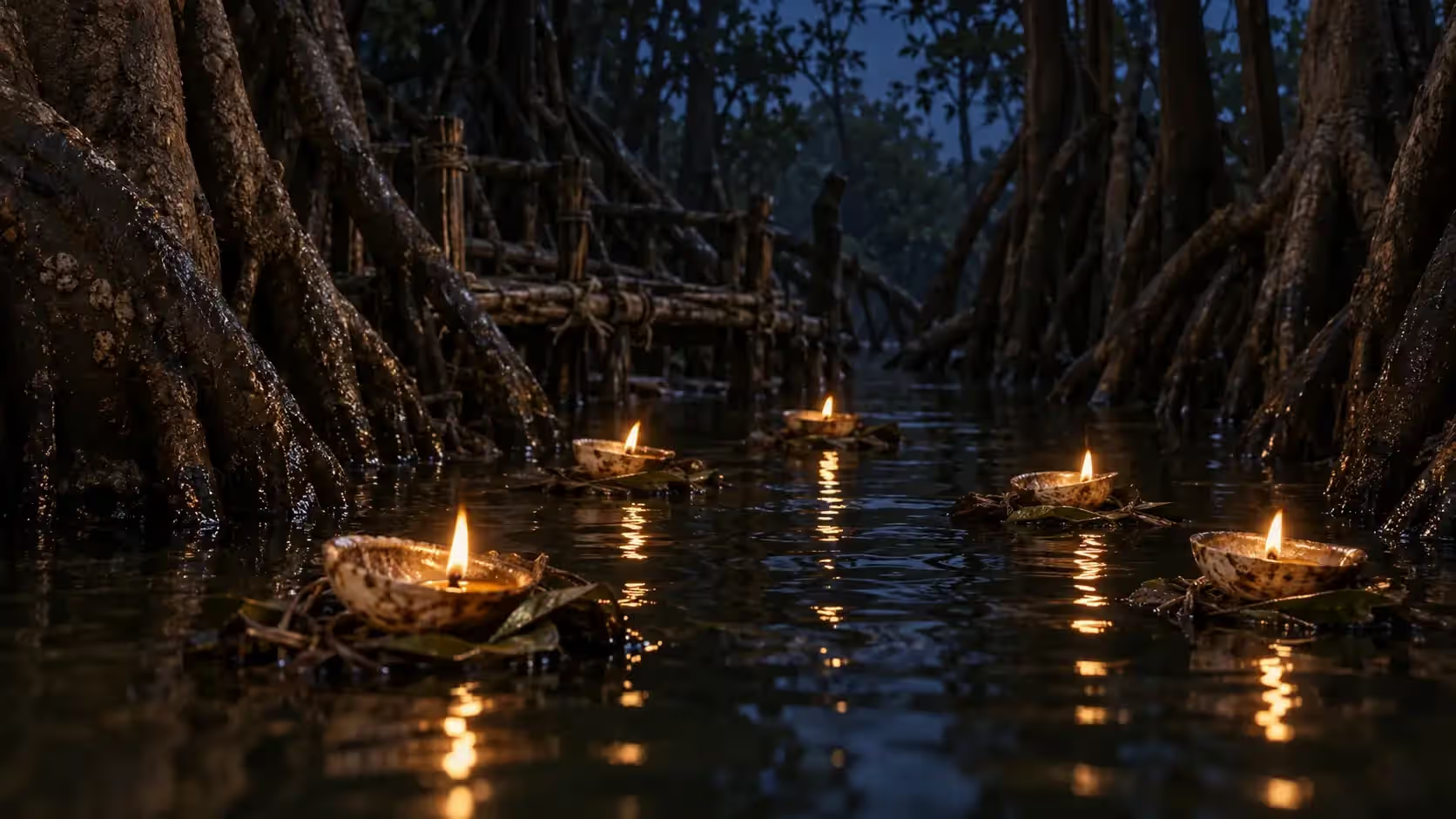
Shell lanterns on canals give a visible place to children who die too early. They let families and loved ones mark a loss without making the marsh dangerous through an unmanaged presence. The practice is simple and collective: it holds together bodily fragility, the water carrying the city and the memory of those who awaited them.
Not every death receives the same protection
People lost in certain systems of exploitation do not always receive a rite. This limit reveals social violence that a general celebration would conceal. The religion of thresholds does not abolish relations of dependence; it also gives inhabitants language to say that return, care or memory have been refused.
“Whatever heals can feed”
N’Goro is the only nation that embraces compost: the body returns to the marsh, according to the saying “whatever heals can feed”. The rite for the little ones, with its shell lanterns set on the canals, answers the all too frequent death of children.
Declaring a death
In N’Goro a death is declared like a birth. The family takes it to the House of Thresholds of its water, where water names, First Sheddings and Breath Debts are already recorded. There the Breath Debt physician closes the dead person’s name: he reads back the care they received and the care they gave, notes the obligations still open and states to whom they pass. A Breath Debt does not die with its debtor; it is passed on through the social network, and the clan must know what it inherits.
The Code of the Black Milk Houses sets a limit everyone invokes at that moment: a child does not pay before its first shedding. A dead parent’s debts therefore do not weigh on the little ones; they wait, or pass to the adults of the clan. The declaration is also a sanitary precaution, since it comes before the Sap-Keeper’s examination that allows the body’s return. An undeclared death, in a country of thresholds, is almost always suspected of hiding something.
The shell lanterns
A shell lantern is made from one valve of a great lake mussel, nacred inside, set on a reed float and fitted with a small jar of luminous spores. It carries no flame: in N’Goro, fire is not put on the water of the dead. On the evening of the rite the family sets it on the nearest canal and lets it drift. The child’s water name, the only one it had, is painted on the nacre, and the lantern often carries the little phial that contained the water of its first bath: the one that would have been broken on the day of its First Shedding.
The cold light of the spores lasts a night, sometimes two. When it goes out, the child is said to have passed. Families do not follow the lantern; they watch it move away from their threshold. On some evenings, near the great Broods where insects are raised and where so many children die, the canals carry dozens of small lights at once, and boatmen slow their barges so as not to overturn them. No one ever picks up a shell lantern, even one that has gone out.
Dying without water
The dead who are not returned have a name in the language: they are said to have died “without water”. The phrase refers first to those who vanish into the Nasses, the networks that move what must not move — drugs, stolen clutches, false certificates, and sometimes people. Those they take do not come back, their bodies are not declared, and no Song of Bones names them. The Ngoro say it is the price of the Nasses, and it is one of the prohibitions the Synod has never managed to close.
The same phrase serves as an accusation. A family that could not return one of its own, because a master made them disappear or a House refused to give back the body, can take the matter to Marais-Serment, the clan court of water justice. The court may order that the dead be sung over an empty barge, that their goods be returned or that reparation be paid to the clan. The religion of thresholds does not abolish injustice, but it gives families words to name it: “dead without water” is, in a mother’s mouth, the gravest of complaints.
The dead of war
War poses the Ngoro a problem the other nations know less: it leaves bodies in the water. After a fight in the marshes the first task is not to count victories but to return the dead, friend and foe, before they spoil the basins. Return crews, Sap-Keepers at their head, gather the bodies, examine them and direct them towards the waters of return or towards closed basins; cleaner beetles and great crocodilians do the rest where no one can go.
Enemy dead are not desecrated, and they are not honoured. They are given back to the marsh like the others, without a name, without a chant, apart from the families’ trees of return. An enemy who dies after being cared for by a clan is the exception: the Breath Debt has brought that person, in a way, into the country’s network, and the name may be noted. N’Goro fighters who die far away are sung over empty barges, and their names join those of their kin. Veterans say it without bitterness: in N’Goro you do not always come home, but you always come back in the chant.