

Religion and rites
Dying in the empire of registers
In Urnok, mourning makes a duty legible, transfers what must be transferred and leaves a trace in the network of the living.
The eulogy begins with what was held
Urnokian mourning does not reduce a person to rank. It recalls the roads, workshops, care or responsibilities in which they took part. Naming what was held lets relatives and colleagues understand what must be taken up. The eulogy therefore does not turn a life into a mere balance sheet: it makes visible the practical bonds their absence leaves behind.
Closing a name, opening relays
A Counter closes the name in the register, reads the duties and organises the transfer of debts or responsibilities. This step does not suppose that everything can be repaired; it prevents an obligation from vanishing with the person who knew it. Family, Lines and public services then have a shared reference for continuing a road, a care duty or a task.
Matter returns to a living route
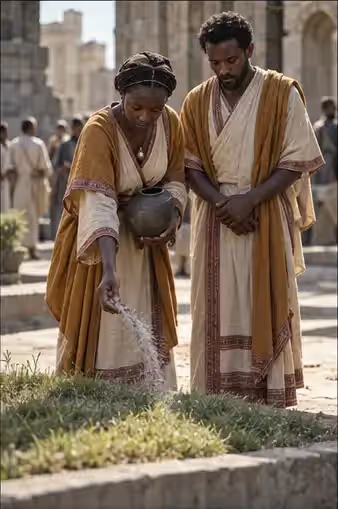
Ashes return to the grass plots along roads. This gesture links the dead to infrastructure that others will continue to use. It expresses a concrete imperial idea: nothing that sustained the collective should be forgotten or wasted. The rite does not promise magical survival; it organises material memory and ongoing maintenance.
“His roads stay open”
The ceremony closes on a formula: “He has passed into the register of the dead. His roads stay open.” The Empire born of famine wastes nothing, not even its dead: the dead feed the road that feeds the Empire. The eulogy is brief and says what the person held, corrected or measured truly. The names that relay workers give to a waymark make up another, popular memory, born of use rather than decree.
Dying on campaign
Soldiers who die far from home are not forgotten by the register. On every campaign the army opens its own register of the dead, kept by the notaries of death: name, legion, place, circumstances, and for fallen animals their lineage, the commander who led them and the debts their loss entails. When the battle allows, the bodies are burned on campaign pyres; the ashes are poured beside the march road, and the name is read at the next relay.
The families then receive a written notice, carried by the relay couriers, and the Counter of their quarter closes the name as for any death. The rite is the same for a general and for a skirmisher: the same formula, the same reading of charges, before a larger or smaller crowd.
The dead without a Line
The poorest are entitled to the same rite. A labourer without a Line, a ramp porter, a seasonal worker who dies without family also have their name closed in the register by a Counter; if they have no charge to pass on, this is simply said, and the register is shut. The wood for the pyre is then supplied by the quarter, and the ashes join the grass plots of the roads like everyone else’s.
This equality before the formula matters a great deal in the capital’s lower quarters. People there say that a death without a register is the only true disappearance, and the neighbours of someone who lived alone make sure that at least one witness goes with the Counter.
Mourning among the living
Mourning is worn for a short time, but it shows. Relatives wear a band of white cloth, the colour of proof, until the dead person’s debts and charges have been passed on; some noble families add ornaments of Velmor jet. On the day of the funeral, at the family table, the dead person’s measure is left empty: the bowl or share of bread that was theirs stays in its place, and the next day it is given to someone in need.
Remembrance then passes through function. The colleagues of the dead speak of them by citing what they held — a road, a workshop, a register — and their signature remains on the deeds they made. For many Urnokians this is where the dead live: in the work that carries on under their name.
Reading one’s dead
Families keep a copy of their dead at home: a tablet or a roll of egg paper on which the names closed in the register are copied, generation after generation, each with its main charge. At the time of the Reading of the Annals the year’s dead are added and the list is read aloud. The oldest families thus go back centuries, to names that are no more than a function: a porter, a miller, a silo keeper.
Part of this article covers events of season 1. Turn spoilers on in the menu to read it.