
Religion and rites
Arkhan’s dead remain persons
In Arkhan, rite strictly separates remembrance of the dead from any material use of their bones.
No human bone enters a supply chain
The Arkhan rule is explicit: a human bone becomes neither tool, weapon nor merchandise, even when it belongs to an enemy. This boundary is essential in a civilisation that works extensively with animal bone. People therefore know how to distinguish building material from the remains of a person. Confusing the two is not a decorative choice; it violates the dead and their household.
Bones carry a household, never a technical function
After the rite, bones join the deceased’s household and remain associated with their name. They may mark a doorway or family memory, but they never become anonymous parts. The difference matters: a place of remembrance affirms relationship and continuity; material erases the person from whom it came. The rite protects this distinction even in domestic architecture.
Recover before sorting
Mortuary teams recover human remains before any workshop chain. They also treat foreign dead as dead, without automatically integrating them into a clan. In campaign, this rule makes care for bodies a collective task with routes, witnesses and delays. It reminds people that a battlefield does not give the victorious force unlimited rights over those who have fallen.
Being buried whole
The Arkhan funerary dishonour is to be buried whole: a wasted body that reaches neither the beasts nor the house. The recently dead travel with the Great Shedding to see one last trail. For a khan, the saddle testament decides the mount’s fate: released, or entrusted to whoever follows. Foreign dead receive mortuary care, never integration, which remains a clan honour.
The first night
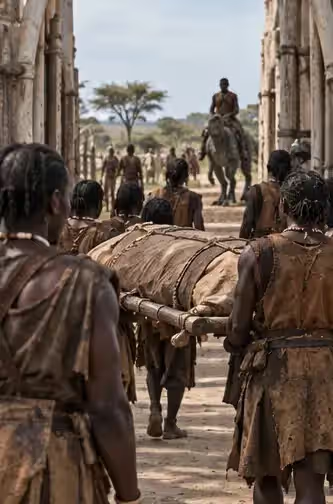
When an Arkhan dies in camp, he is not left inside the tent. His people lay him outside on a hide, his head turned toward the trail by which the clan arrived, and watch over him until dawn beside a fire that is not allowed to die. His mount is tethered nearby; that evening it is fed before the living. Nobody weeps aloud. People speak of the dead in low voices, telling what they saw him do, and each says his sentence with the mark of what was seen.
At dawn an elder or a singer of the clan takes the dead man’s cord and recites his lineage, knot after knot. He adds one last knot, the knot of death, which the Counting of Knots will acknowledge at the end of the season. Only after this recitation does the body leave the camp.
Giving the flesh back to the beasts
Excarnation takes place far from the tents, on a slab or a low platform that each camp sets aside for the purpose. The body is laid there and left to the beasts of the enclosures, then to the scavengers of the trail; in the cities, the house of rites has its own enclosure of the dead. The family attends the beginning and withdraws. Sun, wind and sand finish the work in a few days during the dry season, longer during the rains.
Foreigners see cruelty in this rite; the Arkhans see a debt settled. A man of the trail has lived all his life on the flesh of beasts, and he gives them back his own. This is also why the supreme dishonour is to be buried whole: a body put into the ground is given back to no one, it is wasted, and its house will never receive its bones.
Washing and naming the bones
Once the flesh has gone, the family comes back for the bones. They are rubbed with sand, rinsed when water allows, then left to whiten in the sun. Not all of them go to the same place. The skull and a long bone, most often a femur, return to the house: one is set on the lintel, the other holds a post of the door. The rest is entrusted to the clan’s ossuary, or travels with the family until the next Shedding.
A family bone bears no engraving. It is recognised by the cord knotted around it, which repeats the knot of the dead person’s name, and above all by the memory of those who placed it there. A door may thus carry three or four ancestors; when it is full, the oldest go to the ossuary, usually at the time of a departure. Children learn each name very early and greet them as they cross the threshold.
The time of mourning
Arkhan mourning is short and visible. For one moon the relatives do not paint themselves: no red dust, no clan pigment, and the white paint of war is forbidden to them. They eat only dried meat, never fresh flesh, and do not ride in that season’s Great Race. The dead person’s name is spoken freely by day, but people avoid saying it after sunset, when the fire is low.
Children who die before their first hunt raise a question that each trail settles in its own way: they have received a birth knot, but they have not yet entered the clan, and their name does not enter the chants. Most families keep their small bones in the mother’s house, near the hearth rather than at the door. The mount of an ordinary dead person passes to a relative or returns to the keepers of its lineage; only a khan’s mount follows a saddle testament.