
The law of captives
No common law protects captives: each power treats capture by its own logic, from the Arkhan taking to Korath’s refusal of any human slavery.
No common law
No international law of captives exists. As with eggs, each power has its own system, and no treaty covers people who are taken. Everywhere, capture is an economic event before it is a moral one; what changes from nation to nation is the way value is drawn from it.
Arkhan: a taking without a share
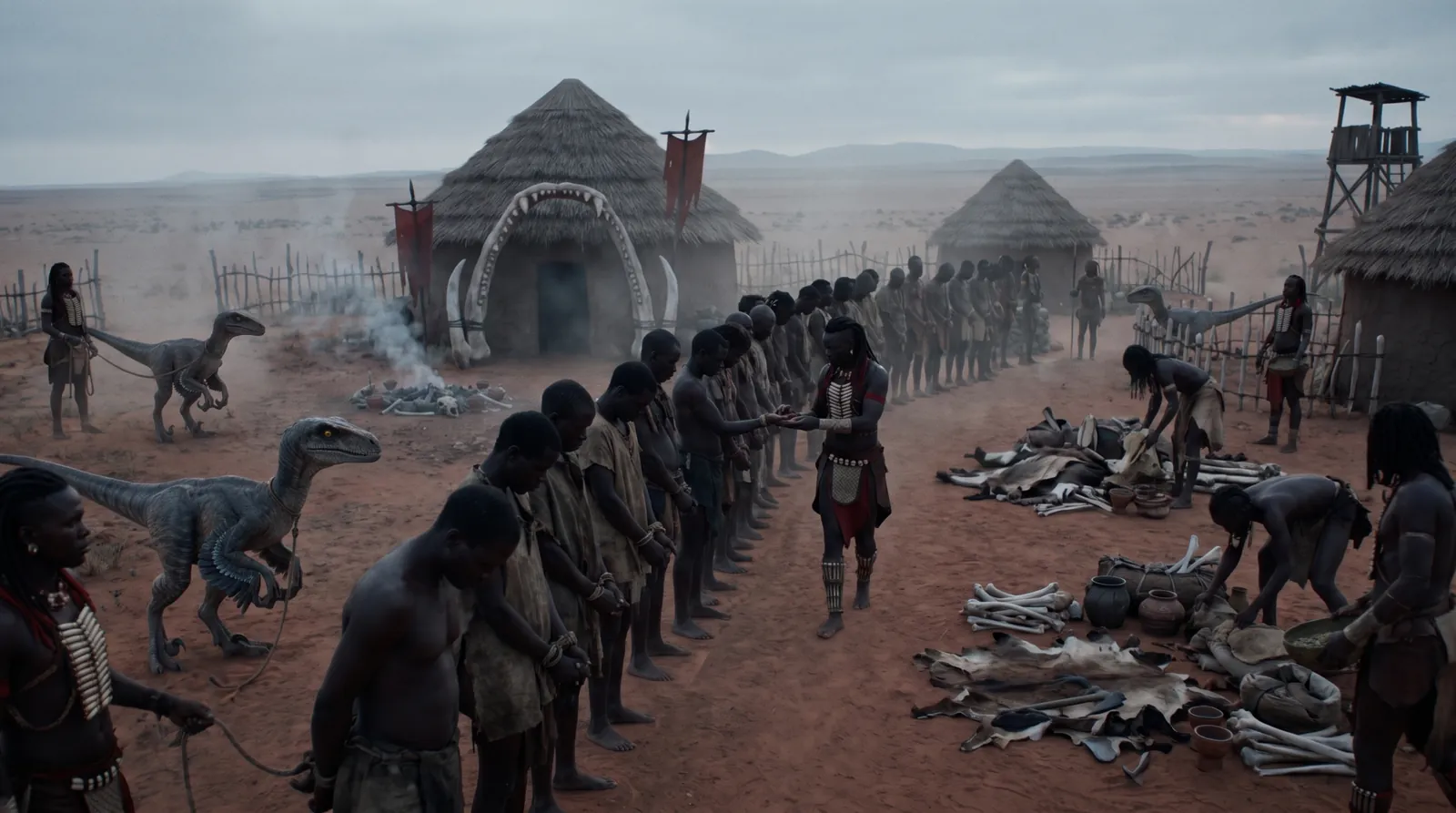
In Arkhan a captive is war booty, not a legal person: “a taking has no share”. The taking belongs to the horde, and the chief arbitrates individual allotments. A higher khan may requisition a taking for its skills; the one who took it has no rank to refuse, and the ration follows the body. The division of a raid’s captives obeys the Rule of Three. A mark, once applied, commits: on the trails, erasing a mark is not done lightly.
Korath: no human slavery
Korath practises no human slavery: legal ownership of human beings does not exist there. Korathians direct the work, and it is animals that labour in the mines. The rule does not make the country gentle: cruelty runs through contracts, bankruptcies, rationing, military discipline, exclusion and the use of living animals as instruments.
Urnok: ordinary justice
In Urnok, ordinary justice belongs to seigneurial and ducal courts: local judges, fines, public penalties such as the pillory. The Crown steps in when imperial order is at stake. The register makes it possible to assign a debt, a property or a responsibility to an identified person or house.
Arkhan: getting counted
Arkhan law knows no buying back of one’s freedom: one does not buy oneself, one gets counted. Through exceptional service a captive may have “a share counted”; this share mark is a first step towards integration. Children taken young join the horde with no captive status after their first hunt: the horde does not own its warriors.
Urnok: three statuses
Urnok distinguishes three statuses. The slave is rare, mostly domestic or foreign, and frowned upon in the old duchies. The prisoner of war is Crown property, exchangeable and ransomable, never private property. The foreigner under debt is the mass status: they work under contract until the debt is extinguished, entered in the registers. Born of a famine, the Empire prefers labour to flesh: a captive is a pair of hands for the silos and the roads, and killing one would be an accounting waste. “The register does not forgive, but it feeds.” The Empire steps in only for imperial war captures.
Ishtir: attribution
Ishtir neither sells nor buys anyone: it has no internal currency and no market. A captive is assigned there like everyone else: assessed, classified, posted. An adult enters as unweighed under observation and works on supervised Bronze tasks; after a cycle they pass an admission Weighing, or are expelled or exchanged. Captive children enter a cohort and become Ishtiri in full. Ishtir keeps no captives: it dissolves them. The Arkhans sum it up: “They sell no one. They assign everyone.”
Volonia: the contract
In Volonian law the captive does not exist: there are debtors and ransom contracts. Piracy captures, Volonia securitises: standardised ransoms, ransom insurance by which a house covers its captains against capture, “freely agreed” labour contracts with disproportionate clauses. This model, that of the Broken Isles, is not slavery but contracts — which is almost worse, and is the root of the northern pirates’ hatred.
At the Ransom Chamber, a public market, ransoms are quoted like cargoes, and a famous captive’s ransom can be speculated upwards. Ransom fraud — false identity, double ransom — falls under the Fifteenth and ends in the sea theatres.
Korath: the passage
In ordinary times Korath practises the technical hostage and the passage ransom: a captive is worth a toll, not an asset. “One does not own a man. One owns what he owes.”
N’Goro: quarantine
In N’Goro every captive or foreigner taken first passes through the Quarantine Basins: the Synod of Sapkeepers takes precedence over any right of capture. Then come ransom by their nation, service in the Broods, or adoption by a Domain. The Nasses, for their part, traffic people like everything else: it is one of the prohibitions the Synod cannot close.
Port de Sable, where the prize becomes value
The laws of the different powers meet in one precise place: Port de Sable, Arkhan’s commercial interface with the Volonian sea. That is where Arkhan prizes become Volonian assets. It has cages, markets for captives and beasts, money-changers, and contracts with particular clauses, the claw clauses. The same person may enter as a prize without a share, under the law of the horde, and leave as a debtor under contract, under the law of Volonia, without their condition having changed in the least. The republic’s cargo arbiters decide there every day what counts as damage and what remains deliverable goods.
On the margins of the six
Outside the six powers, capture follows harsher customs still. Among the tribes of the Seventh People, the Urzok-Khal, the most warlike, raid the marches and sell captives to whoever will buy. In the archipelagos, the Pavillon-Rouge has made hostage-taking a trade, with its lists, its keepers and its negotiators, while the Pirates du Nord return their captives for a ransom fixed once and for all or keep them at work, but refuse to sell their debt: it is the Volonian contract they hate.
Between these worlds move intermediaries whose trade is to bring people home: ransom negotiators, trail interpreters, clan mediators. They know the law of each power, the prices of each market and the delays of each route, and they are often the only chance of a captive no law protects.
Part of this article covers events of season 1. Turn spoilers on in the menu to read it.
Gallery1 image
Zarug plants the three stakes of the Rule of Three.