
Creatures
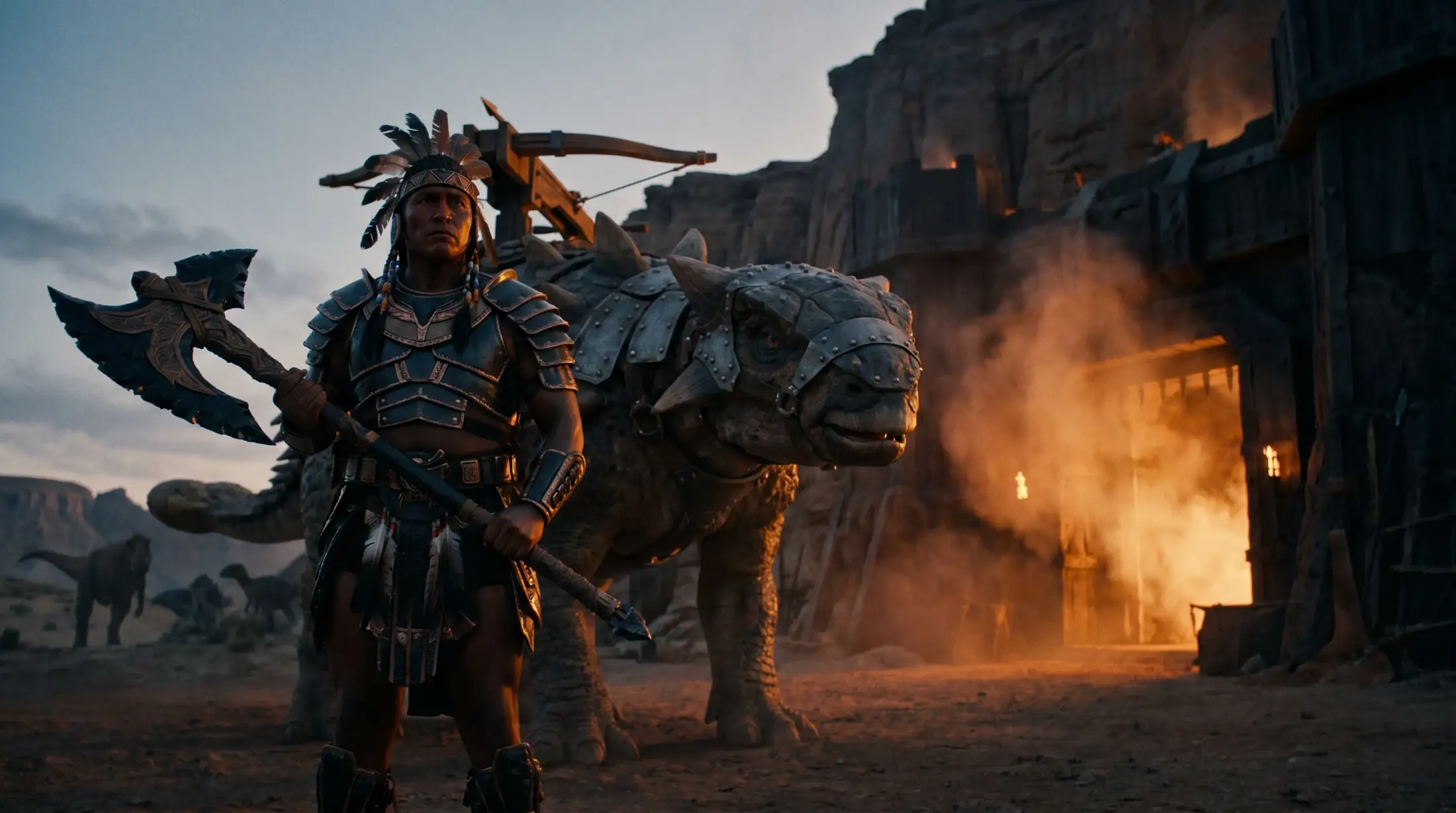
Rivet, Breska’s ankylosaur
The riveting ankylosaur of Breska Chaîne-Basse, master riveter: a living forge platform.
Hearing war in the metal
Rivet is a riveting ankylosaur with black plates, loaded with hammers: the forge platform of Breska Chaîne-Basse, Korath’s master riveter. It cannot bear any irregular vibration and strikes the ground in front of a piece that is too offensive. Breska hears war in the metal before the generals do. Like Korath’s other ankylosaurs, it is an imported animal working at the lower levels.
A forge on its back
Rivet carries a complete field forge on its back. A platform strapped between its shoulders holds a copper stove where the embers stay alive, an anvil, trays of rivets sorted by calibre, spare plates, and hammers and tongs hung on racks. The animal’s mass makes this platform one of the steadiest striking surfaces to be found outside a workshop: a rivet hammered on Rivet’s back does not give.
This forge travels to the repair. Where an ordinary crew must take a barding or a chain apart and carry it to a workshop, Breska Chaîne-Basse brings the workshop to the pass. The animal halts near the bridge, gate or battery to be mended, and the riveters work straight from the platform, at a person’s height.
Rivet’s ear
Rivet cannot stand any irregular vibration. A badly struck hammer blow, a rivet that sings false under the hammer, a plate that rings hollow make it restless, and Breska has learned to use this sensitivity as a check. When the animal stays calm under a series of blows, the work is even; when it shakes its head, someone must redo their stroke.
People in the passes say that Rivet stamps the ground in front of a piece that is too offensive. The riveters see in it a reaction to pieces mounted under too much tension, whose vibration betrays excessive strain, the ones made to strike rather than to hold. Breska, who hears war in the metal before the generals do, says that she and the beast are listening to the same thing.
Breska Chaîne-Basse
Rivet’s rider is one of the most respected figures of the passes. A master riveter, she gave her name to the guild of the Rivet-Masters of Breska, the most famous in Korath, which holds the knowledge of torsion bundles, lashings and plates. Her workshop name, Chaîne-Basse, “Low-Chain”, calls up the short, heavy chains that hold the bridges and traps of the passes, and says plainly where her reputation comes from.
Like every pass riveter, she reads war by the length of a chain: how many links will hold, how many days a battery can fire before it must be overhauled, how long a lock will last without repairs. This science of upkeep makes her more cautious than many officers, and the pass workshops like to quote her when they want to recall that a work is worth first of all what keeps it going.
A riveting ankylosaur
A riveting ankylosaur is chosen for three qualities: a broad, flat back, a placid temperament and an uncommon tolerance for noise. Rivet belongs to the fortress ankylosaur lineage, and its black plates hardly reflect the glow of the embers, which avoids giving the crew away when it works at night. The hammers hanging from its flanks are as much a part of its silhouette as its tail club.
Training takes years. The animal must learn to stand still under the blows, not to swing its tail when people work close to it, to walk slowly up slopes with a high load and to kneel so the platform can be unloaded. Riveter nodosaurs do similar work carrying tool platforms and plates; ankylosaurs like Rivet, which are heavier, carry the forge itself.
A day at the pass
A day for Rivet begins at the depot of the marches, where its straps, feet and platform are checked before the climb. The walk to the work site is slow, set by the weight-clockmaker’s tables, with halts for water and rations. Once there, the animal is placed out of the line of passage with the arc of its tail kept clear, and the crew sets to work around it.
In the evening the forge is put out, the platform emptied and the beast brought back down, for no animal spends the night on the heights of the pass. The carers clean the soot and metal chips from its osteoderms, examine the places rubbed by the straps and note in its register the load carried and the length of the work.