

Creatures
Korath — Le vivant, des soins aux manœuvres
Observer les anatomies, entrer dans les enclos, suivre les équipes de soin puis les retrouver sur le terrain d’exercice : ces scènes rapprochent le bestiaire de la vie des civilisations.
Enclos, soins et circulation
This extended reading is currently available in French.
La disponibilité d’un animal dépend autant de ses appuis que des conditions du passage. Dans les cols de Korath, les charges, les accès et les équipes doivent être pensés ensemble. Le repos et la ventilation des lieux de séjour appartiennent à cette préparation. Les savoirs techniques circulent entre ceux qui fabriquent et ceux qui utilisent : un défaut d’équipement ou une difficulté de mobilité doit pouvoir être observé, décrit et corrigé.
Observe gestures and materials · 5 images
La largeur d’un souffle
Cour des équipements · mesure du dégagement.
La première cuirasse
Nurseries des cours · soins des juvéniles.
Le regard sous la pierre
Citadelle · repos en galerie.
Le repos du marteau
Cours de rotation · inspection de la queue.
Le couloir des Drakes
Galeries d’exercice · apprentissage du passage.
Le détail du vivant se découvre dans les gestes ordinaires : un harnais ajusté, un dégagement vérifié, un troupeau orienté.
L’animal au milieu des hommes
L’exercice donne à voir les distances entre formations, les signaux et les zones de rotation. Certains animaux travaillent avec une unité ; la faune sauvage croisée à l’exercice n’en est pas domestiquée pour autant.
Observe gestures and materials · 6 images
La fermeture du seuil
Galeries défensives · verrouillage défensif d’un seuil.
L’épreuve du flanc
Cour des équipements · géométrie des corridors et couverture latérale.
La frappe puis l’arrêt
Nurseries des cours · contrôle de la masse caudale.
La réserve débouche
Citadelle · relève d’un noyau défensif.
Le cercle de la masse
Cours de rotation · rotation et protection des servants.
Le bélier des petites galeries
Galeries d’exercice · épreuve d’un morphotype pachy-bélier.
Caring for a living worker in motion
Assess before sending onward
Care begins with observation: footing, breathing, harness condition, hydration, irritations and behaviour. Minor discomfort can become a road hazard under load. Transit teams must isolate a problem without immobilising the whole network.
Caring for a living worker in motion
Rest is an operation
A rest space requires water, suitable shelter, safe access, unloading room and the ability to separate animals. The halt makes renewed movement possible. For people it is also where loads, tools and earlier decisions are checked.
Caring for a living worker in motion
Plan for removal and responsibility
Transit places provide escape routes, buffer pens, human refuges and access to care. They allow a body to be removed, panic to be absorbed or a route to be cleared. They also make responsibility visible when circulation conditions were poorly prepared.
Korath passes, lock gates and evacuation
Close without trapping
Lock-gate citadels use double doors, airlocks, counterweights and manual emergency operation. Their function is not only to stop passage: they organise what must remain breathable and accessible when a sector is isolated.
Korath passes, lock gates and evacuation
Air, water and heat are defensive reserves
In a pass or closed district, air, water and heat determine how long people can work, wait or evacuate. These needs require maintenance of ducts, shutters, drains and closure systems.
Korath passes, lock gates and evacuation
Animals do not abolish the mountain
Animals in the lower marches need turning yards, passage arcs and rest areas. They do not make deep urban areas automatically usable. Equipment, winches and access-regulating people remain central to pass transport.
Housing and ventilation in Korath
Excavated levels and vertical access
Cities are excavated into the mountain and connected by winches, galleries, thermal conduits and other vertical access. Visible facades, terraces, towers and markets form only the skin of deeper settlements. Imported animals remain in the lower marches and do not structure deep cities.
Housing and ventilation in Korath
Heat distributed to homes and workshops
The Warm Vein distributes geothermal energy to homes, greenhouses, baths and workshops. Thermally stable zones also house schools, taverns, indoor gardens and markets. Heat is therefore infrastructure that conditions where people live, learn, work and preserve, rather than a molten-rock backdrop.
Housing and ventilation in Korath
Ventilation, doors and evacuation
Returned Breath organises ventilation through thermal differences and pressure. Doors, airlocks, counterweights and stores of air, water and heat can isolate a district; evacuation must nevertheless remain possible. In Korath, a closure may protect the city but also redistributes risk between districts.
The mountain as a weapon
Korath has no institutional giant dinosaur. Its military power rests on forges, passes, chains, winches, armour and ballistae. The prestige of invention and counter-testing sustains workshops and technical publishing; mastering matter becomes a strategic advantage.
Animals in the lower marches
Closing and evacuating
Lock-gate districts combine double doors, airlocks, counterweights and manual emergency closure. They hold air, water and heat reserves. Isolating a district must preserve evacuation: defence also organises flows and failures.
Transmission of technical knowledge in Korath
A method must work in front of other people
A process becomes shareable when it is observed, reproduced and subjected to objection. This principle allows a workshop to transmit useful gestures and limits to partners without pretending a recipe can replace experience.
Transmission of technical knowledge in Korath
Correction retains an origin
A correction can modify a part’s use without erasing the people who designed, tested or identified its limit. Signature makes an object’s evolution legible for those who must maintain or adapt it. It is a condition of trust in a long technical chain.
Transmission of technical knowledge in Korath
Transmission does not mean surrendering all responsibility
Knowledge shared between workshops or territories must remain tied to its material, load and maintenance context. Transmission passes through observation, trial and the experience of the people who work with these processes.
Fitting day
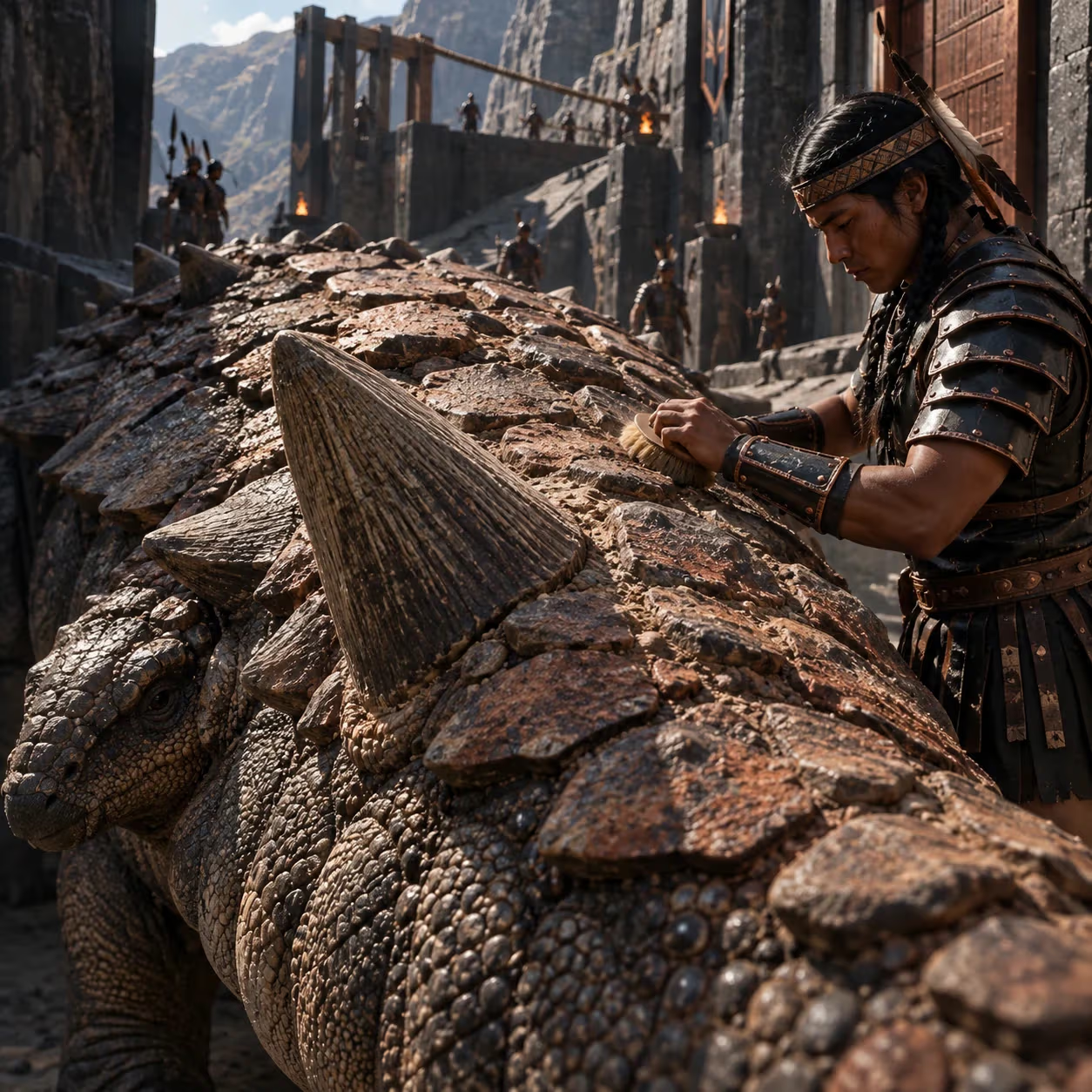
Once a season, every war ankylosaur spends a day in the armourers’ hands. It is led into a clear yard and made to lie down, and a crew of about ten, carers, armourers and beast-master, checks its whole barding: split plates, worn straps, bent hooks. The studded ring that binds its tail club is taken off, cleaned and refitted, because a loose ring can slip at the first blow and injure the tail.
The beast-master stays at the animal’s head throughout and talks to it constantly; the others work outside the arc of the tail, which a slack chain holds to the ground. The carers use the day to examine the skin under the plates, which the barding hides the rest of the time. In the evening the beast is weighed, and its register receives the date of the fitting, the names of the armourers and the list of parts replaced.
A beast down in the pass
A wounded ankylosaur in a pass cannot be carried. When a beast goes down, the chain-masters and haulage crews first try to raise it with straps passed under the belly and winches anchored in the rock, then walk it back down step by step to the depot, where the carers are waiting. The operation can take a whole day and involve dozens of people, and it is only attempted if the passage can stay open meanwhile.
When the beast can no longer be moved, the decision lies with the command. Sometimes it is left where it fell, across the passage, where its body becomes one more obstacle for the enemy; whatever can be recovered is salvaged later. Beast-masters do not argue with the order, but the crew remembers it for a long time, and the animal’s register records the place and date as soberly as it would for a soldier.
The carers of the marches
The carers of the marches form a profession of their own, trained at the depot rather than at school. They learn to read a gait, a breathing pattern and a hide, to clean the folds between the osteoderms and to treat the sores the straps open. Against the mange and parasites that lodge under the plates they use an ointment of sulphur and fat prepared in the Rifts; for deep wounds they rely on veterinary ointments imported from N’Goro, expensive and carefully stored.
Each depot has its veterinary stalls, with an isolation yard for sick beasts and a store of remedies. A good carer spots a problem before it becomes a danger on the road, and beast-masters know it: in the marches people say an ankylosaur lasts twice as long with a good carer as with a bad one.