
Armies
Croc-Amphibe
A marsh militia of water guards.
Function and place in war
Croc-Amphibe is a militia of water guards.
It is one of the defensive minor factions of the marshes, alongside those that keep watch, like Œil-Boue against amphibious reptiles, those that sound the alarm, like Crécelle-Brume, and those that provide common defence, like Brume-Quatre and the Union des Six-Îlots.
A militia of fishers and reed cutters
Croc-Amphibe is a militia in the oldest sense of the word: its water guards are not professional soldiers but fishers, reed cutters and boatmen who take up arms in turn to hold the fords, passes and channels of their sector. One joins young, often around sixteen or seventeen, after proving one can swim in black water, hide in a reed bed and read the marks of a modified water.
As everywhere in N’Goro, command most often falls to women. The captains of Croc-Amphibe are clan mothers or former guards who know the waters they hold by heart, and the militia is divided into small bands of a dozen guards, each attached to an arm of water. It numbers a few hundred active members in all, and many more reservists, since almost every adult in the sector has served.
Weapons and equipment
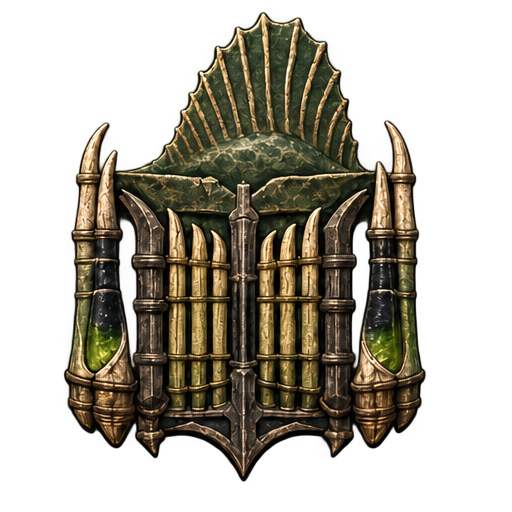
The water guards’ equipment comes from the trades of the marsh. Billhooks and curved bone knives, fishing harpoons tipped with bronze, weighted nets, blowpipes with poisoned darts, javelins of hardened reed: nothing heavy, nothing that sinks. A few bands ride tusked crocodilians, smaller and more manageable than the great saurians of the deep waters, to guard the reed beds and carry the lance teams. Guards wear chitin plates on chest and shoulders, oval shields of waterlogged black wood and hoods of braided rush that blend them into the reed beds; their skin is often smeared with mud and lichen to mask their scent and sheen.
Each guard also carries a threshold kit reinforced for combat: Red Moult to stop bleeding, Counter-milk for anyone who has breathed Black Milk, Silent Water to approach beasts or men without being smelled. Weapon poisons are named and signed like any others, and their counter-flasks deposited with the Sap-Keepers: the militia applies the law of poison with a rigour it is proud of.
Holding a water
In peacetime, holding a water is patrol work. Croc-Amphibe’s bands travel their channels by dugout, check the marks, report waters modified without declaration, escort laden barges through difficult passes and enforce the tolls of neighbouring minor powers. They guard the fords against amphibious reptiles, in liaison with the lookouts of Œil-Boue, and drive off crocodilians that come too boldly near the villages.
Their authority rests on knowledge of the ground more than on their weapons. A Croc-Amphibe guard knows which mat holds a man and which gives way, where the current runs at low tide, which arm turns dangerous after rain. Travellers often pay them for an escort, and the Black Milk Houses prefer dealing with them to crossing them.
Amphibious combat
In war, Croc-Amphibe fights the way one hunts in the marsh: from ambush. The guards wait in the reeds, half submerged, until the enemy commits to a ford or a narrow pass, then strike the flanks and rear before vanishing beneath the water or into the reed bed. They cut the ropes of rafts, puncture floats, lure columns onto floating mats that give way, and leave the waters, the fevers and the beasts to finish the job.
They also know what they cannot do. On dry, open ground, a band of water guards is no more than a handful of peasants armed with billhooks, and their captains always refuse battle in the open. This is the whole N’Goro doctrine on the scale of a militia: choose your water, multiply the thresholds, never offer the enemy the battle he came looking for.
What is said of Croc-Amphibe
The militia’s name comes, it is said, from an old marsh joke: the water guards bite like a crocodilian and vanish like a frog. Urnok merchants find them slow, fussy and expensive; people in neighbouring villages find them indispensable and a little too proud. Children are told that a Croc-Amphibe guard can stay a whole night under water breathing through a reed stem, which is false, but not by much.
Its captains like to point out that the militia does not need to win to fulfil its function: it is enough that the enemy reaches the next threshold later, wearier and fewer.