
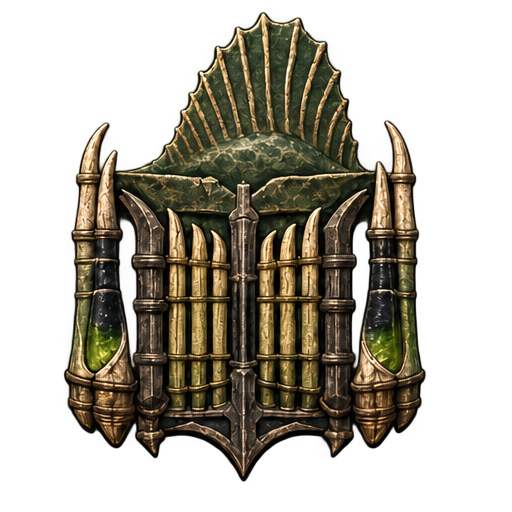
Religion and rites
The Sealing of the Mires
A N’Goro biosafety rite: at the edge of the Forbidden Mires, quarantine zones are resealed and the ancestor masks renewed.
Closing the quarantine again
The Sealing of the Mires (Scellement des Mires) is a biosafety rite. At the edge of the Forbidden Mires the lines of stakes are replanted, mud seals are pressed onto palisades of living stakes, and new masks, the ancestor masks, are solemnly handed over. Herb fires burn along the edge, giving off green smoke. The taboo on anti-marsh leathers is proclaimed once more.
A rite kept at a distance
The crowd is deliberately thin. Only the chosen Sap-Keepers come close; everyone else watches from afar. The distance is part of the rite.
The Forbidden Mires
The Forbidden Mires stretch through the interior of the Bay of Roots, behind the hidden ports: a country of deep mudflats, stagnant waters and drowned forests where wild marsh titans live. Some of their waters have been sick for generations. Fevers persist there, spores proliferate, and whatever leaves without precautions can contaminate a whole basin. They have been neither conquered nor cleansed; they have been sealed.
Tradition credits the first sealing to Vahku, founder of the House of Saek, said to have been the first sealer of the Forbidden Mires and the first keeper of the taboos. Since then his heirs and the house’s quarantine sealers have guarded the edges together with the Sap-Keepers. But a marsh seal does not last: stakes rot, mud shifts, floods erase marks, and the limits of the sick waters themselves advance or retreat. The Sealing is first of all the upkeep of a border that moves.
The gestures of the sealing
The rite is held once a year, at low water, when the edges are visible and the mud can be worked. It lasts several days. The sealers begin by walking the cordon and counting the stakes one by one; rotten ones are pulled out and replaced by living stakes, mangrove cuttings that take root in the mud and over the years form a palisade that grows instead of falling. On each repaired section a seal of thick mud is applied, marked with the sealer’s sign and the season, stating who answers for that stretch of border.
The herb fires come next. Cakes of black spores, peat and fumigation herbs are burnt in them, and their dense green smoke drives off the insects that might carry contagion from one side of the cordon to the other. The last gesture is the handing over of the ancestor masks. These are chitin masks stretched with Siirmuu sail, in the likeness of the Great Ancestor, fitted with a crystal pad and a spore felt: they are both a sacred object and a filter. Renewing the masks means renewing what protects the sealers, and they may be lent and repaired, but never sold.
The taboo of the anti-marsh leathers
At the end of the rite, an elder proclaims once again the taboo of the anti-marsh leathers. Spore-black leather, cold-smoked over black spores for twelve to twenty-four hours and then bathed in roots, is one of the country’s most precious products: dark, supple, rot-proof, it withstands the marsh like no other. But its tanning uses spores gathered near the edges, and a badly kept workshop can spread what it was meant to tame.
The taboo says three things, recited every year in the same order. No hide taken in the Mires may leave them without having been tanned on the spot and inspected. Spore tanning is practised only in recognised tanneries, most of which belong to the House of Saek and lie in the Terres Englouties. Tanners live apart, wash at basins reserved for them and do not share the drinking water of other families. The trade is not cursed, but it is kept at a distance, like the rite itself.
Watching from afar
The Sealing’s thin crowd is not an absent crowd. Families from the nearby villages come by barge and moor on the far bank of an arm of water, from where they can see the green smoke, the masked figures and the stakes being driven in. They do not cross. Distance protects the onlookers, but it also has a meaning: what the sealers touch must not be approached out of curiosity. Children learn there, without anyone needing to explain it, that there are places where one does not go.
The rite closes with a reading. A Sap-Keeper names aloud the year’s sealed zones, the waters that have advanced, those that have retreated, and the names of those who died or vanished there. Then the officiants themselves spend seven days under observation in a quarantine basin before going home, and that delay is part of the festival: you do not come back from the seal the way you come back from market. The Ngoro say that what is sealed is not told, and the Sealing is one of the few festivals from which no story or memento is brought back, only the date.