
Culture
The Great Respiration
The national, simultaneous week of the Respiration, the greatest carnival in the known world. All of Ishtir breathes at once, except the watch teams, whose week is given back to them afterwards.
The whole country at once
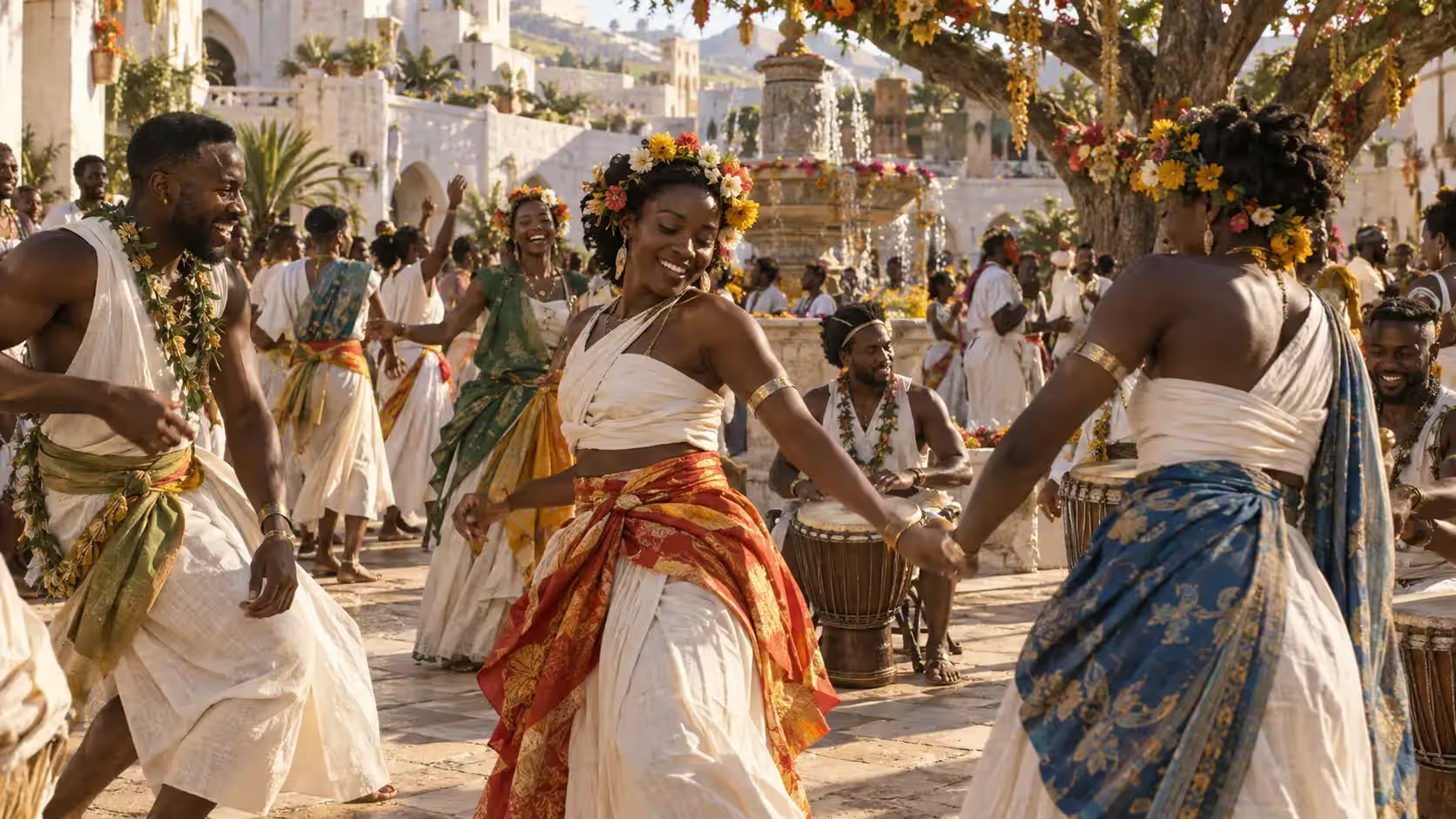
The Great Respiration is one week a year, national and simultaneous. It is shared by all three ranks: one of Bronze’s eight weeks, one of Silver’s four and Gold’s only one. Even the Gold breathe. It is the greatest carnival in the known world; the Jardin du Levant, around the capital, is its heart, with its great flower carnival.
The morning after
The week ends with the harshest cut in Ishtiri culture: a last night of exploding colour, then, in the morning, white, gold, rank, silence and work. The rules return in full. The same society that laughed at itself for seven days still executes whoever truly refuses the Weighing: both are true together.
The watch teams
The Great Respiration never brings the country to a full stop. Indispensable functions — water, medicine, animals, borders and the army — run on watch teams. Their week is returned to them in full afterwards, as deferred Respirations that the Scheduling of Respiration organises all year round. The calendar thus makes visible the work that cannot pause, without turning it into a permanent sacrifice.
The rankless boxes
The carnival has its rankless boxes: places where, for the length of the festival, rank does not count.
The eve and the first morning
The Great Respiration is prepared months in advance: flower fields are sown to bloom that very week, garlands woven, ribbon dyes made ready, places in the guest houses allotted. On the evening before, however, nothing shows yet. The streets are white, the tunics the right way out, and the last noon has been kept in silence like all the others.
On the first morning, colour arrives with the sun. At the first ray, the children’s cohorts, who climbed onto the terraces and roofs during the night, throw the first handfuls of petals onto the streets, and the Midday crier, for the only time in the year, announces dawn instead of noon: “Ishtir breathes.” Within hours the white capital is covered in flowers, fabrics, ribbons and paint, and the white monuments become the frame for a décor that will last only seven days.
Seven days
The week has no official programme, but it has a rhythm everyone knows. The first days belong to flower processions and parades, while the crowd is still fresh and so are the flowers. The middle of the week is for parks, banquets and show houses; this is when the Garden Games run day and night and the Verger des Halcyons sends its wines. The nights of the fifth and sixth days are the longest of the year.
The seventh day brings the last night, the final explosion of colour, drums and dance. Many do not sleep. Others decided long ago to spend the week far from all that: a Gold reads under a tree, a Bronze gardens at home, a carer sleeps for five days in a row. The week is the same for everyone; how to live it belongs to each alone.
What satire may do
Satire is one of the great pleasures of the week. A Bronze dresses as a Gold, with a sleeve embroidered in yellow thread and a stiff gait; children imitate dignitaries; ten Bronze with cloth wings mime the Ten Golden Wings in council; absurd Weighings are staged in which empty jars are weighed and whoever has eaten the most dates is raised to Gold. Everyone laughs, and the real Gold laugh with the rest.
Satire has limits nobody needs to write down. One mocks offices and their quirks, not the dead or the sick; one does not mime a real sentence passed on a real person; one touches neither the great living ones nor the eggs of the lines. Beyond that almost everything is allowed, and the stiffest Gold are the ones most willingly mocked. The next morning the costumes go back to the workshops, the sleeves are sewn up again, and nobody reminds anybody of what was said during the week.
Inside the rankless boxes
The rankless boxes are the carnival’s night-time heart. They are halls, courtyards or terraces fitted out for the week, where rank does not count. One enters only with the sleeve turned, without badge or medal, and no title or office is given there. Everyone speaks in the horn register, the face-to-face of equals, and it is perhaps the only week of the year when a Gold and a Bronze who do not know each other talk that way all night long.
People dance, drink and meet there, and one rule protects it all: what is said in a rankless box does not leave it. The boxes close at dawn on the eighth day. Regulars say one learns more about one’s country there in a single night than in seven years of Weighings, and the priests, who go there too, do not contradict them.
The foreigner and the festival
Foreigners who discover the Great Respiration rarely keep the same memory of it as Ishtiris do. Many arrive expecting a white, stern and silent city, and find forty thousand dancers in a square and a Gold asleep under a table. They no longer understand anything. Then the week ends. The next morning everything is white, the gold is back in its place, the sleeves are the right way out, and the country works in silence. They understand even less.
Ishtiris do not try to explain. To Volonian merchants, Urnok’s envoys or captives under observation who ask, they answer with a single phrase, the only one that seems enough to them: “They are breathing.” The most attentive foreigners remember one thing above all: the same society that laughed at itself for seven days has softened none of its laws. Ishtir is not austere or festive; it is extremely both, and it knows exactly when each one is allowed.