

Culture
Port kitchens
Sea, markets and celebrations feed tables with very different fortunes.
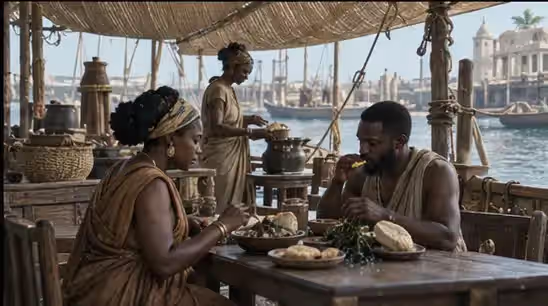
Food from the waters
Fish, lobsters, crustaceans, shellfish and seaweed belong to Volonia’s food repertoire. The sea provides everyday staples as well as luxuries. Fishing, holding ponds and port exchange bring together resources requiring different work. A maritime stall therefore tells of several trades before its produce enters a kitchen.
Cooking among arrivals
Volonia welcomes merchants, workers, refugees and artists from the known world. Port kitchens belong to its culture of circulation, alongside street music and floating markets. Styles and people travel with goods: a port’s life is reflected in what its tables offer and in the people serving them.
Celebration does not erase hunger
Rum, spectacles and luxury make the ports attractive, but social protection remains weak. Middle-class terraces and wreck neighbourhoods exposed to storms belong to the same city as great villas. Food circulates through this unequal geography: conspicuous wealth and daily vulnerability can lie only a few walkways apart.
Some port dishes
Terrace food is often eaten standing up. Crab-shield meat is sold cooked, in a paper cone, at the corners of the gangways; squid caught at night is fried in fish oil; the armoured fish of the silver banks is grilled on planks over the embers and eaten with seaweed. The sailors’ dish is a stew of black-salted fish, spiced with sweet bark and ember-pepper. To mask the taste of six-week salt provisions, crews carry a ship’s blend, ground from spices, bark and black salt, which every ship’s cook claims to measure better than the others.
Rich tables have their own rules. Fish dead since the day before is never served: noble fish and crown lobsters arrive alive, in copper-lined hold tanks, and the lobster is shown alive to the guest before it is cooked. Boutargue is cut into fine slivers as an appetiser, and dried magnolia buds, studded into salted meats, perfume festive dishes.
Rum and taverns
Rum is the drink of Volonia. Port rum, distilled from the molasses of the Souths in the cellars of Séloris and the Bay of a Thousand Masts, is served in every tavern, poured at paydays and flows at feasts; flavoured with magnolia buds, it is drunk hot on stormy nights. Century-old rum, aged a hundred years in a cask of archipelago wood, is drunk by the spoonful, and connoisseurs can argue about it for an entire evening without agreeing.
Taverns live by the rhythm of tides and wages. They fill when the crews draw their pay at the quay bell, and empty on the departing tide. People toast “at quay” there, that is, to what is settled: the toast celebrates an extinguished debt, a finished voyage or wages received, and toasting “in the hold” is thought a bad omen. On Friday evenings, after the maritime theatre, families have a meal of fried fish there before going home, and some taverns are so attached to a theatre that they change their sign with its playbill.
Hosting, Volonian style
Hosting is a house art. The seating plan reflects the contracts under way, and those who must come to terms are placed side by side. Conversation follows a curious custom: at table, one speaks in Mist. Guests trade rumours, impressions and plans without endorsing anything, and whoever switches to the Sealed mode during the meal commits a discourtesy, for he forces his neighbours to answer in business terms. Agreements are concluded afterwards, in another room, in the appropriate mode.
Foreigners are often surprised by these tables. Envoys from Ishtir eat little and drink even less, merchants from Urnok ask for bread where fish is served, and Arkhan visitors are amused that a live animal is shown before it is eaten. The cuisines of migrants add their dishes to this repertoire: spiced fried food from Sand Port, grain cakes from Urnok, fermented preparations from the marshes. A Volonian city can be recognised by the fact that, in a single street, one can eat the cuisines of five nations.