
Religion and rites
The Black Kindling
The ritual lighting of Korath’s black forges: the season’s first casting and the blessing of obsidian and iron crystal.
The first casting
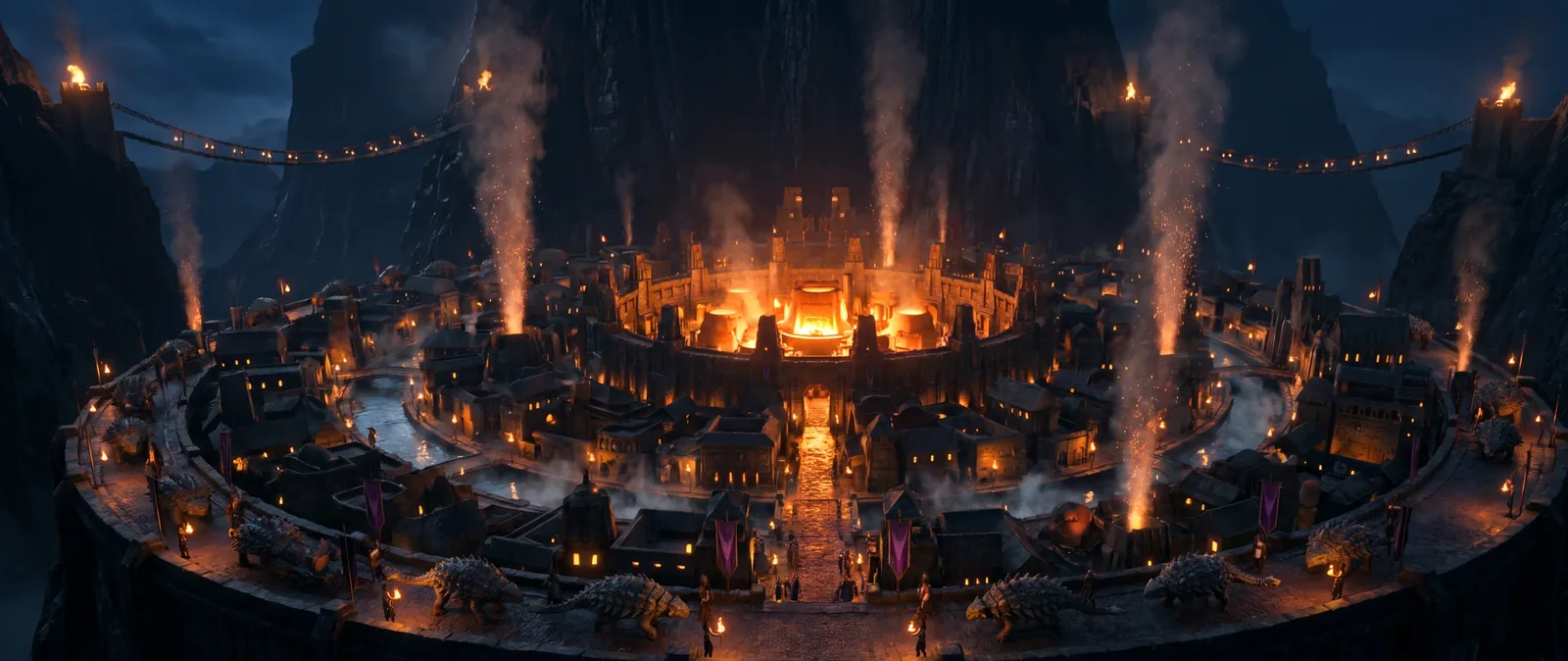
The Black Kindling (Embrasement Noir) is the ritual lighting of Korath’s black forges. The season’s first casting takes place at night in the mountain; columns of smoke rise from the passes and the glow of the crucibles stains the basalt plum and ember. Obsidian and iron crystal are blessed.
Shards for the warriors
Obsidian is broken into votive shards that are handed out to warriors. All Korath gathers on the stone tiers to watch the casting.
The only fire that is put out
It is said of Korath that it never sleeps, that it only lowers the fire. Yet there is one moment in the year when the great black forges truly go out. For a few weeks the furnaces are cooled to be repaired: cracked crucibles are replaced, ducts are cleared, moulds and basins are reworked. This is the great cooling of the forges, which Korathians readily compare to the Cooling Time, the rite that forbids judging a decision while it is still hot; the cities then live through an unusual silence, without the continuous bass of the breathing furnaces.
The Black Kindling ends that silence. It relights the forges and opens the working season with a first pouring, held at night, in the mountain. For Korathians it is the moment when force returns into Form: the Magma takes its place again beneath the works of humankind.
The night of the lighting
The ceremony begins at nightfall. The crowd takes its place on the stone tiers around the black forge, or on those of the great lava stadiums in the Failles rouges. The sacred geometers trace a black square on the ground around the main crucible, and silence falls. The fire is relit from an ember kept since the end of the previous season, then the bellows start up one by one, until the whole forge is breathing again.
Then comes the first pouring. Molten bronze is poured into a round basin carved at the centre of a square slab of black basalt, and for a few moments the red circle of liquid metal glows in the middle of the square: the national symbol takes shape before everyone’s eyes. Columns of smoke rise from the passes, and the glow of the crucibles tints the basalt plum and ember. The first parts cast that night are stamped with a special mark and kept by the workshop that made them.
Obsidian and iron crystal
On the night of the Kindling, two materials are blessed. Obsidian, the black glass of the Failles rouges, stands for rock that fire has already worked: the Mountain and the Magma united in a single stone. Iron crystal, bright shards of ore that miners draw from certain veins, stands for metal still waiting to be smelted. Both are laid on the threshold of the forge before the first pouring.
Korathian blessing claims no hidden power. It consists in measuring, naming and declaring: the sacred geometers examine the stones, state their origin, declare their visible flaws, then hand them to the smiths. What is blessed is the relationship between matter and those who will work it, in keeping with the country’s belief: the Mountain owns matter, the Magma force, and humanity owns only Form.
What becomes of the shards
After the pouring, the blessed obsidian is broken into votive shards distributed to warriors. Each receives his own from a smith’s hand and keeps it on him all year: in a pouch at the belt, sewn into a lining, or set in a small bronze plaque at the neck. On the eve of battle, when the unit waits until a heated stone can be touched with a bare hand, many clench their shard in their fist.
The shard follows its bearer to the end. When a soldier dies, it is given back to the magma with him, as the rite of the dead requires. The survivors’ shards are brought back to the forge at the next Kindling and thrown into the fire before a new one is received: the year of service is closed, as a square is closed.
All Korath on the tiers
Each great city holds its Kindling, and the pass towns light their own forge on the same evening. Workshops come as a body, with their colours, banners and songs; families bring the children, who see for the first time the black square and the red disc take shape in the metal. Foreign buyers, when admitted, stand under escort in the places reserved for them.
The papers discuss the night passionately. The colour of the flame, the length of the pouring, how the mould held and the order of the bellows become subjects of national debate, by the Korathian rule that turns a tiny detail into a controversy. Taverns stay open until morning. One thing, however, never changes: even in celebration Korath unlocks nothing, and the passes stay guarded while the country watches its forges come back to life.