

Culture
Food of the passes and greenhouses
Preserving, importing and growing under constraint give food its value.
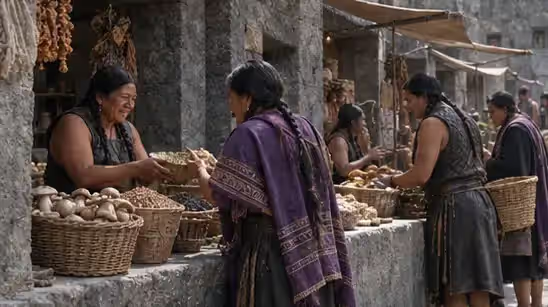
Mushrooms, smoking and imported grain
In Korath, mushrooms, smoked meats, imported grain and pass rations feed the inhabitants. Local resources and incoming supplies together sustain mountain life. Preserving meat and delivering grain are different responses to the same constraint: having food where rock leaves little cultivable soil.
A local fruit carries engineering
Some valleys become habitable through terraces, greenhouses, imported soils, mirrors and aqueducts. Heated orchards and vineyards make a local fruit a technical achievement and a luxury. Its value comes from more than scarcity: several systems have allowed a plant to grow in terrain that did not naturally provide those conditions.
Grain can support an education
A foreign student’s education can be paid for in grain, wood, resins, oils, medicines, fish, animals or ores. Hosting a student mobilises scarce mountain resources. Food therefore participates in the exchange of knowledge: the household or state funding an education can materially support the learner’s life.
Mushrooms, the base of the meal
The cave mushroom is the most Korathi food there is. It is grown on beds of dung and sawdust in the disused levels of the galleries, in the dark and the lukewarmth of the conduits, and harvested all year round. It is eaten fresh in broth, grilled on a hot stone, chopped with grain into cakes, or dried: dry, it keeps through a whole winter and swells again in a little cooking water.
Growers tell dozens of varieties apart by colour, firmness and where they grow, and taverns post their origin the way others post the origin of a wine. A broth of black mushrooms from the old mines is held to be the best remedy against the cold of the passes. Foreigners soon tire of it; Korathi who leave to study or work far away say it is the first thing they miss.
Eating to the beat of the gong
The Korathi day leaves little room for long meals. In the morning people swallow a cake and a bowl of broth before the gong. At noon the workshops stop for the time set by the public clock, and journeymen eat on the spot, often at the bench itself, from copper pots their families filled the evening before. The large workshops have canteens, where the meal is part of the contract just like the heated lodging.
The real meal is the evening one, at home or in the taverns of the warm city. Stews of mushrooms and grain are served there, smoked meats and, for those who can pay, the small white fish of the underground lakes, rare and much sought after. The square-rule taverns, where people eat while redoing the day’s calculations in chalk on the slate tabletops, are the heart of this evening life.
Black beer, heated wine, rift spirit
The drink of the many is black beer, also called forge beer: thick, almost a food, brewed near the rifts with imported grain, it is drunk in the evening after the day’s precision work. The wine of the heated vineyards is its opposite: rare, made in small quantities on a few terraces, it costs some twenty times the price of an Ishtiri wine and seldom leaves the boxes and the bourgeois tables.
Between the two stands rift spirit, a liquor drawn from black beer and distilled with the heat of the conduits. It is drunk little and seldom: it is often what fills the First Glass at the coming of age, and it goes with the reunion of a crew back from a pass. It is served in red copper cups set with jet, which miners raise after the change of shift.
The tables of wealthy houses
Among the bourgeois of the Four Sides, a meal is a demonstration. The table is square, made of a costly imported wood, and carries the plaque of the workshop that calculated its load. Crystal salt, the rock salt of the massif’s salt mines, is served in large clear lumps grated at the table. Dessert brings the hothouse fruit, figs, citrus and stone fruit, offered in small amounts, each one standing for weeks of angled mirrors and maintained heat.
The richest houses have the wine poured by a parlour automaton, a mechanical figure that pours, bows and folds away, and that is shown to guests the way others show a gallery of portraits. Refinement lies less in abundance than in difficulty: in Korath, a dish impresses when everyone knows how much technique it took to bring it to the table.
Smoking, salting, preserving
Meat is scarce and nearly always preserved. Part of it comes from the lower marches, where retired beasts from which no more work is expected are slaughtered; another part is bought smoked or salted from the trails of Arkhan, through the south-eastern exit of the massif, which greatly amuses the Arkhan and slightly embarrasses the Korathi. It is smoked in chambers cut above the conduits, where dry heat rises slowly, then hung in the stores of the deep core.
Crystal salt serves for everything: brine for greenhouse vegetables, preserved fish, salted meat. Families lay in their stores at the end of summer, when the convoys have filled the markets, and count them before winter the way one counts spare parts.