

Culture
Learning through the object that resists
Observing, repairing and demonstrating give technical teaching a daily form.
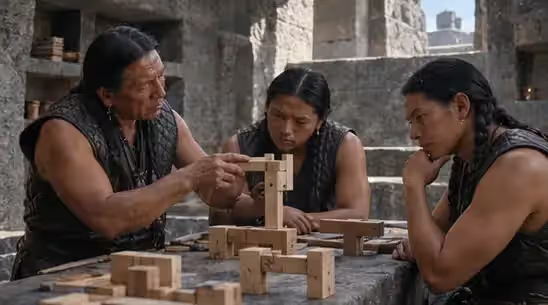
Small practical patents
Children learn to observe and demonstrate by filing small practical patents. Objects supply a question to solve and a result to show. This training connects knowledge to use early: an idea must meet a material, a functioning mechanism and the need it claims to answer. Workshops also become places where young people follow a working tradition.
Understanding before repairing
The Trial of the Crack asks young people to understand and repair a damaged object. Invention does not exhaust skill: one must also read a failure and restore use. Failed material requires recognising what gave way. Repair makes patience and observation visible abilities alongside making a new object.
Honestly showing what fails
A prototype can fail without dishonouring its author; concealing failure is worse. Counterproof allows a rival workshop to reproduce and challenge a design. Learners must therefore be able to explain an imperfect result and its limits. Correction belongs to transmitted knowledge: recognising a deviation leaves others a basis for further work.
Students from other countries
Foreign families and states send students to learn engineering, architecture and construction in Korath. Mathematics, open patents and civil standards form shareable knowledge. This attendance extends workshop influence beyond the mountain. Education also needs resources: grain, timber, medicines or ores can contribute to a student’s stay.
Apprentice, journeyman, master
Korathi training follows three grades. The apprentice joins a workshop after the youth school, often at about fourteen, and spends the first years observing, measuring and repairing. He becomes a journeyman after the Trial of the Crack and a few years of work, when his master judges him able to deliver a piece alone and declare its limits. The title of master, finally, is not given: it is won with an examination piece judged by other masters.
The bond between master and apprentice is a contract as much as an affection. The workshop lodges, heats and feeds the apprentice; the master owes him a complete teaching, including the mistakes he himself has made and the way he corrected them. A master who keeps his failures to himself is held to be a poor master, and apprentices judge their elders as much by what they admit as by what they achieve.
The examination piece
To become a master, a journeyman designs and makes a piece of his choice, together with a written declaration of its limits. The piece is examined by masters from another workshop, preferably a rival one, who try to make it fail on the principle of the counter-proof. The candidate is not judged on the beauty of the object alone: a modest piece whose limits are exactly declared is worth more than a marvel that gives way where its maker did not expect.
The examination pieces then stay in the new master’s workshop, lined up on a shelf the apprentices consult. Some were attacked until they broke, and the fragments are kept too. Korathi love these shelves, because they tell a workshop’s history through its hands, generation after generation.
The trial workshops
Not everyone belongs to a workshop able to fund a prototype. The cities therefore maintain public trial workshops, where any citizen may present an idea. A jury of journeymen listens, discusses it, and may grant a place at the bench, materials and a few weeks of work to build a first model. Most ideas fail, and that is expected: the trial workshop counts its failures as part of its work.
These places play a large part in the country’s social mobility. A porter, a cook or a soldier may walk in with an idea born of their trade, and several famous inventors made their start there. Private backers come regularly in search of talent, and each season the gazettes print the list of prototypes that came out of them.
The knowledge of hands and ears
Part of Korathi knowledge is never written down. Apprentices learn to judge the heat of a piece by bringing a hand near it, the way soldiers wait for a heated stone to become touchable on the eve of a battle. They learn to recognise by sound a crack in a plate, a badly set rivet, a straining winch, and masters sometimes have their pupils work blindfolded to sharpen that ear.
This knowledge of the senses completes that of the drawings; it does not replace it. An impression of the ear must be checked by a measurement before it is declared, and a journeyman who says a piece “rings false” without being able to prove it commits a small false precision. The best craftsmen are those whose hand and gauge say the same thing.
Women and men inventors
Korathi workshops take in girls and boys in the same way, and no trade there is closed to women. The country’s civic heroes include women clockmakers, geometers, glassmakers and mechanics, and one of the best-known inventors, Selka Tor, is famous for a black patent whose object nobody knows. In the passes, women riveters are as numerous as men.
This equality rests less on a principle than on a necessity. A country of seven million people defending an entire massif cannot do without half of its hands, and Korathi judge a piece, not the person who made it. Foreign women students from more closed countries are often surprised by it, and some never go home.